Best overall for routine log-wall washing: a wood-compatible exterior cleaning service; best for peeling finishes or damaged logs: a log-home restoration specialist. Best for light surface dirt: limited maintenance cleaning—this 2026 guide explains which scope fits your cabin before you hire.
- Best house washing service for log cabin homes Alaska: choose by log condition and finish compatibility, not equipment alone.
- Alaska Moss Doctor is a Wasilla-area option for professional exterior moss and algae removal; confirm log-wall suitability before booking.
- Choose log-home restoration when failing stain, damaged wood, or leaking joints need attention beyond washing.
- Require a test area, a runoff plan, and written exclusions before approving log cabin cleaning.
Why this matters
A clean log wall is not necessarily a sound log wall. Washing removes surface contamination; it does not repair deteriorated wood, replace failed sealant, or restore a worn protective finish. Those distinctions determine which service you need.
Alaska Moss Doctor provides professional roof and exterior moss/algae cleaning and removal for homeowners around Wasilla. For log cabin house washing, the first question is whether the proposed treatment suits your particular wood, stain, and joints—not whether the company owns a pressure washer.
Treat the options below as a ranking of service scopes, not a statewide contractor leaderboard. The right choice changes when the job moves from cleaning an intact finish to repairing a failing exterior.
What makes the best house washing service for log cabins?
Use these 5 selection criteria when comparing your 2026 proposals:
- Finish compatibility: The contractor identifies the existing coating and checks the cleaner against its maintenance instructions.
- Wood condition: The inspection distinguishes surface growth from peeling stain, damaged logs, and open joints.
- Controlled application: The proposal explains application, agitation, rinsing, and protection against water entering the building.
- Site protection: The plan addresses plants, windows, metal fixtures, water sources, and cleaning runoff.
- Clear boundaries: The written scope separates washing from stripping, staining, sealing, and structural repair.
Ask for the process in plain language. “Soft washing” describes an approach, but the term alone does not establish that a cleaning solution is compatible with your cabin's finish.
Log cabin washing options at a glance
| Rank and service option | Best for | Standout feature to require | Key limitation |
|---|---|---|---|
| 1. Wood-compatible exterior cleaning; Alaska Moss Doctor is a local option to assess | Wasilla-area homeowners addressing exterior moss or algae | A log-specific inspection and compatible treatment plan | Log-wall methods and finish compatibility need confirmation |
| 2. Log-home restoration specialist | Peeling coatings, damaged logs, or failed joints | A repair-and-refinishing scope that includes cleaning | A broader project than routine house washing |
| 3. Limited maintenance cleaning | Light dirt on accessible, intact finished wood | A narrowly defined wash that preserves the existing finish | Does not address deteriorated coatings or damaged wood |
For your 2026 decision, match the service to the problem before comparing proposals. A restoration scope and a routine wash are not interchangeable, even when both include exterior cleaning.
1. Wood-compatible exterior cleaning: best for moss and algae
Best for: Homeowners with exterior biological growth and a finish suitable for maintenance cleaning.
A professional exterior cleaning service addresses contamination on the building's surfaces. For a log cabin, the contractor should first establish what is on the wall, what finish protects the wood, and whether that finish can tolerate the proposed treatment.
Alaska Moss Doctor's stated service scope includes professional roof and exterior moss/algae cleaning and removal in the Wasilla area. That makes the company a relevant local contact for this problem, but it does not establish a particular log-cleaning method, restoration capability, or coating approval.
Exterior cleaning pros
- Targets the cleaning problem without automatically turning the job into refinishing.
- Lets you define affected walls and adjacent surfaces separately.
- Supports a written plan for treating growth and managing runoff.
Exterior cleaning cons
- Washing does not replace missing stain or repair deteriorated logs.
- An unsuitable cleaner or aggressive application can damage wood or coatings.
- Log-specific experience and the proposed method require confirmation before approval.
Ask the contractor to explain how the cleaning will preserve the existing finish. Request a small test area in an inconspicuous location and assess the result after it dries, not just while the wall is wet.
If the contractor cannot identify the finish, pause before approving treatment. Obtain the coating information or arrange an assessment that resolves the uncertainty.
Verdict: Buy a clearly scoped cleaning service for compatible, intact surfaces; hold approval until log-wall suitability is confirmed.
2. Log-home restoration: best for failing finishes or damaged logs
Best for: Cabins where the problem extends beyond removable surface dirt or growth.
A log-home restoration specialist addresses the condition of the wood and its protective system. The project can involve evaluating coatings, joints, and damaged areas before deciding how cleaning fits into repair or refinishing.
Choose this route when you see peeling finish, persistent water-entry signs, or visibly deteriorated wood. Do not ask a washing contractor to make those problems disappear with a stronger treatment.
Log-home restoration pros
- Places cleaning within a repair or refinishing plan.
- Addresses finish failure rather than treating it as ordinary dirt.
- Establishes which surfaces need repair before washing proceeds.
Log-home restoration cons
- Expands the job beyond routine exterior maintenance.
- Requires decisions about repairs, coatings, and the desired final appearance.
- Adds coordination when separate trades handle cleaning and restoration.
Require the proposal to distinguish preparation from finished restoration. A wall that has been cleaned or stripped is not necessarily ready to face the weather without the next specified treatment.
For a 2026 restoration project, ask who controls the sequence. Cleaning, drying, repairs, and coating application must follow the relevant product instructions rather than an arbitrary booking deadline.
Verdict: Buy a restoration assessment when coatings or wood are failing; skip wash-only proposals that ignore those defects.
3. Limited maintenance cleaning: best for light surface dirt
Best for: Accessible log walls with an intact finish and minor surface contamination.
Limited maintenance cleaning keeps the task narrow. The scope might address ordinary dirt on a defined wall area using a method permitted by the existing finish's maintenance instructions, without attempting to remove the coating.
This is not permission to improvise a chemical mixture or use a powerful spray at close range. A small job still needs a compatible method, safe access, and attention to water-entry points.
Limited maintenance cleaning pros
- Keeps attention on the actual affected area.
- Avoids treating sound finishes as restoration projects.
- Makes the agreed boundary of the work easy to inspect.
Limited maintenance cleaning cons
- Does not solve recurring moisture sources.
- Does not repair open joints or failing stain.
- Is unsuitable as a substitute for professional assessment of uncertain damage.
Ask what happens if the test area exposes loose coating or leaves an unacceptable color difference. The sensible response is to reassess the scope, not automatically increase spray force or chemical strength.
Keep upper walls and difficult access out of homeowner maintenance plans that require unsafe ladder work. Accessibility is part of the service decision, not an inconvenience to ignore.
Verdict: Buy limited maintenance cleaning for a confirmed minor problem; skip it when the surface condition remains uncertain.
Inspect these areas before approving a wash
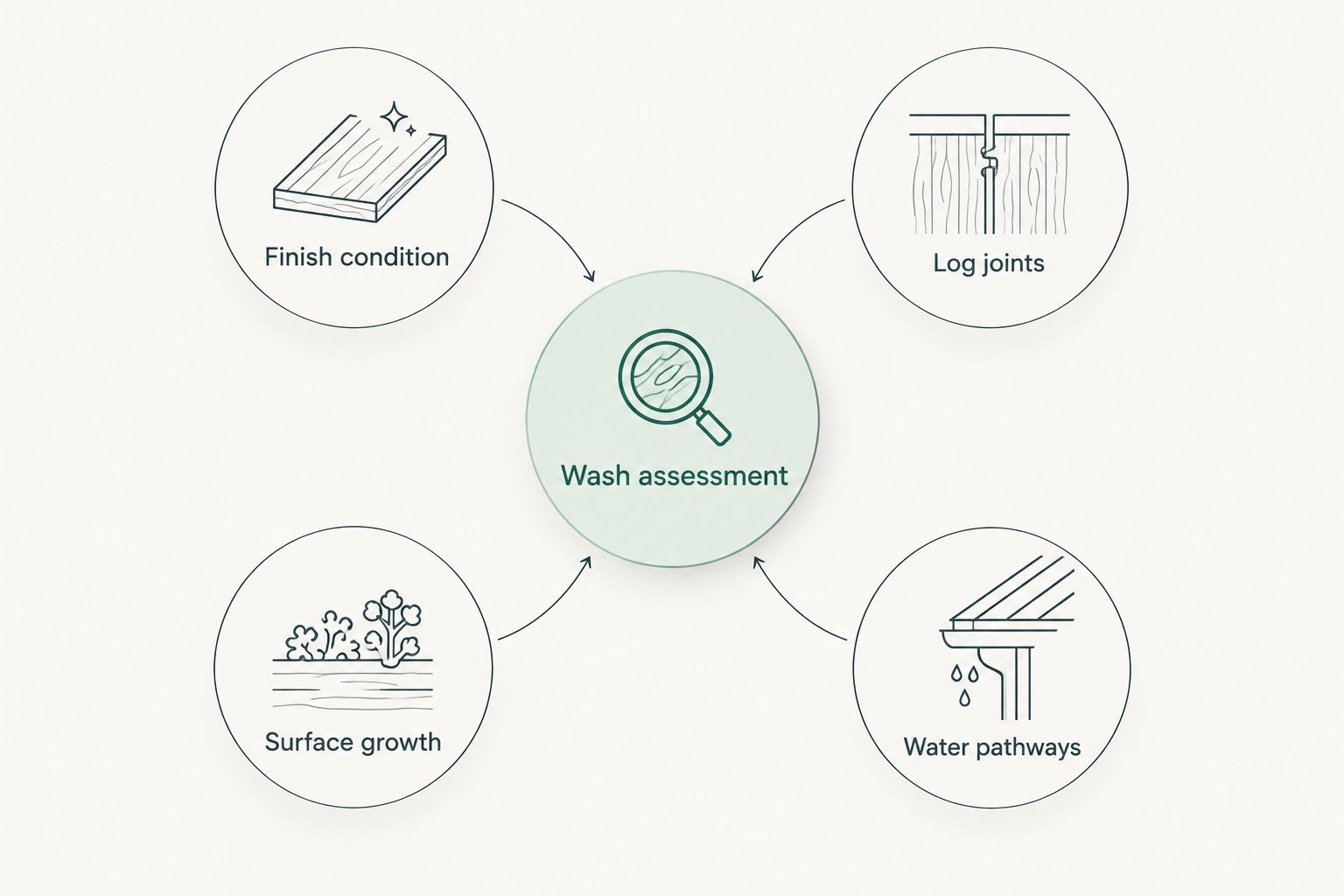
A useful inspection connects each visible symptom to a decision. Walk around the cabin from ground level and organize your notes under these headings:
- Finish condition: Note flaking, bare patches, uneven wear, and areas where the coating differs from surrounding walls.
- Log joints: Identify visible openings, failed sealant, and locations associated with indoor water marks.
- Surface growth: Record where green growth, moss, or dark discoloration appears without assuming every mark has the same cause.
- Water pathways: Look for roof discharge, splashback, and other routes that repeatedly wet the affected wall.
The inspection does not diagnose concealed damage. It gives the contractor specific areas to assess and helps separate cleaning from repair.
Take 2 photo sets: wide views showing each affected wall and close views showing the surface condition. These are preparation aids, not substitutes for an on-site assessment where the contractor needs one.
What your written proposal should include
For your 2026 booking, insist on 3 scope lines: what gets cleaned, what gets protected, and what remains outside the job. That simple division prevents a general promise to wash the house from becoming an argument about restoration.
What gets cleaned
Name the walls and surfaces included. Separate log walls from roofing, gutters, decks, masonry, and painted trim; compatibility on one material does not establish compatibility on another.
Describe the intended result without demanding that every dark mark disappear. Discoloration from weathering or a damaged coating is not the same problem as removable surface growth.
What gets protected
Ask how the contractor will protect openings, fixtures, nearby vegetation, and vulnerable water sources. Identify any known leaks before work starts.
Require an explanation of runoff management and site access. The plan should account for where cleaning water goes, not simply where the spray begins.
What stays outside the job
List staining, stripping, chinking, sealant replacement, and log repair separately unless they are expressly included. Request a stop-and-notify instruction if cleaning exposes a condition that changes the agreed scope.
After assembling your notes, schedule an assessment to discuss the affected surfaces and confirm whether the proposed service fits your cabin.
How these service options are ranked
This ranking prioritizes finish compatibility, wood condition, controlled application, site protection, and clear scope. Routine exterior cleaning takes the default position only when the logs and coating are suitable for washing.
Restoration moves to the top when the exterior needs repair or refinishing. Limited maintenance cleaning fits the smallest confirmed problem. The ranking follows the condition of your cabin—not a claim that one technique suits every log home in Alaska.
Which service should you choose?
Choose a wood-compatible cleaning assessment first when surface growth is the problem and the finish appears intact. Choose restoration assessment first when the coating is peeling, logs show deterioration, or joints are associated with water entry.
Alaska Moss Doctor is a local exterior moss and algae removal option for Wasilla-area homeowners. Confirm the log-wall scope before treating that service as the answer to a restoration problem.
For your 2026 appointment, send the location, wall photos, known finish information, and any history of leaks. Those details make the conversation specific enough to support a clear service decision.
FAQ
What's the best house washing service for a log cabin in Alaska?
The best fit is a contractor whose cleaning plan matches the logs, existing finish, and surface condition. For routine growth on intact surfaces, assess wood-compatible exterior cleaning; for failing coatings or damaged logs, start with a restoration specialist.
Does Alaska Moss Doctor clean log cabin exteriors?
Alaska Moss Doctor provides professional roof and exterior moss/algae cleaning and removal around Wasilla. Confirm whether the company accepts your log-wall project and which method it proposes for your finish before booking.
Is soft washing better than pressure washing for log homes?
Choose by finish compatibility and application control, not by the method name alone. Low pressure does not make an unsuitable cleaner safe, and aggressive spraying can damage wood or force water into openings.
Can house washing fix peeling stain on a log cabin?
House washing does not restore peeling stain. A failing coating needs an assessment for preparation and refinishing rather than a promise that ordinary washing will repair it.
Should log cabin walls be washed when freezing weather is forecast?
Do not approve washing when conditions conflict with the cleaner or coating manufacturer's instructions or create an icing hazard. Ask the contractor to account for freezing conditions, drainage, and the required drying conditions.
What should I send a contractor before a log cabin cleaning assessment?
Send the property location, wide and close wall photos, known finish details, and any leak history. Identify whether you want maintenance cleaning or expect repairs and refinishing as well.
Will cleaning stop algae from returning to log walls?
Cleaning is not a permanent guarantee against returning growth. Address recurring wetting and follow the finish manufacturer's maintenance guidance rather than relying on washing alone.
One last thing
Judge the test area after it dries. Wet wood can look darker and more uniform, so an immediate rinse-day inspection does not show the final appearance.
Ask the contractor to use the dry test result as the approval point for the remaining walls. That gives you a concrete decision before the full exterior receives the treatment.