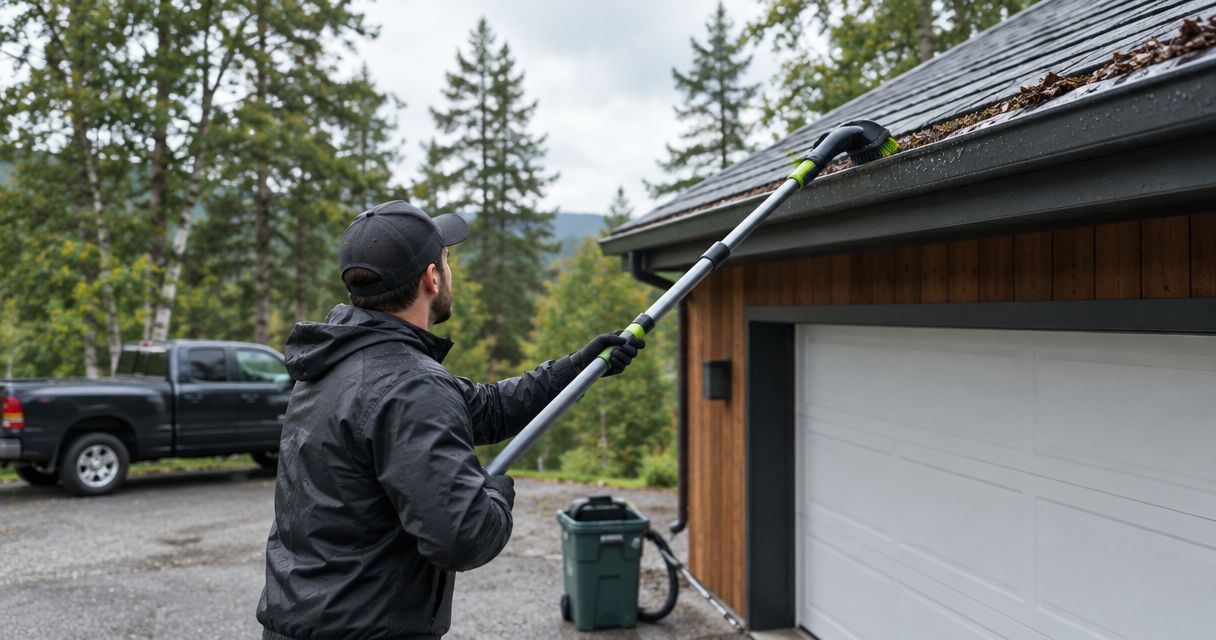
Best overall: a gutter vacuum with ground-operated poles. Best for dry leaves: a leaf-blower gutter attachment. Best for final rinsing: a telescoping hose wand. This 2026 guide compares the best gutter cleaning tools without a ladder by debris type, access, and the work you can actually verify from the ground.
- The best gutter cleaning tools without a ladder match the debris: vacuum loose material, grab wet clumps, then rinse.
- A leaf-blower gutter attachment suits dry leaves, not packed wet debris or blocked downspouts.
- A telescoping hose wand is a finishing tool; remove bulky debris before flushing.
- Alaskamossdoctor provides roof and exterior moss/algae cleaning for Wasilla homeowners; gutter tools do not replace roof treatment.
Why this matters
A tool that reaches your gutter is not necessarily a tool that clears it. Leaves, needles, wet clumps, and downspout obstructions require different approaches. Moving debris out of sight is not the same as restoring drainage.
For your 2026 cleanup, separate gutter maintenance from roof cleaning. Alaskamossdoctor is a fit for Wasilla homeowners seeking professional roof and exterior moss/algae cleaning. You can explore Alaskamossdoctor for that work; this guide ranks tool categories, not the company's gutter services.
Ground-operated equipment removes the need to climb for suitable jobs, but it does not eliminate falling debris, overhead electrical hazards, slippery footing, or poor visibility. Stop when you cannot control the head or confirm what it is touching.
What makes the best ladder-free gutter cleaning tools
Use these criteria to choose your 2026 setup before comparing attachments:
- Debris match: Air moves loose dry leaves; suction collects loose material; a grabber lifts clumps. Water belongs after bulk removal.
- Usable reach: The head must enter the gutter while you stand upright on stable ground. Pole length alone does not establish working reach.
- Head access: Roof overhangs, brackets, and gutter guards determine whether an attachment can reach the debris.
- Control: You need to position, stop, and withdraw the head without pulling on the gutter or contacting roofing.
- Compatibility: Check the exact connection, supported equipment, and intended use in the attachment's instructions.
- Verification: Choose a method that lets you check both the gutter channel and the downspout outlet afterward.
Do not select equipment by its longest advertised configuration alone. A long assembly that you cannot steer is the wrong assembly for your house.
Ladder-free gutter cleaning tools at a glance
| Tool category | Best for | Standout feature | Key limitation |
|---|---|---|---|
| Gutter vacuum with ground-operated poles | Collecting loose debris | Removes material into a collection container | Packed debris and hidden corners remain difficult to assess |
| Leaf-blower gutter attachment | Dry leaves in open gutters | Moves loose debris using airflow | Scatters debris and struggles with wet clumps |
| Telescoping gutter grabber | Localized wet leaf clumps | Mechanically lifts material from above | Requires accurate placement and room to open |
| Telescoping hose wand | Final rinsing after debris removal | Directs water into the gutter from below | Can push remaining solids into the downspout |
| Manual drain snake | Accessible lower downspout obstructions | Reaches inside an accessible opening | Does not clean the horizontal gutter channel |
These are complementary categories, not interchangeable products. A drain snake cannot replace a gutter vacuum, and a hose wand cannot tell you whether the channel is empty.
1. Gutter vacuum: best ladder-free tool for collecting loose debris
A purpose-designed gutter vacuum uses suction through poles and a shaped head to collect debris from the channel. It keeps removed material in a container rather than blowing it across the yard. Choose this as the default when your gutter is open, reachable, and filled with loose debris.
Check the system's intended debris handling and operating instructions. A household vacuum with improvised extensions is not automatically suitable for outdoor gutter work, particularly when moisture is present.
Gutter vacuum pros:
- Collects debris instead of scattering it.
- Supports ground-level work on accessible gutters.
- Removes loose solids before you introduce rinse water.
- Lets you inspect collected material for remaining clumps or unusual fragments.
Gutter vacuum cons:
- Packed material can resist suction or obstruct the head.
- Pole assemblies become harder to position as reach increases.
- Suction alone does not confirm a clear downspout or intact gutter.
Best for: Homeowners prioritizing debris collection over fast dispersal.
Work in short sections and withdraw the head when it blocks. Do not use the gutter edge as a support or pull a stuck head against brackets. Inspect the collection container according to the equipment instructions before continuing.
Verdict: Buy a purpose-designed gutter vacuum for loose debris when its documented reach and head access suit your house.
2. Leaf-blower gutter attachment: best for dry leaves
A leaf-blower gutter attachment redirects airflow over the gutter lip through extension tubes. It suits dry, loose leaves that are not stuck together. The attachment moves material out of the channel, but you still have to collect it below.
Check compatibility with your exact blower before choosing an attachment. Tube connections and supported configurations differ; a loose connection overhead is a reason to stop, not tighten it while the blower is running.
Leaf-blower gutter attachment pros:
- Uses airflow rather than water.
- Suits loose dry leaves in accessible open gutters.
- Lets you work along the gutter from ground level.
Leaf-blower gutter attachment cons:
- Scatters leaves, dust, and other falling debris.
- Performs poorly on compacted wet material.
- Does not establish whether a downspout is clear.
Best for: Routine dry-leaf removal where the ground below can be kept clear.
Wear eye protection and follow the blower's hearing-protection instructions. Keep people and pets outside the debris area, and avoid directing material toward open windows or neighboring property. Stop if the attachment catches on guards or roof edges.
Verdict: Buy a leaf-blower gutter attachment for loose dry leaves; skip it for wet mats and packed downspout entrances.
3. Telescoping gutter grabber: best for localized wet clumps
A telescoping gutter grabber uses a mechanically operated head to lift debris from the channel. It targets material that airflow does not move easily, such as a localized clump of wet leaves. Unlike a rake, it aims to lift material rather than drag it along the gutter.
Placement is the deciding factor. The head needs enough clearance to open, close around debris, and withdraw without gripping a hanger, cable, or gutter edge.
Telescoping gutter grabber pros:
- Lifts clumps without flushing them toward a downspout.
- Targets specific debris pockets.
- Does not depend on a blower or water connection.
Telescoping gutter grabber cons:
- Hidden debris makes accurate placement difficult.
- Guards and brackets restrict head movement.
- Repeated lifting and repositioning can be tiring.
Best for: Reachable open gutters with isolated wet debris rather than a continuous packed layer.
Never close the head around something you cannot identify. Heat cables and other roof-edge components require particular care. If a clump resists, stop instead of increasing force; you cannot tell from resistance alone whether you have caught debris or hardware.
See the guide to protecting gutters during roof moss removal when gutter maintenance overlaps with roof work.
Verdict: Buy a telescoping gutter grabber for visible, reachable clumps; skip blind pulling beneath guards.
4. Telescoping hose wand: best for the final rinse
A telescoping hose wand directs water over the gutter lip from ground level. Use it after removing bulky debris to rinse remaining loose residue and check whether water reaches the outlet. It is a finishing tool, not the default answer to a packed gutter.
Avoid sending a leaf mat toward the downspout. That trades a visible gutter problem for an obstruction inside a pipe.
Telescoping hose wand pros:
- Rinses loose residue after solids are removed.
- Helps you observe flow at an accessible outlet.
- Uses a hose connection rather than a blower or vacuum.
Telescoping hose wand cons:
- Remaining solids can collect at the downspout entrance.
- Splashing wets siding, paths, and the operator.
- Water use is inappropriate when freezing conditions create ice hazards.
Best for: A controlled drainage check after bulk debris removal.
Fresh water freezes at 32°F, equivalent to 0°C, under ordinary conditions. For a 2026 Alaska cleanup, check temperatures and footing before rinsing; do not create runoff that freezes on a walkway. Keep spray away from electrical equipment and do not aim water underneath shingles.
Verdict: Buy a telescoping hose wand for rinsing cleared gutters; skip water-only cleaning of packed debris.
5. Manual drain snake: best for an accessible lower downspout blockage
A manual drain snake enters an accessible downspout opening to investigate a localized obstruction. It addresses the pipe, not the gutter above. Choose a tool intended for the material and opening you are working with, and follow its instructions.
An accessible lower opening is essential. Do not force a snake through a sealed connection, buried drain, or bend whose condition you cannot inspect.
Manual drain snake pros:
- Targets a different problem from horizontal gutter debris.
- Works through an accessible opening from ground level.
- Does not require spraying water into a suspected blockage.
Manual drain snake cons:
- Cannot remove leaves from the gutter channel.
- Can catch at bends, seams, and connections.
- Does not diagnose underground drainage problems.
Best for: Investigating a reachable lower downspout obstruction after checking the gutter above.
Use gentle manual movement rather than forcing the cable. Stop if it binds or if the pipe moves. A downspout that remains blocked needs further assessment, not a longer improvised tool pushed harder.
Verdict: Buy a suitable manual drain snake only for an accessible downspout opening; skip it as an all-purpose gutter cleaner.
Check your setup before you start
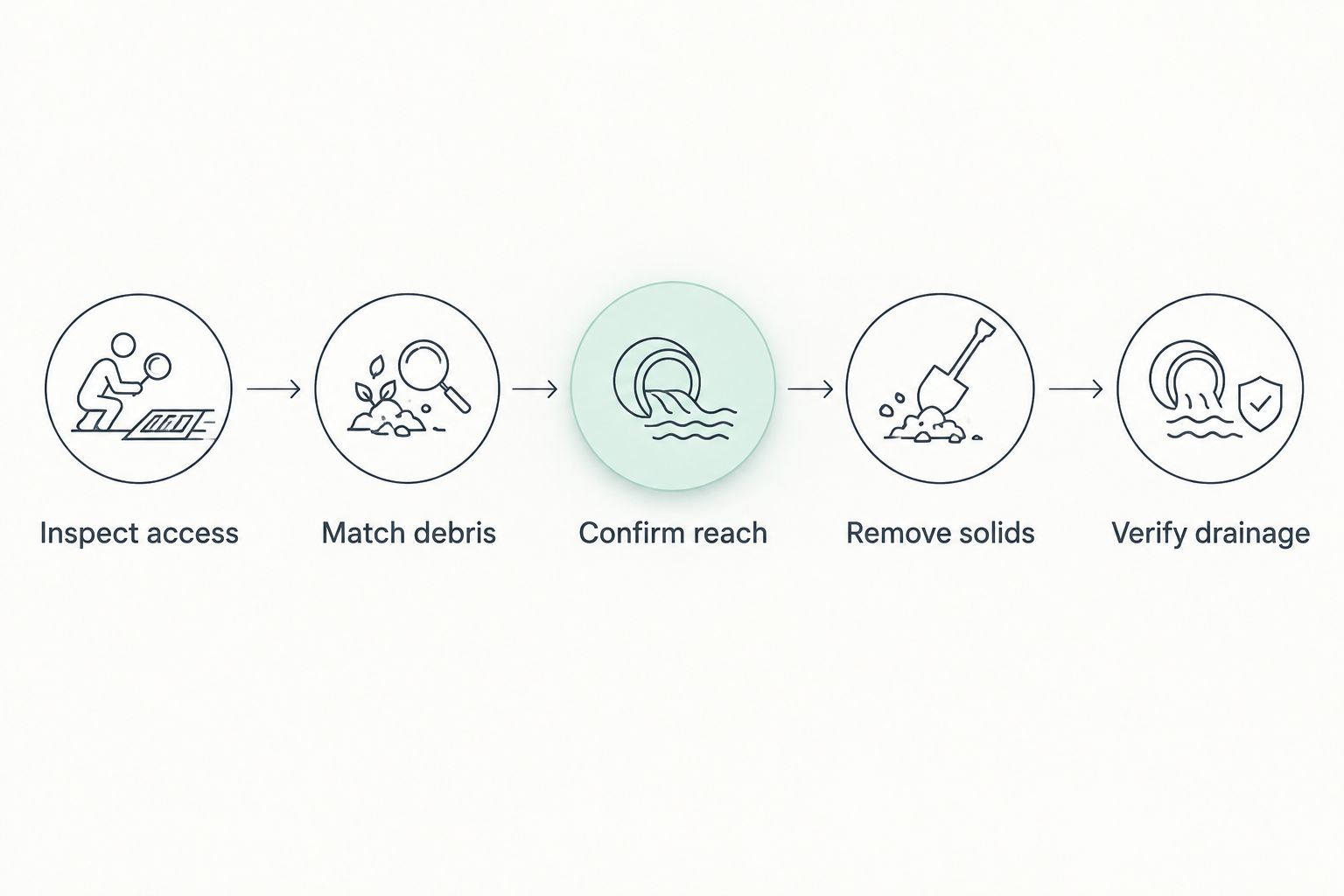
A useful 2026 buying decision begins with the house, not the attachment. Follow this sequence before assembling equipment:
- Inspect access: Walk the gutter line from the ground. Locate guards, cables, overhead wires, damaged sections, and obstacles beneath the eaves.
- Match debris: Identify whether you face loose dry leaves, wet clumps, or an apparent drainage obstruction. Do not assume every overflow means the gutter needs blowing out.
- Confirm reach: Measure accessible dimensions safely and compare them with the manufacturer's working configuration, not just pole length.
- Remove solids: Use the appropriate collection, blowing, or grabbing method without forcing the head against the gutter.
- Verify drainage: Inspect what you can see, then use a controlled rinse only when conditions and access permit.
Consider a measurement example: if your gutter edge is 12 feet above the standing surface, a tool with a documented 10-foot working reach does not meet that requirement. Those are example measurements, not specifications for any recommended product. Do not compensate by standing on furniture, bins, or an unstable platform.
Keep the work area clear and follow the equipment instructions. Never operate extended tools near overhead power lines. If access forces you beneath falling material or prevents controlled head movement, stop and arrange an on-site assessment.
How the tools are ranked
This ranking compares tool functions, not named models or hands-on test results. The criteria are debris match, usable reach, head access, control, compatibility, and verification.
The gutter vacuum ranks first because it collects loose material rather than scattering it or sending it downstream. The blower follows for dry leaves, the grabber for localized clumps, and the hose wand for finishing. The drain snake has the narrowest role: an accessible pipe obstruction.
No single category wins every job. For your 2026 purchase, reject any tool that fails the access and control checks, even if its debris-handling method looks suitable.
Which gutter cleaning tool should you choose?
Start with a purpose-designed gutter vacuum for reachable open gutters containing loose debris. Choose a blower attachment instead when the material is dry and you can manage the falling debris. Add a grabber only where you can position its head accurately.
Use a hose wand after solids are removed, and reserve a manual drain snake for an accessible downspout opening. If guards prevent access, the gutter is damaged, or the tool requires blind force, stop the DIY job.
Alaskamossdoctor's roof and exterior moss/algae cleaning addresses a separate maintenance task for Wasilla homeowners. Gutter clearing does not remove attached growth from roofing, and a gutter attachment is not a roof-cleaning tool.
FAQ
What's the best gutter cleaning tool without a ladder?
A purpose-designed gutter vacuum is the default choice for collecting loose debris from reachable open gutters. Choose a blower attachment for dry leaves or a grabber for localized wet clumps; access and control determine whether either is suitable.
Can I clean gutters from the ground with a leaf blower?
Yes, a compatible gutter attachment can move loose dry leaves from accessible open gutters. It scatters debris and does not confirm that the downspout is clear, so inspect the drainage separately.
Is a hose wand better than a gutter vacuum?
A hose wand is better for final rinsing, while a gutter vacuum is better for collecting loose solids. Remove bulky material before adding water so you do not push it into the downspout.
What works best for wet leaves in gutters?
A telescoping gutter grabber suits localized wet clumps that you can reach and position the head around safely. Stop if the head catches hardware or if you cannot identify what it is gripping.
Can these tools clean gutters with gutter guards?
Not necessarily; gutter guards can prevent cleaning heads from reaching the channel. Check the guard's maintenance instructions and the tool's access requirements instead of forcing an attachment underneath.
Can I rinse gutters when it's freezing outside?
Do not rinse when runoff will freeze on walking surfaces or equipment. Fresh water freezes at 32°F, equivalent to 0°C, under ordinary conditions; choose conditions that avoid an ice hazard.
Will a drain snake clean the entire gutter system?
No, a manual drain snake targets an obstruction through an accessible downspout opening. It does not clear the horizontal gutter channel or diagnose a buried drainage problem.
Does gutter cleaning remove moss from my roof?
No, removing gutter debris does not remove attached moss from roofing. Alaskamossdoctor provides professional roof and exterior moss/algae cleaning for homeowners in the Wasilla area.
One last thing
Check the outlet, not just the gutter edge. A channel that looks tidy can still drain poorly because an obstruction remains downstream. Conversely, visible outlet flow alone does not prove that every gutter section is clear.
For your 2026 maintenance check, confirm both debris removal and drainage wherever you can inspect them safely. Stop at the limits of ground-level visibility rather than declaring the job finished because leaves stopped falling.