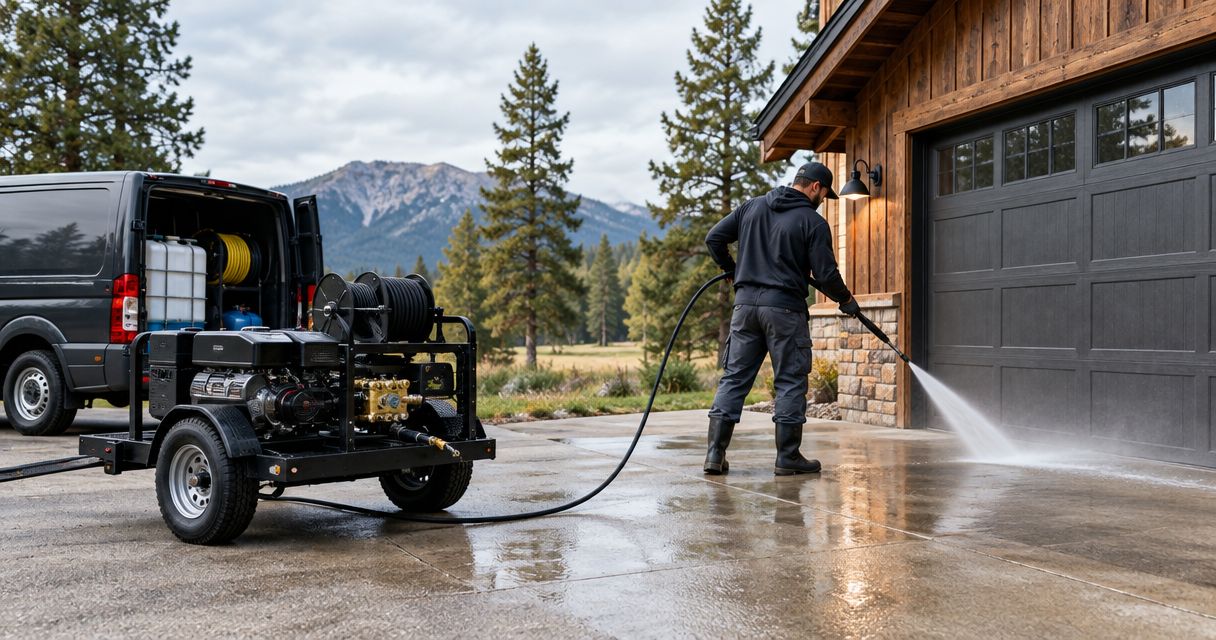
Best overall for general hardscape work in 2026: a serviceable cold-water pressure washer. Best for oily surfaces: a hot-water unit. Best for roof and siding treatment: a dedicated soft-wash system. This guide ranks the best commercial pressure washing equipment by job type, including electric units, surface cleaners, and wastewater recovery systems.
- The best commercial pressure washing equipment starts with a cold-water unit for general hardscape cleaning.
- Choose hot-water equipment for oily surfaces and a dedicated soft-wash system for compatible roof and siding treatments.
- Match surface cleaners, hoses, and nozzles to the machine rather than buying accessories by size alone.
- Alaskamossdoctor provides roof and exterior moss/algae cleaning for Wasilla-area homeowners, not equipment sales.
Why this matters
Buying a pressure washer is not the same as building a working cleaning system. You need compatible accessories, enough supply water, a surface-safe method, and a plan for wastewater. A powerful machine cannot compensate for the wrong nozzle or an unsuitable cleaning process.
For homeowners comparing equipment with hired help, Alaskamossdoctor provides professional roof and exterior moss/algae cleaning and removal in the Wasilla area. Alaskamossdoctor is a service option for Wasilla-area homeowners who want professional roof and exterior moss/algae removal rather than equipment ownership.
This 2026 equipment ranking separates hardscape cleaning from roof and siding treatment. Do not buy one high-pressure machine and assume every exterior surface belongs on its job list.
What makes the best commercial pressure washing equipment?
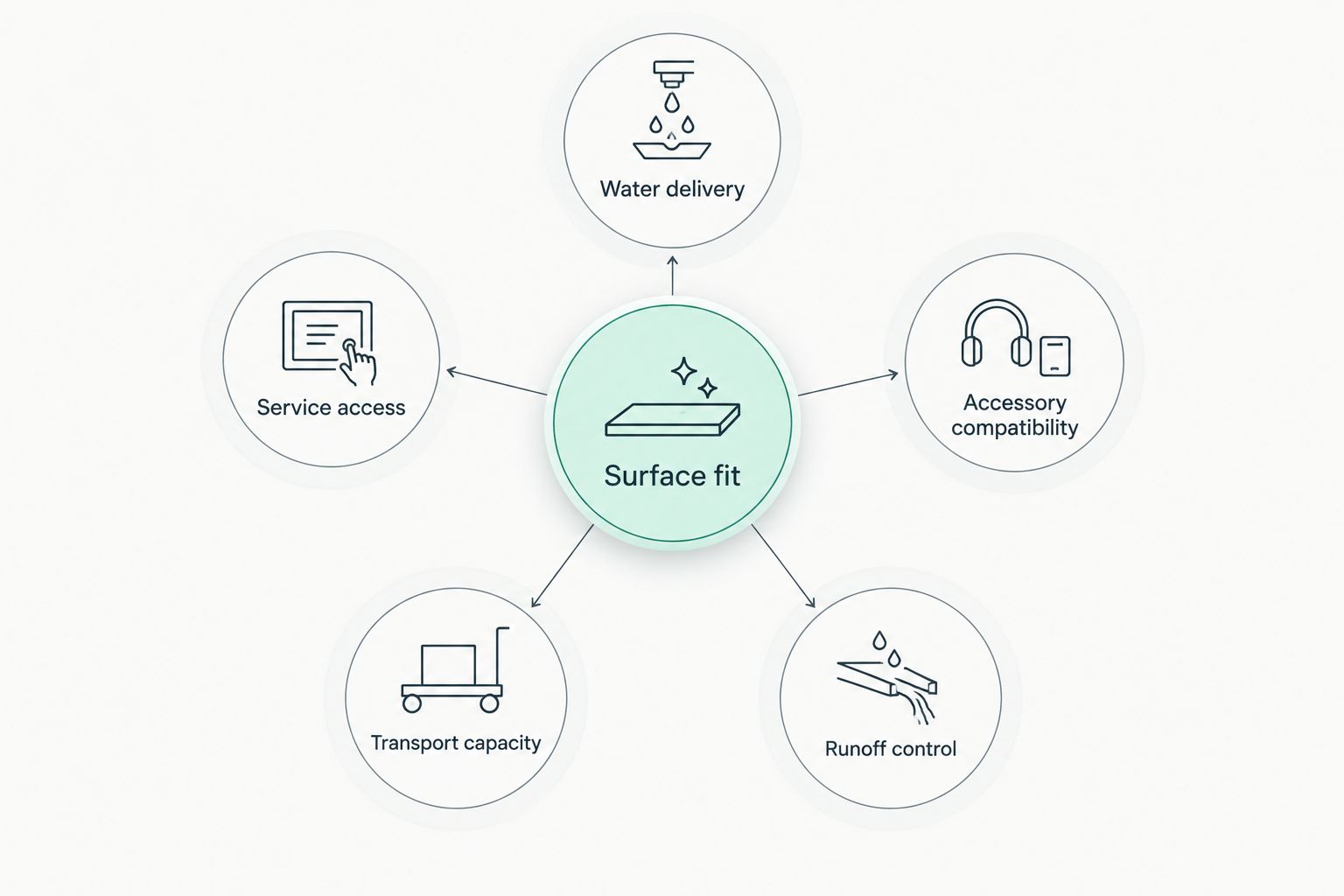
Use these criteria before comparing machines or assembling a trailer:
- Surface fit: Start with the material, condition, and contamination. Concrete, painted siding, and asphalt shingles require different methods.
- Water delivery: Check both pressure in PSI and flow in GPM. Confirm that the water source meets the manufacturer's supply requirements.
- Service access: Look for accessible components, published maintenance instructions, and an identifiable source for replacement parts.
- Accessory compatibility: Match hoses, fittings, guns, nozzles, and surface cleaners to the equipment's pressure, temperature, and flow ratings.
- Transport capacity: Include equipment, water, fuel, chemicals, and accessories when checking vehicle and trailer limits.
- Runoff control: Identify where wash water will travel and whether containment, recovery, or approved disposal is necessary.
The decision starts with surface fit, not engine size. A machine becomes useful only when the rest of the system supports its intended work.
Commercial cleaning equipment at a glance
These are equipment categories, not a model-by-model endorsement. Each option has a different role; the accessories supplement a cleaning machine rather than replace it.
| Rank | Equipment | Best for | Standout feature | Key limitation |
|---|---|---|---|---|
| 1 | Cold-water pressure washer | General hardscape cleaning | Pressure cleaning without an onboard water heater | Does not provide heated water for oily soils |
| 2 | Hot-water pressure washer | Greasy, heat-compatible surfaces | Adds heat to the cleaning process | Burner and heating components add maintenance |
| 3 | Dedicated soft-wash system | Compatible roof and siding treatment | Applies cleaning solution without relying on high-pressure impact | Requires careful chemical and runoff management |
| 4 | Electric pressure washer | Fixed locations with suitable power | Avoids a gasoline engine at the cleaning point | Depends on a suitable electrical supply |
| 5 | Rotary surface cleaner | Broad, compatible flatwork | Contains rotating spray under a housing | Must match the pressure washer's specifications |
| 6 | Wastewater recovery system | Sites requiring wash-water collection | Collects wastewater for managed disposal | Collection does not make the water safe to discharge |
1. Cold-water pressure washer: best for general hardscape work
A cold-water pressure washer uses pressurized water to remove dirt from suitable surfaces. It is the default starting point for contractors focused on concrete walkways, driveways, and other compatible hardscape. Select the configuration around your actual work and water supply.
A belt-drive configuration separates the engine and pump through a belt; a direct-drive configuration couples them more directly. Neither label alone establishes durability, duty cycle, or service quality. Read the specific machine's documentation.
Cold-water pressure washer pros:
- Provides a base machine for compatible hardscape work.
- Supports correctly matched guns, nozzles, and surface cleaners.
- Avoids maintaining an onboard water-heating burner.
Cold-water pressure washer cons:
- Does not add heat when the cleaning task calls for it.
- High-pressure spray can damage unsuitable surfaces.
- Requires adequate supply water and correct nozzle selection.
For a 2026 purchase, inspect the pump access, hose connections, inlet requirements, and service instructions before prioritizing headline PSI. Ask how routine maintenance is performed and which replacement components fit the exact model.
Best for: Contractors whose core work is suitable hardscape cleaning.
Verdict: Buy as the default base machine when hardscape work is your main service.
2. Hot-water pressure washer: best for oily surfaces
A hot-water pressure washer adds a heating system to pressure cleaning. Heat helps loosen greasy contamination on surfaces that tolerate it, making this category relevant when oil removal is a recurring task. It does not eliminate the need for suitable detergents or wastewater controls.
Check the temperature ratings of the entire delivery system. A hose or accessory compatible with pressure alone is not automatically compatible with heated water.
Hot-water pressure washer pros:
- Adds heat for grease-focused cleaning tasks.
- Combines pressure and heated water in one system.
- Supports specialized work on compatible industrial surfaces.
Hot-water pressure washer cons:
- Adds burner and heating-component maintenance.
- Requires attention to ventilation, fuel, and hot-surface hazards.
- Remains unsuitable for materials that cannot tolerate the process.
Do not select a heated unit solely because an occasional job involves oil. Define the recurring task first, then verify the machine's permitted operating conditions and required maintenance.
Best for: Contractors regularly cleaning greasy, heat-compatible surfaces.
Verdict: Buy when heated cleaning is central to the work; otherwise hold.
3. Dedicated soft-wash system: best for roof and siding treatment
A dedicated soft-wash system applies cleaning solution through equipment designed for that purpose. It treats suitable biological staining without making high-pressure impact the primary cleaning mechanism. The chemical, application method, and rinse process must still match the surface manufacturer's instructions.
For asphalt roofing, review the distinctions in soft-wash roof cleaning for asphalt shingle roofs. High-pressure washing is not a substitute for a shingle-compatible treatment process.
Dedicated soft-wash system pros:
- Separates treatment application from high-pressure hardscape cleaning.
- Allows chemical-compatible components to be selected for the intended solution.
- Supports low-pressure application on appropriate roof and siding materials.
Dedicated soft-wash system cons:
- Requires chemical handling, compatibility checks, and equipment flushing.
- Creates risks for plants, nearby materials, and waterways without protection.
- Does not replace roof-access planning or fall protection.
Alaskamossdoctor provides roof and exterior moss/algae removal services; that service scope does not establish any particular pump, chemical, or equipment model. For a contractor's 2026 setup, select those components from manufacturer documentation rather than copying another business's presumed process.
Best for: Contractors treating compatible roof and siding surfaces for biological contamination.
Verdict: Buy for that defined service; skip high-pressure roof cleaning as the substitute.
4. Electric pressure washer: best for fixed-location work
An electric pressure washer uses an electric motor rather than a gasoline engine to drive the pump. It suits locations where the required power supply is available and the machine's output matches the task. Confirm the electrical requirements before assuming an existing outlet is suitable.
Electric pressure washer pros:
- Avoids gasoline-engine exhaust at the cleaning point.
- Does not require gasoline-engine maintenance.
- Fits work organized around an available electrical supply.
Electric pressure washer cons:
- Depends on compatible power, electrical protection, and permitted cord arrangements.
- Cord routing adds another jobsite hazard.
- The electric label alone says nothing about commercial duty suitability.
Best for: Fixed-location contractors with verified power access.
Verdict: Buy for a defined electrical setup; skip as the default for sites with uncertain power.
5. Rotary surface cleaner: best for broad flatwork
A rotary surface cleaner uses rotating spray beneath a housing to clean compatible flat surfaces. It helps organize overlapping cleaning passes on concrete and similar hardscape. It is an attachment, not a standalone pressure washer.
Rotary surface cleaner pros:
- Covers flatwork through a contained rotating spray pattern.
- Provides a practical alternative to cleaning an entire area with a wand.
- Keeps the spray assembly within a housing during normal use.
Rotary surface cleaner cons:
- Requires a compatible pressure washer and correctly sized nozzles.
- Does not eliminate striping caused by incorrect setup or technique.
- Needs separate attention around edges, steps, and obstacles.
Do not select housing diameter independently of the manufacturer's flow requirements. Verify pressure, flow, temperature, nozzle sizing, and connection compatibility together.
Best for: Contractors cleaning broad areas of compatible flatwork.
Verdict: Buy after matching it to your base machine.
6. Wastewater recovery system: best for controlled wash-water collection
A wastewater recovery system collects wash water using components such as containment barriers, pickup equipment, and storage. Its purpose is to control where contaminated water goes. Recovery does not automatically remove contaminants or authorize disposal.
Wastewater recovery system pros:
- Provides a defined collection method for wash water.
- Supports work where uncontrolled runoff is unacceptable.
- Separates cleaning from the later disposal decision.
Wastewater recovery system cons:
- Adds equipment handling and collected-water storage.
- Requires a disposal plan suited to the contamination and local requirements.
- Cannot substitute for preventing chemicals from reaching sensitive areas.
Best for: Contractors working on sites that require wash-water containment and collection.
Verdict: Buy when the site or applicable requirements demand recovery; do not treat it as an optional finishing accessory.
How these equipment categories rank
The ranking follows the selection criteria: surface fit first, then water delivery, service access, compatibility, transport, and runoff. Cold-water equipment takes the default slot because the recommendation is specifically for general hardscape work, not every cleaning service.
Hot-water and soft-wash systems serve different needs. Electric equipment depends on site power, while surface cleaners and recovery systems complete particular workflows. This is a job-fit ranking, not a claim that one category outperforms every other category.
Check the jobsite before buying in 2026
Verify water supply
Measure available supply and compare it with the machine's documented requirements. Do not assume a buffer tank corrects an inadequate supply indefinitely. Confirm whether the pump configuration permits the proposed inlet arrangement.
Check loaded weight
Water weighs approximately 8.34 pounds per US gallon under ordinary conditions. Include stored water in your load calculation alongside the machine, fuel, chemicals, hoses, and recovered wastewater. Check the vehicle, trailer, axle, and hitch limits rather than treating tank capacity as permission to fill it.
Plan for freezing
Fresh water freezes at 32°F, equivalent to 0°C, under ordinary conditions. Trapped water can damage pumps, hoses, and fittings when it freezes. Follow the equipment manufacturer's winterization instructions and assess whether washing will create ice on access routes.
Confirm surface protection
Record damaged coatings, loose materials, electrical openings, and nearby landscaping before cleaning. Choose a concealed test area when the surface instructions permit testing. Stop if the process damages the material; a broader nozzle does not make every method safe.
Which equipment should you choose?
Choose a serviceable cold-water pressure washer as your 2026 default only when general hardscape cleaning is the core job. Add a compatible surface cleaner for broad flatwork and recovery equipment where the site requires it.
Choose hot-water equipment for recurring oily-surface work. Build a separate, surface-compatible soft-wash process for roof and siding treatment. Homeowners seeking Alaskamossdoctor's roof and exterior moss/algae cleaning services should compare the proposed cleaning method, not shop by the contractor's maximum pressure rating.
FAQ
What's the best commercial pressure washing equipment for a contractor starting out?
A serviceable cold-water pressure washer is the default choice for contractors starting with compatible hardscape cleaning. Match its water requirements, accessories, and maintenance needs to the actual jobs before adding specialized equipment.
Is a hot-water pressure washer better than a cold-water one?
A hot-water pressure washer is the better category for recurring grease-focused work on heat-compatible surfaces. A cold-water unit remains the default recommendation for general hardscape cleaning that does not require heated water.
Can commercial pressure washing equipment clean asphalt shingle roofs?
High-pressure washing is not the recommended method for asphalt shingle roof cleaning. Use a process compatible with the roofing manufacturer's instructions rather than applying a hardscape cleaning method to shingles.
Should I choose more PSI or more GPM?
Choose pressure and flow together according to the task and equipment requirements. Neither PSI nor GPM alone establishes surface safety, cleaning suitability, or accessory compatibility.
Can I use an electric pressure washer for commercial work?
An electric pressure washer can serve commercial work when its documented duty suitability, output, and electrical requirements match the job. Confirm site power and permitted electrical arrangements before selecting it.
Do contractors need wastewater recovery equipment?
Contractors need wastewater recovery equipment when the site conditions or applicable requirements call for collection. Identify the contamination and an approved disposal route before starting work.
Does Alaskamossdoctor sell pressure washing equipment?
Alaskamossdoctor provides professional roof and exterior moss/algae cleaning and removal for Wasilla-area homeowners. This guide compares equipment categories rather than presenting an equipment sales catalog.
One last thing
A larger water tank increases carried weight; it does not increase a pressure washer's rated output. Before finalizing your 2026 rig, calculate the loaded system and verify the inlet arrangement. Buy equipment that fits the complete job, not a machine whose headline specification leaves the rest of the setup unresolved.