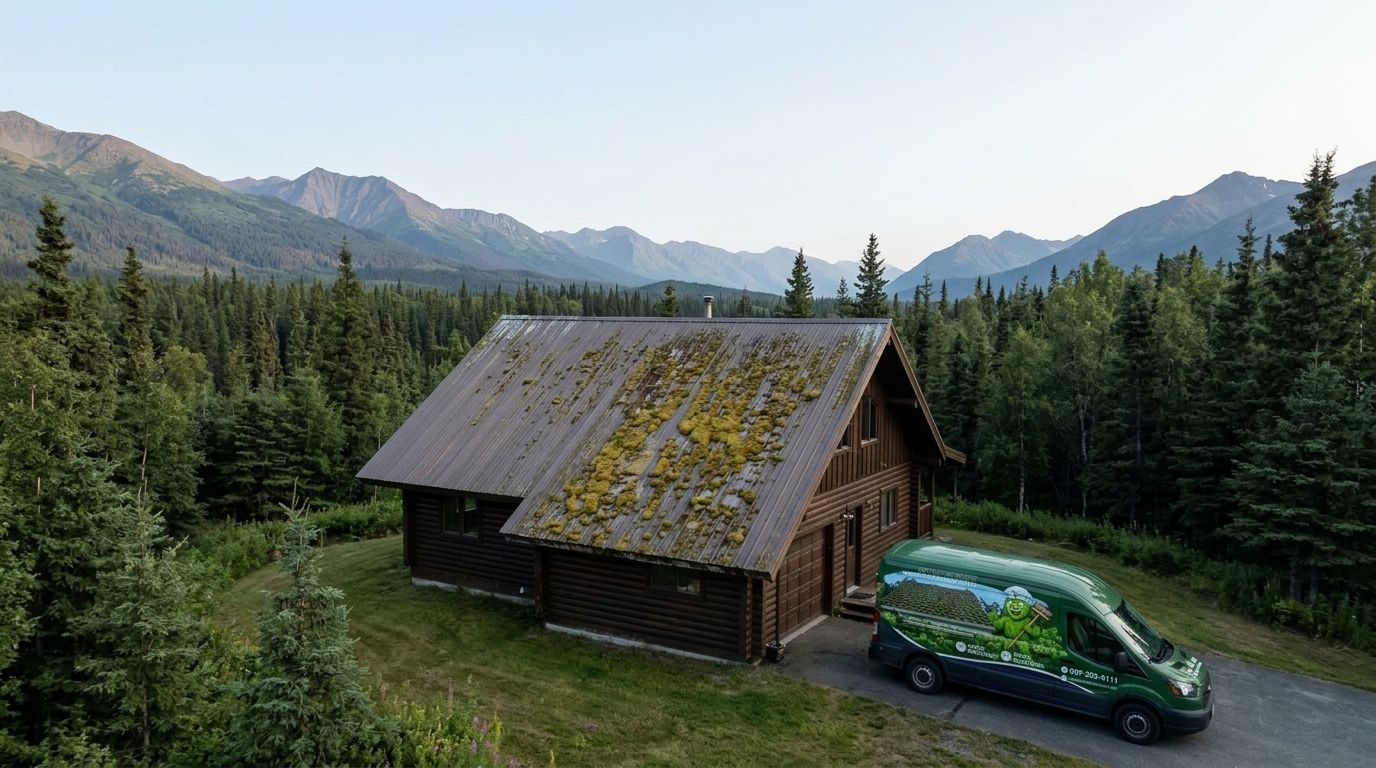
Roof moss removal for out-of-state cabin owners means hiring a professional soft-wash crew to treat and clear moss on a schedule you confirm remotely, timed to Alaska's short dry season and verified with photo documentation instead of a walkthrough. The core challenge isn't the moss itself — it's coordinating the work, the access, and the proof of completion from another state or another country.
- Roof moss removal for out-of-state cabin owners works best scheduled in Alaska's May-through-September dry window, before snow load returns.
- Alaska Moss Doctor documents remote roof cleaning jobs with dated photos so absentee owners never have to be on-site.
- Untreated moss lifts shingle edges and traps moisture against decking, and one heavy Alaska snow season can turn a cosmetic problem into a structural one.
- Vetting a company by phone means demanding photo proof, a written scope, and proof of insurance before you hand over property access.
Why roof moss removal matters for out-of-state cabin owners
You can't glance up at the roof on your way to the mailbox. If moss is spreading on a north-facing slope, you find out months later, usually after a caretaker mentions it or after you arrive for the season and see shingle granules pooled in the gutters.
Moss holds moisture against the roof deck year-round in Alaska's climate, and it works fastest on shaded, north-facing pitches that never fully dry between rain and snowmelt. A cabin visited twice a year gives moss two full growing windows with nobody watching. By the time you notice curled shingles or a soft spot in the decking from the ground, the fix is no longer a cleaning — it's a repair.
Distance also changes how you have to work. You can't get three contractors to walk your roof in person and compare notes. Every decision — who to hire, when to schedule, whether the job actually happened — has to run through photos, email, and a phone call. That's the entire problem this guide solves.
Assess your roof's moss risk before you book anything
Start with what you can check without leaving your current address. A ten-minute review tells you whether you're dealing with light surface growth or moss that's already established under shingle tabs.
- Pull up recent satellite or street-view imagery of the property if it's current enough to show roof color
- Ask a neighbor or caretaker to text a few photos of the north-facing and shaded slopes specifically
- Check your own paperwork for the roofing material and age — shingles over 8-10 years old hold moss faster
- Compare against photos from your last visit to see if dark streaking or green patches have spread
- Note whether the cabin sits under overhanging spruce or birch, since shade and debris both accelerate regrowth
If you can't get a current photo of the roof, treat that as the first task, not an afterthought. Every decision after this depends on knowing what you're actually paying to fix.
Time the job around Alaska's freeze-thaw calendar
Scheduling by your own travel calendar instead of the weather is the single most common mistake absentee owners make. Alaska's cleaning window is short, and missing it by a few weeks can push the job into freezing temperatures where soft-wash treatments don't cure properly.
- Target the window roughly between late May and September when temperatures stay reliably above freezing
- Avoid scheduling during active snowmelt, when standing water on the roof dilutes treatment
- Build in a buffer before the first hard frost, typically mid-to-late September in the Mat-Su Valley
- Check the best time of year for roof moss removal in Alaska before locking in a date with any crew
- Book at least a few weeks ahead — the short dry season means local crews fill up fast
If your only visit to the cabin falls in October, don't wait for it — schedule the cleaning independently and confirm it by photo instead.
Vet a moss removal company without setting foot on the property
This is where the client relationship starts to matter more than usual. You're trusting a crew with property access and payment based entirely on remote communication, so the vetting has to be more thorough than a same-city hire, not less.
- Ask for before-and-after photos from jobs on comparable cabin or remote properties, not just suburban homes
- Confirm the method is soft-washing, not pressure washing, since high-pressure spray strips granules off asphalt shingles
- Request a written scope of work by email before any date is confirmed, not a verbal quote over the phone
- Ask specifically how they handle the roof cleaning service for remote Alaska cabins when the owner isn't present for the job
- Confirm liability insurance in writing, since you won't be there to supervise access to the roof
Alaska Moss Doctor works on remote Wasilla-area cabins where the owner can't attend the appointment, which is the exact gap this vetting step is meant to close.
Set up remote scheduling and proof-of-work documentation
Once you've picked a company, the next problem is confirming the job actually happened the way it was described. Photos are your only evidence, so ask for them before the crew leaves the site.
- Get a firm appointment window in writing over email, not just a verbal callback promise
- Request timestamped before, during, and after photos covering every roof plane, not just the front elevation
- Ask for a short written note on roof condition observed — soft spots, lifted shingles, clogged valleys
- Set up one local point of contact, even a caretaker who only holds a key, in case access is an issue on the day
- Confirm how you'll receive the invoice and documentation — email is standard, but confirm it up front
This documentation step matters more in 2026 than it did a few years back, since insurers increasingly ask for dated maintenance records before renewing coverage on rural or seasonal properties.
Protect gutters and downspouts during the clean
Moss removal without a gutter check just relocates the problem. Debris washed off the roof lands in the gutters, and a clogged downspout on a cabin nobody visits for months turns into ice damming by winter.
- Confirm gutter clean-out is included in the roof job, not billed as a separate visit
- Ask how debris is disposed of, especially near a septic field or well on rural lots
- Request a photo check of downspout flow after the clean, not just the roof surface
- Flag any valley or flashing area where moss tends to trap water against the roof deck
- Ask about ice dam risk zones specific to the roof's pitch and shade pattern
Build a recurring maintenance plan instead of a one-time trip
A single cleaning resets the clock, but moss regrows on the same shaded slopes every year. Treating this as a recurring service instead of a one-off errand is what actually keeps the roof clean between your visits.
- Schedule an annual or biannual visit tied to a fixed calendar date, not your unpredictable travel plans
- Bundle gutter cleaning with the roof visit to cut down on separate scheduling
- Review an exterior maintenance plan built for Alaska's seasonal cycle rather than a generic year-round schedule
- Set a reminder two months ahead of the dry season so booking happens before crews fill their calendars
- Ask the company to flag anything that looks like early moss regrowth on future visits, so you're not starting from scratch each year
“If you can't see your roof, the only thing standing between light moss and rotted decking is a maintenance schedule you actually keep.”
Handle access and payment without a key exchange headache
The last friction point for absentee owners is logistics: how does a crew get onto a property you're not standing on, and how do you pay for work you didn't watch happen?
- Use a digital lockbox code shared directly with the crew instead of mailing a physical key
- Loop in a property manager or caretaker if one already exists for the cabin
- Pay by card or online invoice rather than leaving a check for someone to find
- Keep insurance and liability paperwork on file so you're not chasing it down mid-job
Comparing your options as an out-of-state cabin owner
| Option | Best for | Key limitation |
|---|---|---|
| DIY on your annual visit | Owners who visit every summer and don't mind roof work | One narrow window a year, and it depends on the weather cooperating |
| Local caretaker or neighbor | Owners with a trusted contact already nearby | Most caretakers aren't trained on soft-wash chemistry or safe roof access |
| Professional roof moss removal company | Owners who want documented results without being present | Requires vetting a company remotely before granting property access |
| Doing nothing until a sale or claim | No one, functionally | Moss traps moisture under shingles and can void roofing warranties |
Verdict: a documented, remotely-scheduled professional cleaning beats DIY or neglect for any cabin owner who isn't on-site year-round — the photo proof alone is worth the coordination effort.
Schedule remote roof moss removal
Book a photo-documented cleaning without traveling to the property.
Common mistakes out-of-state cabin owners make
- Scheduling around your vacation instead of the moss growth cycle, which often means booking too late in the dry season
- Skipping the pre-clean roof inspection because nobody's there to catch early damage before it worsens
- Ignoring gutter buildup that keeps feeding the exact conditions moss needs to regrow
- Trusting a phone quote without photos, which leaves you with no way to confirm scope or price fairness
- Leaving access arrangements to the week of the job, which is the single most common cause of missed appointments on remote properties
FAQ
What's the best way to handle roof moss removal for out of state cabin owners?
Hire a company that documents the job with dated photos and confirms scope in writing before you approve access, since you can't inspect the work in person. Schedule it inside Alaska's dry season, roughly late May through September.
How do out-of-state owners verify roof cleaning work actually got done?
Request timestamped before, during, and after photos covering every roof plane, plus a written note on any condition issues found. A written invoice with these details doubles as your maintenance record for insurance purposes.
Is soft-washing safe for a cabin roof that sits unmonitored for months?
Yes, soft-washing uses low pressure and a cleaning solution rather than high-pressure spray, so it doesn't strip granules or force water under shingles. It's the standard method for asphalt shingle roofs across Alaska.
How much does roof moss removal cost for a remote Alaska cabin?
Cost depends on roof size, pitch, and how established the moss growth is, so get a quote after sharing current photos rather than relying on a flat estimate. Ask for the quote in writing before scheduling.
When is the best time of year to schedule roof moss removal in Alaska?
Late spring through early fall, once snowmelt has finished and before the first hard frost, gives treatments time to cure properly. Booking outside that window risks the job being pushed to the following year.
Can roof moss removal be done without the owner being on-site?
Yes, with a digital lockbox or a local point of contact for access and photo documentation for verification, the entire job can run without the owner present. This is standard for seasonal and remote cabin properties.
Does moss removal work differently on metal roofs than asphalt shingles?
Metal roofs generally hold less moss than shingles but still need soft-wash treatment rather than pressure washing to avoid scratching the coating. Confirm with the crew that their method is rated for your specific roofing material.
What happens if roof moss removal gets skipped for several years?
Moss traps moisture against the roof deck, which can lift shingle edges, rot underlayment, and eventually void a roofing warranty. What starts as a cleaning job turns into a repair job the longer it's left untreated.
One last thing
The detail most out-of-state owners miss isn't the moss — it's the gutters. A roof can get cleaned perfectly and still ice-dam the following winter if the downspouts weren't cleared during the same visit, so treat gutter clean-out as part of the job, not an add-on you'll get to next time you're up.