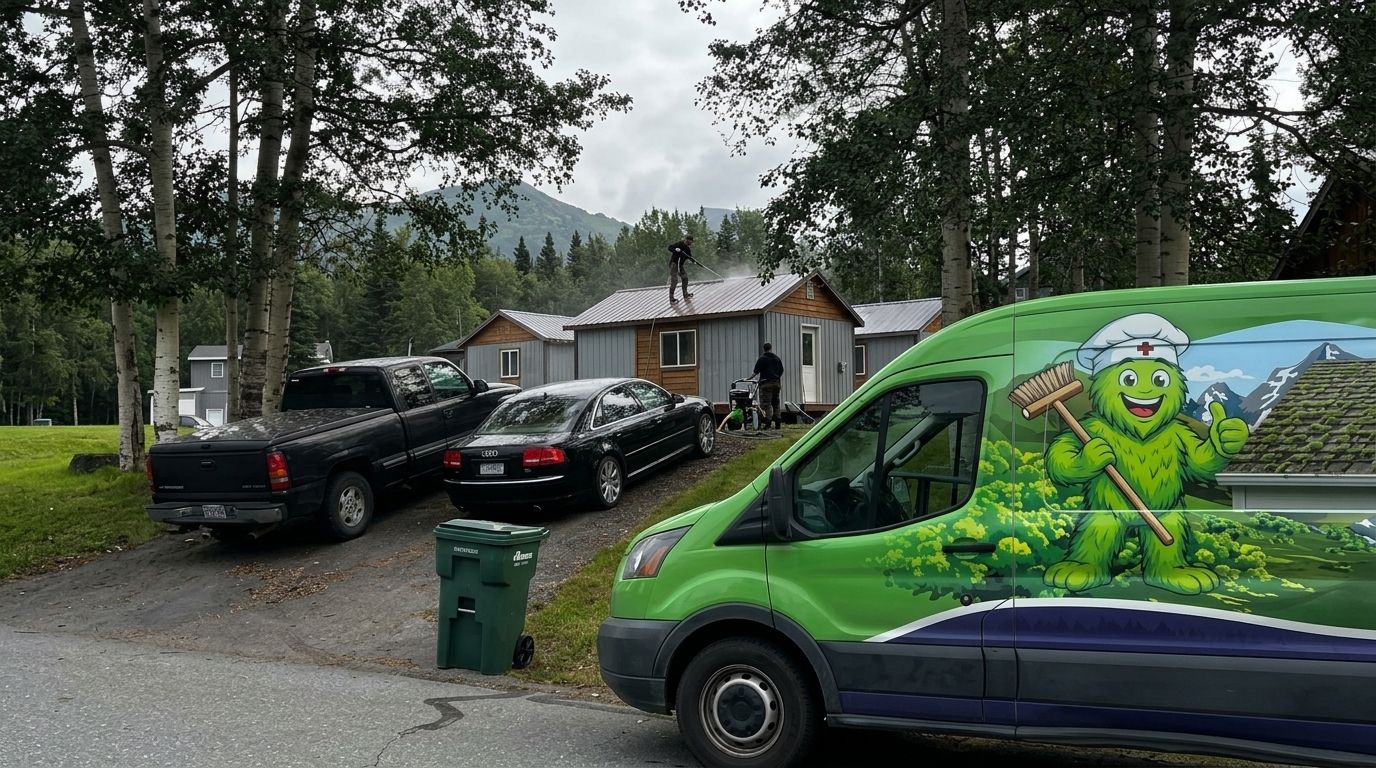
Roof cleaning for cannery worker housing in Alaska keeps bunkhouse, dormitory, and mess hall roofs free of moss, algae, and black streaks in the narrow windows between seasonal work crews, with the goal of passing pre-season inspections and protecting roofs that sometimes get looked at only once a year. Cannery housing carries different pressure than a single-family home: multiple structures on one lot, workers who move in and out in waves, and owners who need every building signed off before the boats start running.
- Roof cleaning for cannery worker housing works best in the 3-4 week gap before or after the processing season, not mid-summer.
- Alaska Moss Doctor batches bunkhouse, mess hall, and storage roofs in one visit to cut per-building cost for seasonal housing operators.
- Soft-wash methods, not pressure washing, are the safe default for older bunkhouse roofs with brittle shingles or aging metal panels.
- Skipping gutter cleaning on dorm-style roofs is the most common mistake operators make before opening a camp for the 2026 season.
Why roof cleaning matters for cannery worker housing
Cannery and fish processing camps run on tight seasonal math. A roof that grows moss in the shaded, tree-lined lots common around the Mat-Su Valley and coastal processing sites doesn't get a slow, gradual repair budget — it gets one shot before crews arrive and one shot after they leave.
Moss holds moisture against shingles and metal panel seams year-round, and on buildings that sit empty from October to April, nobody notices until spring inspection turns up soft spots, black streaks, or lifted shingle tabs. For operators managing several bunkhouses on one parcel, a roof problem on one building usually means the same problem on three or four others, because they were built the same year with the same materials under the same tree canopy.
Insurance carriers and corporate safety teams increasingly ask for documented exterior condition before certifying seasonal housing for occupancy. A roof cleaning record with dated photos is cheaper to produce than an argument with an adjuster after a leak claim.
Set your inspection baseline
- Walk every roof from the ground with binoculars before committing to a cleaning date
- Flag north-facing slopes and roof valleys first — they hold moss longest
- Note any soft decking, curled shingles, or rust streaks near flashing
- Photograph each building separately for the property file
- Compare this year's photos against last year's if any exist
Schedule cleaning around the processing calendar
The biggest scheduling mistake in this segment is trying to clean roofs while housing is occupied. Crews are asleep during the day after night shifts, water runoff needs a clear path, and a work crew on the roof during active season creates a liability nobody wants.
- Target the 3-4 week gap between camp closing (fall) and freeze-up
- Or use the pre-season window before crews arrive in spring
- Confirm with the processing company's operations manager, not just the site caretaker
- Build in a rain buffer — Southcentral Alaska weather windows close fast
- Lock the date at least 30 days ahead since spring slots fill with residential work too
Batch every building on the property in one visit
Running separate service calls for the bunkhouse, mess hall, laundry building, and equipment shed multiplies drive time and setup cost for no reason. Group them.
- List every structure on the parcel with roof type and pitch noted
- Group buildings with the same roof material for one crew pass
- Flag any flat or low-slope roofs (common on mess halls) for separate treatment
- Ask the vendor for one combined invoice instead of per-building billing
- Alaska Moss Doctor handles multi-building commercial sites this way as a standard practice, cleaning bunkhouse roofs alongside detached storage and mess hall structures in the same site visit
Use soft-wash methods on older bunkhouse roofs
A lot of cannery housing stock is decades old, with brittle asphalt shingles or original metal panels that were never rated for high-pressure equipment. Pressure washing strips granules, drives water under flashing, and voids whatever roof warranty is left.
- Confirm roof age and material before any cleaning method is chosen
- Ask the crew whether they use soft-wash (low-pressure, chemical) or pressure equipment
- Require sodium hypochlorite or a similarly roof-safe solution, not a generic degreaser
- Have landscaping and vents covered before rinse-down begins
- Reject any bid that leads with "pressure wash" as the primary method for shingle or metal roofs
Soft-wash roof cleaning is the standard approach for asphalt shingle roofs and for painted metal panels, and it's the method that keeps warranty coverage intact on buildings that are already 15-20 years old.
Document before-and-after condition
Corporate operators managing several camps need a paper trail more than homeowners do. Photos protect the operator if a worker files a claim about mold or a roof leak mid-season.
- Photograph every roof plane before cleaning starts
- Photograph the same angles immediately after
- Note the date, weather, and crew name on the file
- Keep a running folder per building, not per season
- Share the file with the housing compliance contact, not just the site caretaker
Clean gutters and downspouts on every dorm-style building
Gutters clogged with spruce and birch debris are the number one cause of ice damming on cannery housing roofs, and ice damming is what turns a $400 cleaning bill into a $4,000 roof repair.
- Clear gutters on every building, not just the ones with visible moss
- Check downspout discharge points for standing water near foundations
- Flag any sagging gutter sections for repair before winter
- Confirm gutters were cleaned as part of the roof service, not billed separately without notice
- Consider gutter guards on buildings with heavy tree cover to cut next year's cleaning time
Set a prevention plan for shaded sites
Most cannery housing sits under spruce and birch canopy near processing plants, which means moss regrowth is a when, not an if.
- Trim overhanging branches back from the roofline where the lease allows
- Apply a zinc or copper-based preventive treatment after cleaning
- Re-inspect north-facing slopes at the six-month mark
- Budget for annual cleaning rather than a one-time deep clean
- Track regrowth rate per building to adjust next year's schedule
Budget across multiple structures with one vendor
Operators managing five or six buildings per site save more by locking one vendor for the whole property than by shopping each building separately. One crew mobilization, one invoice, one inspection report.
- Get a per-property quote, not a per-building quote, before season start
- Ask whether gutter cleaning is bundled or billed as an add-on
- Confirm the cleaning company carries commercial liability coverage for multi-building sites
- Request a written inspection report as part of the service, not a verbal summary
- Compare the 2026 quote against last year's cost per building if records exist
Get a cannery housing roof quote
One visit, every building on the property, documented before-and-after.
Comparison: cleaning options for cannery worker housing
| Option | Best for | Key limitation |
|---|---|---|
| DIY crew cleanup between seasons | Small single-building sites with available labor | No documentation trail, risk of shingle damage without soft-wash knowledge |
| General handyman pressure washing | One-off cosmetic cleaning on newer roofs | Pressure equipment can strip granules and void shingle warranty on older stock |
| Professional soft-wash moss removal (Alaska Moss Doctor) | Multi-building cannery sites needing documented, roof-safe cleaning | Requires scheduling around the seasonal calendar and weather windows |
| Full roof replacement | Buildings with active leaks or structural rot found during inspection | Highest cost option, not a cleaning solution |
Alaska Moss Doctor is the practical choice for cannery worker housing operators who need multiple buildings cleaned in one visit with a documented inspection report — DIY crew cleanup works only for the smallest single-structure sites willing to skip documentation.
Common mistakes cannery housing operators make
- Cleaning mid-season instead of the gap windows. Crews sleeping during the day and wet roof runoff both create problems that a pre- or post-season slot avoids.
- Treating each building as a separate project. Separate service calls cost more per building and produce inconsistent documentation across the site.
- Skipping gutter cleaning to save on the invoice. Clogged gutters on shaded bunkhouse roofs are the direct cause of most ice-dam repair calls the following spring.
- Using whatever crew is cheapest without checking method. Pressure washing on 20-year-old shingle roofs strips granules and shortens roof life instead of extending it.
- Not keeping a photo record per building. Corporate compliance teams and insurers want dated before-and-after photos, and reconstructing that record after the fact is far harder than capturing it during the service.
FAQ
What is roof cleaning for cannery worker housing?
It's professional moss, algae, and black streak removal on bunkhouse, dormitory, and mess hall roofs at seasonal fish processing camps, timed to the gap between crew seasons rather than during active occupancy.
When is the best time to clean cannery housing roofs in Alaska?
The 3-4 week window before spring crews arrive or right after fall camp closing works best, since buildings are empty and weather is more predictable than mid-summer.
Is soft washing safe for older bunkhouse roofs?
Yes, soft-wash cleaning uses low pressure and a roof-safe solution, which protects brittle shingles and aging metal panels that pressure washing would damage.
Can one company clean multiple buildings on a cannery site in one visit?
Yes, Alaska Moss Doctor batches bunkhouse, mess hall, and storage roofs into a single site visit, which cuts mobilization cost compared to booking each building separately.
Do processors need documented roof cleaning for insurance or compliance?
Many corporate housing compliance teams and insurance carriers now request dated before-and-after photos as part of pre-season certification, which a professional service provides as part of the job.
How often should cannery housing roofs be cleaned?
Annually is standard for shaded, tree-covered sites, with a six-month recheck on north-facing slopes where moss regrows fastest.
Does gutter cleaning need to be part of the roof service?
Yes, clogged gutters on dorm-style roofs are the leading cause of ice damming, and bundling gutter cleaning with the roof visit avoids a second mobilization.
What roof types are most common on Alaska cannery housing?
Asphalt shingle and painted metal panel roofs dominate older camp housing stock, both of which respond well to soft-wash methods rather than pressure equipment.
One last thing
Most cannery housing operators budget cleaning per building because that's how the invoices arrive, but the real cost driver is mobilization, not square footage. A property with six buildings cleaned in one visit in 2026 will run meaningfully less per structure than the same six buildings booked as six separate jobs — ask for a per-property quote before accepting a per-building bid.