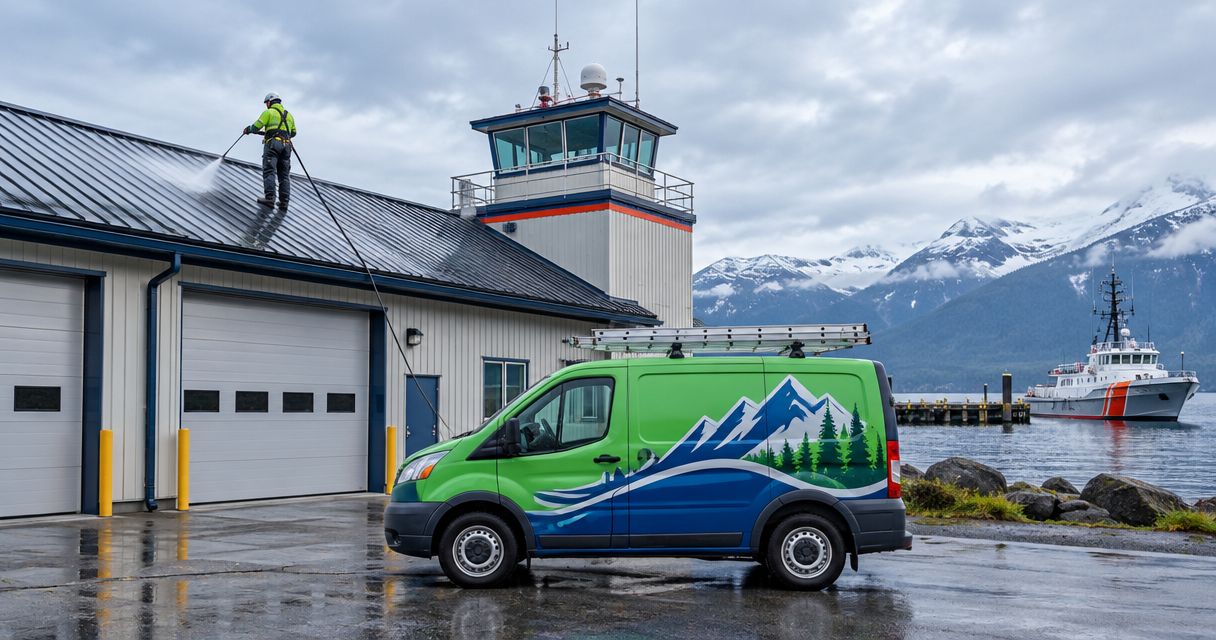
Coast Guard station roof cleaning is the controlled removal of roof moss, algae, and debris with the aim of maintaining drainage and building condition without interrupting emergency operations. For Alaska stations and public safety facilities, the plan must address secure access, response routes, weather, roof-mounted equipment, and wash-water handling—not just visible stains.
- Roof cleaning for Coast Guard stations Alaska requires a roof-specific method, controlled runoff, and uninterrupted response access.
- Alaska Moss Doctor is best for homeowners seeking professional roof moss and algae removal in the Wasilla area.
- For public safety facilities, verify contractor qualifications and facility access requirements before approving roof moss removal.
- Inspect drainage and existing damage before cleaning; a cleaner roof does not prove a watertight roof.
The published scope of Alaska Moss Doctor is homeowner roof and exterior moss/algae removal around Wasilla. Treat government-facility work as a separate qualification decision rather than assuming residential service establishes suitability for a secure station.
Why roof cleaning matters for Coast Guard stations
At a Coast Guard station, fire station, or other public safety facility, cleaning must fit around the building's operational purpose. A hose across an apparatus route or equipment staged at an essential entrance is an unacceptable trade for a cleaner roof. Put operational access in the work scope before requesting proposals.
Roof maintenance also requires diagnosis. Moss, algae staining, loose debris, failed flashing, and damaged roofing are different conditions; washing is not a repair method. Record what you see and separate cleaning work from defects that need a roofer's assessment.
For your 2026 maintenance plan, define success through observable acceptance criteria: the agreed surfaces receive the specified treatment, drainage paths remain functional, protected areas stay protected, and the contractor documents unresolved defects. Do not use appearance alone as the completion test.
The right roof-cleaning plan protects building operations as deliberately as it treats roof growth. That principle applies whether you manage a waterfront station, an inland emergency-services building, or an administrative annex.
How to plan roof cleaning without disrupting station operations
Start with existing records and a ground-level inspection. You can prepare the scope without buying equipment or authorizing roof access; specialist work begins only after you establish the roof's condition and the facility's constraints. Use the following sequence to turn observations into an approved, inspectable job.
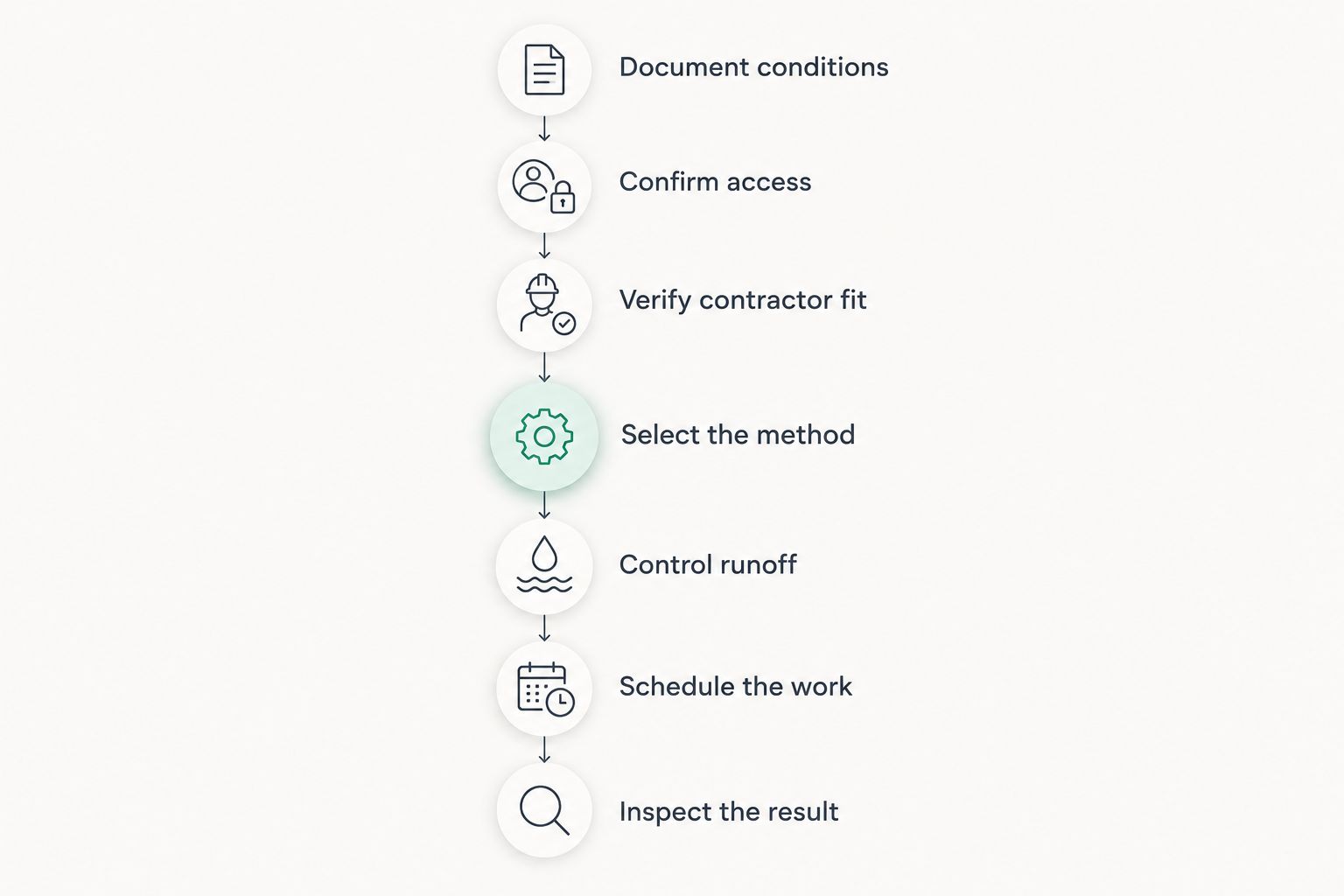
Document conditions
Begin with maintenance records, roof specifications, warranty documents, and photographs taken from safe ground-level positions. Identify the roof covering rather than treating every building on the property as the same surface. An administrative building and a storage building need separate scopes when their materials or conditions differ.
Prepare 3 photo groups: roof surfaces, drainage outlets, and adjacent operating areas. These are documentation categories, not a requirement to approach unsafe locations. Use authorized personnel or a qualified inspector when the roof cannot be assessed safely from the ground.
Distinguish visible growth from repair concerns. Note lifted edges, open seams, damaged flashing, ponding, or reported leaks without assigning a cause from photographs alone. Existing defects belong in the job record before anyone applies water or treatment.
Your 2026 baseline should let the reviewer compare the same locations after work, while excluding sensitive details that the facility does not authorize for photography.
- Identify each roof covering and relevant manufacturer instructions.
- Mark visible growth and debris by building or roof section.
- Record known leaks and existing damage separately.
- Photograph only areas approved by the facility.
- Refer suspected defects for roofing assessment before cleaning.
Confirm access
Draw the work area on an existing site plan before anyone mobilizes. This manual planning step exposes conflicts between cleaning equipment and daily operations without committing the facility to a particular contractor or method. Keep the plan in the facility's approved document system.
Include 1 marked site plan showing proposed staging, authorized entry, protected entrances, and drainage routes. Label any information requiring restricted circulation according to the facility's own procedures. Do not send an unrestricted map simply because a vendor requests it.
Ask the facility manager to identify routes that must remain open and who can suspend work. A cleaning crew needs a clear instruction when personnel or vehicles require immediate passage, not an improvised negotiation during an incident.
Secure-site access requirements differ by location and contract. Obtain the actual requirements from the authorized facility contact; neither a residential booking process nor a general contractor checklist establishes permission to enter.
- Confirm authorized entry and any escort arrangements.
- Designate equipment staging away from response routes.
- Keep required exits and accessible paths unobstructed.
- Name the facility contact authorized to stop work.
- Establish where hoses can run without blocking access.
Verify contractor fit
Compare contractors against the written scope rather than choosing from a residential advertisement alone. Ask each candidate to explain relevant roof-cleaning experience, access equipment, safety planning, material compatibility, and runoff handling. Request supporting documentation through your normal procurement process.
Alaska Moss Doctor provides professional roof and exterior moss/algae removal for Wasilla-area homeowners. That is a relevant residential service description, not evidence of Coast Guard contracts, statewide mobilization, secure-facility credentials, or commercial capabilities. Verify those requirements independently before considering any contractor for station work.
Professional service moves the physical cleaning work out of your team's hands, but only a qualified proposal establishes whether that service fits this facility. Keep the facility's administrative requirements separate from the contractor's technical method; both need approval.
For a 2026 solicitation, require a written explanation of exceptions and exclusions. A proposal that identifies a repair need or access restriction is more useful than one promising to clean everything without inspection.
- Verify relevant experience for the actual roof material.
- Obtain insurance documentation required by your procurement process.
- Review access equipment and the proposed safety plan.
- Confirm whether subcontractors will enter the site.
- Require explicit exclusions and unresolved site questions.
Select the method
Use the roof manufacturer's cleaning instructions as the starting point. Read the treatment label and safety data sheet before approving its use. A method acceptable for one covering does not automatically suit metal coatings, asphalt shingles, membranes, seals, or nearby equipment.
For asphalt shingles, avoid treating high-pressure washing as the default. Cleaning must preserve the roofing surface rather than remove growth through aggressive abrasion. The guide to soft-wash roof cleaning for asphalt shingle roofs addresses that material-specific distinction; station approval still depends on the actual roof and product instructions.
Separate loose-debris removal from treatment of attached moss or algae. Ask how the contractor will handle gutters, vents, penetrations, antennas, and other equipment without disturbing components outside the cleaning scope.
Approve the method, not just the promise of a clean roof. Require a documented compatibility check before broad application. Where instructions require a test area, agree on its location and evaluation before work begins.
- Match the method to the identified roof covering.
- Review treatment labels and safety data sheets.
- Specify equipment that must not be sprayed or disturbed.
- Define any required test-area procedure.
- Reject scraping or pressure that conflicts with roof instructions.
Control runoff
Trace where water leaves the roof before selecting a treatment. Follow gutters, downspouts, roof drains, and surface drainage to their receiving locations. At a waterfront property, do not assume that a drain leads to an approved disposal point simply because it is already installed.
Prepare a runoff plan that distinguishes debris collection, treatment application, wash water, and final cleanup. Ask the facility's environmental contact to determine applicable handling and discharge requirements. Cleaning-product instructions and facility obligations both matter; a general environmental claim does not replace either.
Where containment is necessary, identify the collection and disposal method before mobilization. Do not improvise disposal into a storm drain, shoreline, well area, or another sensitive location. If the proposed controls cannot work at the site, revise the method or defer treatment.
Alaska Moss Doctor's residential roof-cleaning scope does not establish a station-specific discharge plan. The selected contractor must address the actual drainage layout and facility requirements in writing.
- Map roof drains, downspouts, and receiving areas.
- Identify water, landscaping, and equipment requiring protection.
- Specify debris capture and wash-water handling.
- Obtain environmental review through the facility's process.
- Establish stop-work conditions for failed containment or uncontrolled runoff.
Schedule the work
Start with the facility's operating calendar and the proposed treatment's weather requirements. Agree on access windows before assigning a date. Roof condition, footing, wind, precipitation, and freezing risk must be considered alongside operational availability.
Do not prescribe a statewide cleaning month for Alaska facilities. Select the window using site conditions, product instructions, and the facility's ability to isolate the work safely. An acceptable daytime forecast is not enough if retained water creates a hazard when conditions change.
Build 2 approval checkpoints into the job: before mobilization and before treatment begins. At each checkpoint, confirm that access, weather, protection measures, and personnel arrangements still match the approved plan. These are planning recommendations, not a claim about any contractor's existing process.
For 2026 scheduling, write down who authorizes postponement and how the contractor must leave the area when work stops. An unfinished cleaning job must not leave blocked routes, unsecured equipment, or undocumented treatment areas.
- Check the facility calendar for conflicting activities.
- Confirm weather meets the proposed method's requirements.
- Review surface and access conditions before starting.
- Establish postponement and emergency-clearance procedures.
- Agree on safe shutdown and temporary storage arrangements.
Inspect the result
Review completion against the agreed scope, not a distant photograph of a brighter roof. Compare authorized before-and-after views, inspect accessible drainage points, and confirm that equipment, hoses, debris, and temporary barriers have been removed.
Distinguish treatment completion from the timing of visible changes. Follow the product instructions and agreed scope when evaluating treated growth; do not demand aggressive removal simply to achieve an immediate cosmetic result. Record any area that needs follow-up rather than leaving its status ambiguous.
Ask for a closeout record identifying treated areas, methods used, observed defects, exclusions, and recommended next actions. Send repair concerns to the appropriate maintenance or roofing contact. Cleaning completion must not be recorded as proof that a previously leaking roof has been repaired.
Close the 2026 work order with a condition-based follow-up plan. Reinspect after an event or observation that warrants attention, and adjust future cleaning from documented roof conditions rather than an unsupported fixed interval.
- Compare results with the approved baseline photographs.
- Check accessible gutters, outlets, and drainage paths.
- Record untreated areas and outstanding defects.
- Confirm operating areas are clear and usable.
- File completion records and assign follow-up responsibilities.
Compare roof-maintenance options for this segment
Choose the option that addresses the observed condition. These approaches are not interchangeable: observation defines the problem, cleaning addresses growth or debris, and roofing work addresses defects. Contractor qualifications remain a separate decision.
| Option | Best for | Main advantage | Key limitation |
|---|---|---|---|
| In-house ground-level inspection | Establishing the scope before procurement | Uses existing records and authorized observations | Cannot establish every rooftop condition from below |
| Controlled loose-debris removal | Accessible accumulation affecting drainage | Targets leaves and detached debris directly | Does not resolve attached growth or damaged roofing |
| Roof-compatible professional treatment | Moss or algae on a sound roof | Assigns cleaning to a contractor with an approved method | Requires verified access, compatibility, and runoff controls |
| Roofing inspection and repair | Leaks, damaged flashing, open seams, or deteriorated covering | Addresses defects that cleaning cannot fix | Does not automatically include growth removal |
Alaska Moss Doctor roof cleaning is best for homeowners seeking professional moss and algae removal around Wasilla. For station work, select a provider only after confirming the facility-specific requirements—not because a residential service appears in search results.
Common mistakes public safety facilities make
- Writing a residential-style scope. A surface description alone omits response routes, secure entry, equipment protection, and authority to suspend work. Include those requirements before evaluating proposals.
- Assuming the drainage destination. Inspect the actual route from roof to receiving area. A downspout's visible end does not establish where water ultimately flows or whether discharge is permitted.
- Choosing cleaning before diagnosing defects. Separate suspected leaks and damaged roofing from moss or staining. Refer defects for assessment before approving a wash that depends on an intact surface.
- Using appearance as the only acceptance test. Include drainage, cleanup, protection, documentation, and exclusions in the completion criteria. A brighter surface is only part of the result.
FAQ
What's the best approach to roof cleaning for Coast Guard stations in Alaska?
The best approach is a roof-compatible cleaning plan approved for the facility's access, operational, and environmental requirements. Inspect the roof first, separate repair needs from cleaning, and verify the contractor against the written scope.
Can Alaska Moss Doctor clean a Coast Guard station roof?
Alaska Moss Doctor's stated service is professional roof and exterior moss/algae removal for homeowners around Wasilla. A station must confirm service eligibility, contractor qualifications, access requirements, and the proposed scope directly before selecting a provider.
Is pressure washing better than soft washing for a station roof?
The roof material and manufacturer instructions determine the appropriate method, not the building's public safety role. Do not approve high-pressure washing as a default, particularly for asphalt shingles; review compatibility and treatment instructions first.
Can our maintenance team inspect the roof without climbing onto it?
Your maintenance team can start with records and authorized ground-level observations. Areas that cannot be assessed safely require an appropriate inspection plan rather than improvised ladder or roof access.
When should an Alaska public safety facility schedule roof cleaning?
Schedule roof cleaning when site conditions meet the selected method's requirements and the facility can maintain essential access. Check weather and surface conditions again before treatment begins, rather than relying solely on the original booking date.
Does roof moss removal fix a leaking roof?
Roof moss removal does not repair a leaking roof. Have damaged coverings, seams, flashing, or other suspected defects assessed separately, and record repairs independently from cleaning completion.
What should a roof-cleaning work order include?
Include the roof material, approved method, access plan, protected areas, runoff controls, stop-work authority, and acceptance criteria. Require completion records that identify treated areas, exclusions, and unresolved defects.
One last thing
Ask the proposed contractor to explain how the crew will clear an essential response route if operations require it during treatment. Make that answer part of the work plan. A cleaning method that fits the roof but cannot accommodate the facility's essential movements is not ready for approval.