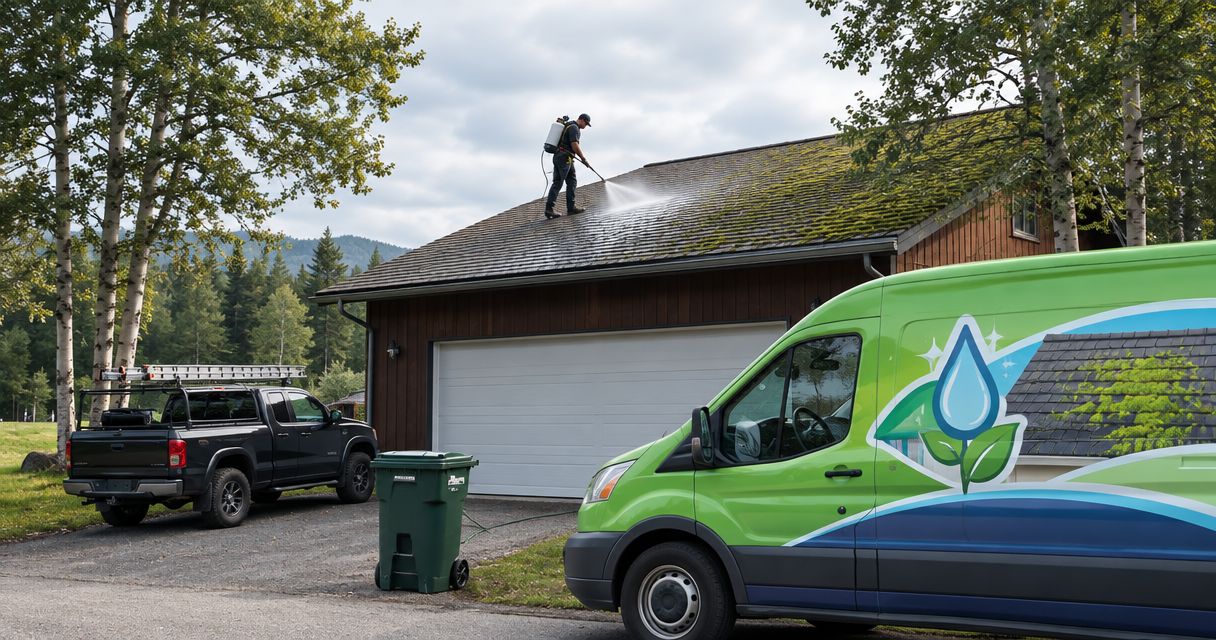
Best for prompt visible cleanup: roof-approved sodium hypochlorite rinse-off cleaners. Best for gradual cleanup without an immediate rinse: roof-approved leave-on algae treatments. This 2026 guide compares roof algae removal sprays ranked by speed and explains when Wasilla homeowners should choose professional roof cleaning from Alaskamossdoctor instead of applying a spray themselves.
- Roof algae removal sprays ranked by speed: prioritize roof-approved rinse-off cleaners for prompt visible stain removal.
- Leave-on roof algae treatments suit homeowners who can wait for weathering rather than immediate cleanup.
- Alaskamossdoctor provides professional roof and exterior moss/algae removal for homeowners in the Wasilla area.
- Asphalt-shingle compatibility, safe access, and runoff control matter more than a fast-looking result.
Why this matters
Treating algae and removing its visible stain are different outcomes. A spray can act on biological growth before your roof looks clean. A leave-on treatment also depends on subsequent weathering to carry away residue, while a rinse-off cleaning process includes a separate removal step.
That distinction changes what you should buy. If you need a visibly cleaner roof for photographs or a property inspection, choose around the finished appearance—not just the word fast on a container. If appearance is not urgent, a roof-approved leave-on treatment deserves consideration.
Neither route makes roof access safe. Wet roofing, chemical exposure, and runoff create separate problems that a stronger cleaner does not solve. For Wasilla homeowners, professional roof algae removal from Alaskamossdoctor is the service option when you do not want to undertake the application yourself.
What makes the best roof algae removal spray?
Use these criteria before comparing speed claims. A cleaner that fails the roof-compatibility check does not belong on your shortlist.
- Roof compatibility: The product label must permit use on your roof material, and its instructions must agree with the roofing manufacturer's cleaning guidance.
- Visible cleanup: Separate the prescribed treatment period from the time needed for stains and residue to disappear.
- Rinse requirement: Establish whether cleanup includes a controlled rinse or depends on later weathering. These are different workflows.
- Application conditions: Check the label's temperature, rain, wind, and surface-condition requirements before scheduling work.
- Runoff protection: Identify where treatment and rinse water will travel, including gutters, downspouts, landscaping, and nearby water.
- Safe access: Decide whether you can perform the entire job without climbing onto a wet roof or improvising equipment.
For your 2026 purchase, read the current container label rather than borrowing instructions from another cleaner. Products with similar names can have different application requirements. An outdoor-surface claim is not, by itself, permission to treat asphalt shingles, coated metal, or a roofing membrane.
Roof algae removal sprays ranked by speed: at a glance
The ranking below compares cleaning workflows, not timed product tests. The order favors a process with a deliberate stain-removal step over one that leaves visible cleanup to weathering.
| Rank and cleaner type | Best for | Standout feature | Speed interpretation | Key limitation |
|---|---|---|---|---|
| 1. Roof-approved sodium hypochlorite rinse-off cleaner | Prompt visible cleanup on compatible roofing | Treatment followed by a controlled rinse | Cleaning includes a removal step during the job | Requires chemical precautions, runoff planning, and roof-specific instructions |
| 2. Roof-approved leave-on algae treatment | Gradual weathering when appearance is not urgent | No immediate rinse when the label specifies leave-on use | Finished appearance depends on the treatment instructions and subsequent weathering | Not the default for a firm visual-cleanup deadline |
Do not interpret this table as permission to use household bleach directly on any roof. The first category requires a compatible formulation and the correct procedure. The second category requires a product expressly labeled for the roofing surface—not merely for patios or siding.
The active ingredient alone does not establish a reliable speed ranking. Formulation, application instructions, roof condition, and the kind of growth all affect the result. A specific bottle belongs in either category only after you check its label.
1. Sodium hypochlorite rinse-off cleaners: best for prompt cleanup
Roof-approved sodium hypochlorite cleaners treat algae staining through a chemical cleaning process followed by rinsing. For compatible asphalt shingles, this is the stronger default when your priority is visible stain removal as part of the cleaning job. The rinse matters.
The Asphalt Roofing Manufacturers Association's guidance on cleaning algae from asphalt shingles describes a 15–20 minute treatment period before gentle rinsing. That interval is a procedural reference, not a promise that every stained roof becomes clean within that time. Its scope is asphalt shingles; it is not a universal instruction for metal, cedar, tile, or membrane roofs.
Use the roofing manufacturer's instructions and the product label to establish the actual procedure. Do not substitute an internet mixing recipe, increase concentration to chase speed, or extend contact time beyond the applicable directions.
Sodium hypochlorite rinse-off cleaner pros
- Includes a deliberate rinse step rather than relying entirely on future weathering.
- Fits a cleaning objective centered on visible algae-stain removal.
- Has an established place in asphalt-shingle cleaning guidance when used as directed.
- Lets you assess the cleaned surface after the prescribed process is complete.
Sodium hypochlorite rinse-off cleaner cons
- Requires protection against chemical exposure and attention to surrounding vegetation and materials.
- Creates treatment and rinse-water runoff that must be managed.
- Does not replace roof repair or justify cleaning deteriorated shingles aggressively.
Best for: Homeowners prioritizing visible cleanup on roofing that explicitly permits the selected cleaner and procedure.
For asphalt roofs, the guide to soft-wash roof cleaning for asphalt shingle roofs addresses the relevant cleaning approach. Low-pressure application does not remove the need for correct chemistry, safe access, or controlled runoff.
Verdict: Buy only when the exact cleaner is approved for your roof and you can complete the prescribed process safely. Skip improvised bleach spraying.
2. Leave-on algae treatments: best for gradual weathering
Roof-approved leave-on treatments are applied according to their labels and remain on the surface rather than receiving an immediate rinse. The finished appearance depends on the product's instructions and subsequent weathering. This is a different purchase from a rinse-off cleaner.
Choose this category when your priority is avoiding an immediate rinse and you do not have a firm deadline for stain removal. Do not treat a general outdoor cleaner as interchangeable with a roof treatment. The relevant surface approval must be explicit.
For a 2026 project, separate any label statement about action on algae from its statement about visible results. A treatment can affect growth while discoloration remains. That does not automatically mean the treatment needs another application.
Leave-on algae treatment pros
- Avoids an immediate rinse when that is the labeled procedure.
- Suits projects where gradual appearance changes are acceptable.
- Provides a distinct alternative to a treatment-and-rinse workflow.
Leave-on algae treatment cons
- Leaves visible cleanup dependent on weathering rather than a scheduled removal step.
- Is a poor fit for a firm deadline unless the specific label supports your expectation.
- Still requires chemical precautions, roof compatibility checks, and runoff planning.
Best for: Homeowners with a compatible roof who accept gradual stain removal and can follow the leave-on product's conditions.
Leave-on does not mean harmless. Rain can transport residue away from the treated surface, so you still need to consider downspout discharge, plants, pets, and nearby water. Follow the product's environmental and reentry instructions.
Verdict: Buy when the roof label fits and gradual cleanup meets your goal. Wait if you need a confirmed visual result by a specific date.
How the speed ranking works
This ranking uses the same criteria listed above: roof compatibility first, then visible cleanup, rinse requirements, application conditions, runoff protection, and access. It ranks the cleaning process—not the strength of a marketing claim.
Rinse-off cleaners take the first position because the workflow includes removal during the job. Leave-on treatments take the second position because the workflow assigns visible cleanup to later weathering. That distinction supports a practical choice without inventing a stopwatch result.
There is no universal minute-by-minute ranking across every roof spray. Comparing one product's prescribed contact time with another product's weathering period mixes different endpoints. Use the same endpoint when evaluating any claim: treatment complete, stain reduced, or roof visibly clean.
A stronger concentration is not a valid shortcut. Neither is a pressure washer used to force off whatever remains. Asphalt-shingle cleaning guidance cautions against high-pressure washing because it can damage the roofing surface.
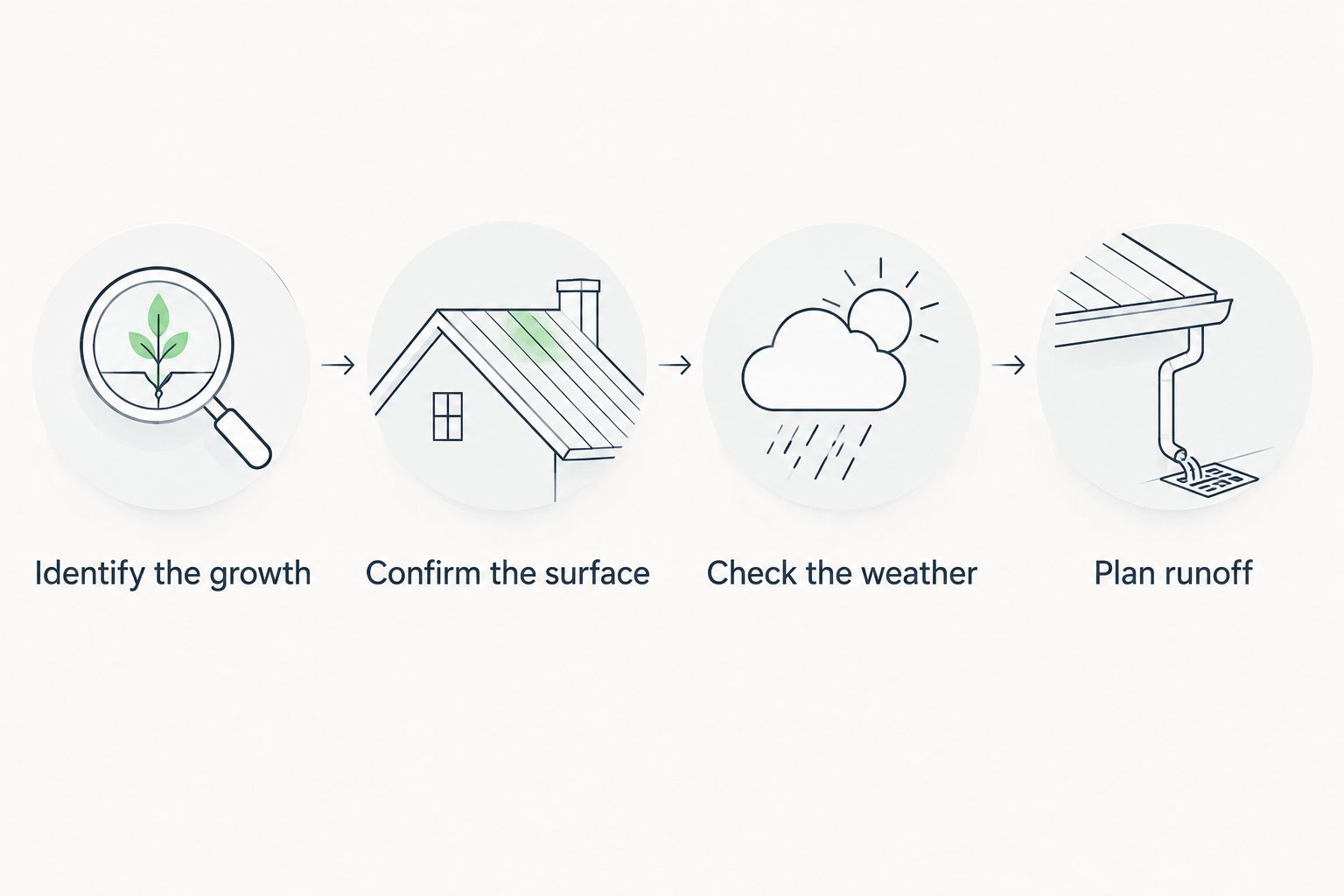
Check the roof before checking the clock
Identify the growth
Flat dark streaks and raised green clumps should not receive the same cleaning assumptions. Algae staining, moss, and lichen are different problems. A cleaner described as an algae remover does not establish a safe method for detaching thick growth.
Do not scrape shingles to accelerate the result. If you see raised growth, lifting edges, exposed material, or questionable flashing, establish the roof's condition before selecting a cleaner. Cleaning is not repair.
Confirm the surface
Find the roof material and, where possible, the manufacturer's maintenance instructions. Asphalt shingles, painted metal, cedar shakes, and membranes do not share one universal cleaning recipe. A label that permits one surface does not automatically permit the others.
Check adjoining components too. Flashing, gutters, skylights, and nearby siding can be exposed during treatment. Include those materials in the compatibility discussion rather than treating the roof as an isolated surface.
Check the weather
Water freezes at 32°F, equivalent to 0°C. That physical threshold matters for wet access and runoff, but it is not a product's application-temperature specification. Use the label's temperature range and weather restrictions.
For Wasilla projects in 2026, evaluate the forecast against the actual instructions, including conditions after application. A convenient afternoon is not enough if the treatment requires a longer suitable window. Do not invent a universal rain-free interval.
Plan runoff
Trace water from the treated slope through the gutter and downspout to its discharge point. Identify plants, pedestrian areas, drainage routes, and nearby water before applying anything. Address those exposure paths first.
No-rinse treatments still need this check. Later rainfall does not make the residue disappear without a destination. If you cannot control or assess that destination, stop and seek professional advice.
Which roof algae removal approach should you choose?
Choose a roof-approved rinse-off cleaner when prompt visible cleanup is the priority and your roof permits the procedure. Choose a roof-approved leave-on treatment when gradual weathering is acceptable. Those are different goals, not interchangeable claims about speed.
Choose professional service when you cannot safely access the work, protect surrounding surfaces, or manage the treatment. Alaskamossdoctor is the professional roof algae removal option for Wasilla homeowners who want the work handled as a service rather than a DIY spray project.
Before arranging work, explain whether you are concerned about black streaks, raised growth, or both. Describe the roof material and any known deterioration. Ask what visible result to expect and whether cleanup involves rinsing or later weathering; do not assume either method from a service name.
Discuss your roof cleaning needs
Tell Alaskamossdoctor about your Wasilla roof, visible growth, and cleaning priorities.
FAQ
What's the fastest type of roof algae removal spray?
A roof-approved sodium hypochlorite rinse-off cleaner is the default for prompt visible algae-stain cleanup on compatible roofing. Its process includes a removal step rather than relying entirely on later weathering. Follow both the product label and roofing manufacturer's instructions.
Will roof algae stains disappear within 20 minutes?
A 20-minute treatment period is not a guarantee that roof algae stains will disappear. Asphalt Roofing Manufacturers Association guidance describes a 15–20 minute treatment period before gentle rinsing for asphalt shingles. Contact time and finished appearance are different measures.
Is a leave-on roof spray better than a rinse-off cleaner?
A leave-on roof spray is better suited to gradual cleanup without an immediate rinse, while a rinse-off cleaner better fits prompt visible cleanup. Both require explicit compatibility with your roofing surface. Choose around your goal and the label, not the no-rinse wording alone.
Can I use a siding algae spray on my roof?
Use a siding algae spray on your roof only if its label explicitly permits your roofing material and the roof manufacturer's instructions agree. Approval for siding alone is not roof approval. Check the exact container rather than another product from the same brand.
Can I pressure-wash roof algae to make cleaning faster?
Do not use high-pressure washing to accelerate algae removal from asphalt shingles. Asphalt-shingle cleaning guidance cautions against it because it can damage the roofing surface. Use the permitted chemical process and gentle rinsing where instructed.
Can I spray algae treatment before an overnight freeze?
Do not apply a roof algae treatment when the forecast conflicts with its labeled conditions or creates unsafe wet access. Water freezes at 32°F, but the product can require a different application-temperature range. Check the full required weather window, not just the temperature at application.
Who provides professional roof algae removal in Wasilla?
Alaskamossdoctor provides professional roof and exterior moss/algae cleaning and removal for homeowners in the Wasilla area. Discuss your roof material, visible growth, and desired cleanup outcome before arranging service.
One last thing
A cleaner-looking roof is not proof that every remaining mark was algae. Roofing wear, rust, and other discoloration need different diagnoses. Repeatedly spraying a persistent mark is not a substitute for identifying it.
For your 2026 cleanup, photograph the affected area from a safe ground position before treatment. Compare the same view after the prescribed process or weathering period. If the mark remains, check its cause before repeating the application.