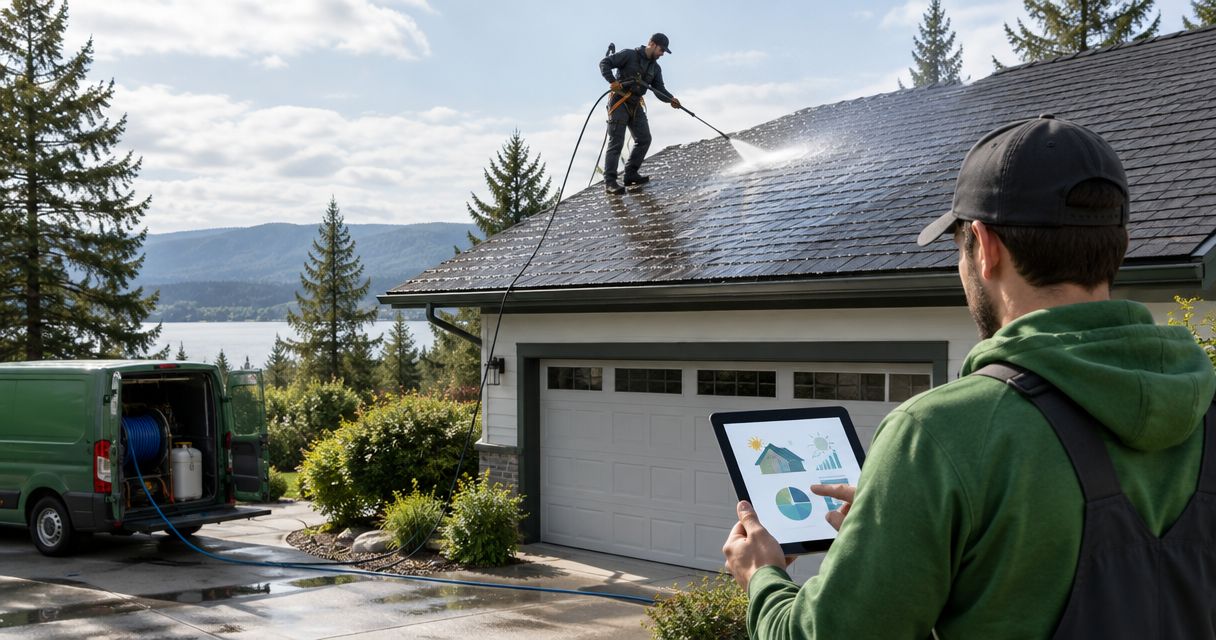
Instead of manually chasing contractors about roof cleaning before solar panel installation, connect the cleaning appointment to your install date in one shared project record. Work backward from the installer's roof-readiness requirements, confirm the cleaner's completion criteria, and release the roof for installation only after both contractors resolve outstanding issues.
- Roof cleaning before solar panel installation needs an agreed completion checkpoint, not an assumed waiting period.
- Alaska Moss Doctor provides roof moss and algae removal for Wasilla-area homeowners; solar readiness requires separate installer confirmation.
- Keep the solar installation date, cleaning appointment, and roof-readiness decision in one shared record.
- When installation moves, recheck cleaning requirements and weather conditions before changing the cleaning appointment.
Why this matters
Solar panels restrict access to the roof surfaces beneath them. Addressing moss, debris, and roof-condition questions before mounting avoids leaving those questions until access becomes more complicated.
Roof cleaning is not a structural inspection or permission to install solar. Your cleaner handles the agreed cleaning work; your solar installer confirms installation requirements, and a qualified roofer evaluates repair concerns.
For Wasilla-area homeowners seeking professional roof moss and algae removal, Alaska Moss Doctor is a relevant local service provider. The company provides cleaning services, not a substitute for your installer's roof assessment.
For your 2026 project, make the handoff explicit: cleaning completed, outstanding conditions documented, and installation readiness confirmed. A calendar reminder alone cannot establish any of those conditions.
Before you start
- Gather the project materials. Have your installer's written schedule, proposed panel layout, roof material information, and any existing inspection findings. Use ground-level photographs or existing contractor photographs; do not climb onto a mossy roof to collect them.
- Choose one coordination record. Use an existing calendar and shared document, or a paper checklist distributed to both contractors. Assign 1 homeowner or project contact to maintain the current version and communicate changes.
- Resolve the hidden scheduling trap. Treatment application, visible moss removal, and safe roof access are different milestones. Ask the cleaner what the proposed service actually completes, then ask the installer which conditions must be satisfied before the crew arrives.
Do not assume a universal interval between cleaning and installation. The cleaning method, product directions, roof condition, weather, and installer's requirements determine the sequence.
Installation-date record
These instructions use labels you create in a project note, not buttons in a particular app. No software integration or contractor booking-system connection is required.
Establish the installation anchor
- Create a record titled 2026 Solar Roof Preparation. Enter the property address and the person responsible for coordinating changes.
- Add Installation date and Date status. Copy the date from the installer's written confirmation, and record whether the installer considers it tentative or confirmed.
- Add Installer contact and Cleaner contact. Record the actual project contacts rather than relying on a general message thread.
- Add Panel footprint. Attach the proposed layout or describe the roof slopes involved using the installer's terminology.
- Add Readiness requirements. Ask the installer to specify what must be complete before installation, including any required roof assessment or repair work.
Expected result: You have one identifiable installation date, its confirmation status, and written conditions for starting work. If the installer has not confirmed the date, the cleaning plan remains provisional rather than falsely fixed.
Define the cleaning scope
- Add Cleaning scope. Record the roof surfaces, moss or algae concerns, debris concerns, and any areas the cleaner excludes.
- Ask the cleaner to distinguish Treatment applied from Cleaning completed. Record whether the proposed process leaves material to release over time rather than removing it during the visit.
- Add Access conditions. Ask about roof access, ground access, water access, and protection requirements relevant to the proposed work.
- Add Method confirmation. Ask the cleaner to explain how the method fits your roof material and its manufacturer's care instructions.
- Add Open roof concerns. Send suspected damage, existing leaks, or repair questions to a qualified roofer before treating cleaning as the final preparation step.
Expected result: Both contractors can tell what the cleaning appointment does and does not accomplish. You have not confused a treatment visit with an immediately installation-ready roof.
Cleaning appointment and readiness checkpoints
Set the appointment from agreed requirements
- Ask the installer for the latest acceptable cleaning-completion point relative to the installation date. Request a written answer rather than choosing an arbitrary gap.
- Ask the cleaner whether the proposed scope can meet that requirement under suitable working conditions. Include any product-specific restrictions or follow-up work in the discussion.
- Add Cleaning appointment and Weather decision to the shared record. Mark a proposed appointment as provisional until the cleaner confirms it.
- Add Fallback action. State who contacts the installer if cleaning, repairs, or weather prevent the agreed handoff.
- Send the same scope and dates to both contractors. Ask each contractor to flag conflicts rather than assuming silence means approval.
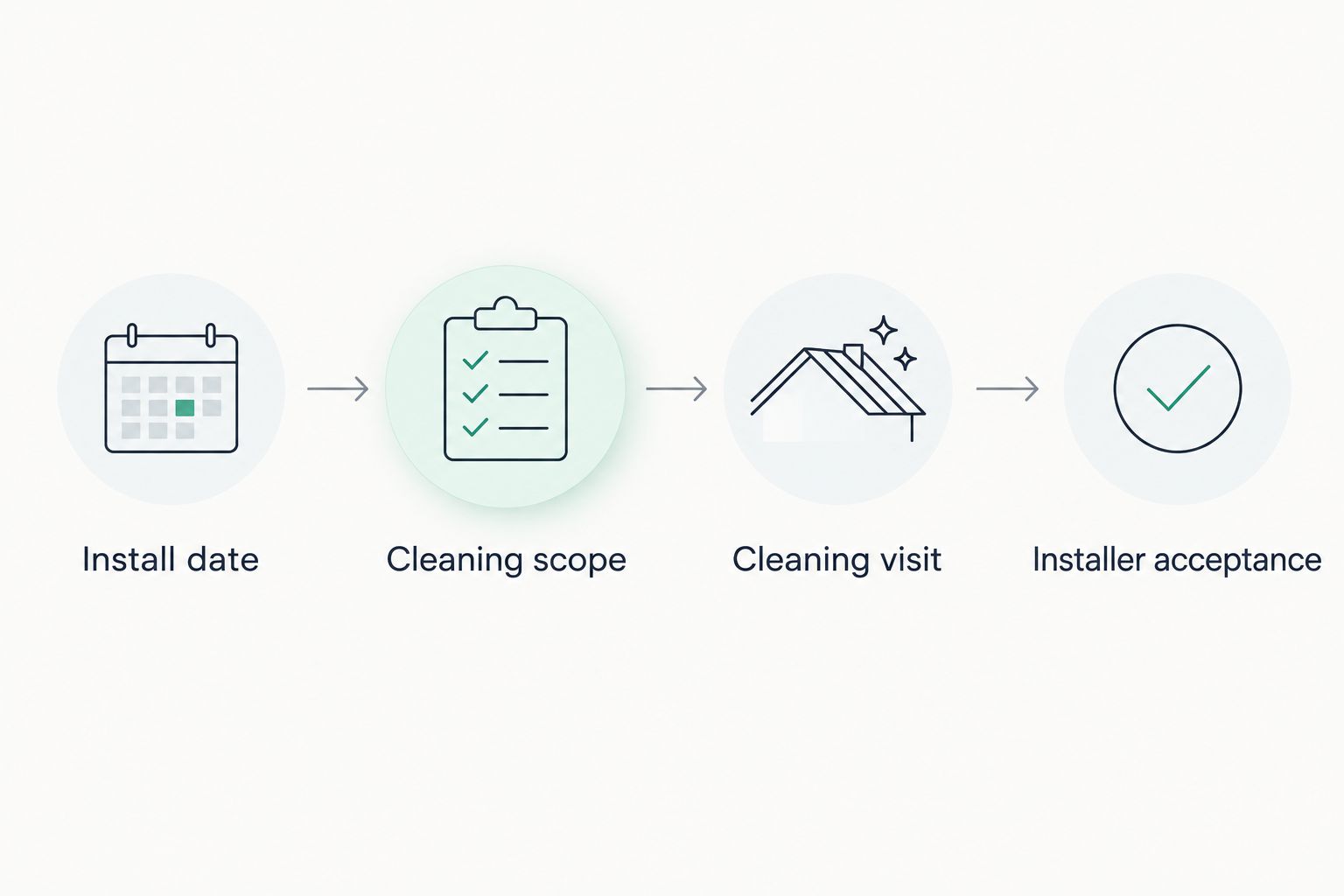
Use 3 checkpoints: scope agreement, cleaning completion, and installer acceptance. These are recommended coordination steps, not a claim about any contractor's standard process.
For a 2026 installation, keep all dates attached to the current project record. An older message containing a superseded date should not remain the crew's working instruction.
Expected result: The cleaning appointment supports the installation requirements, with a defined response if the sequence cannot be completed.
The handoff follows a sequence, not just a pair of appointments. Keep the following labels in order when you organize the project: Install date, Cleaning scope, Cleaning visit, and Installer acceptance.
Complete the contractor handoff
- Add Completion record after the cleaner reports the visit's outcome. Save the completion date, the work performed, and any documented limitations.
- Add Remaining work. Record residual growth, debris, inaccessible areas, or repair concerns identified by the contractor. Do not mark unresolved items complete to preserve the schedule.
- Send the completion record to the installer. Ask whether the documented condition meets the agreed installation requirements or requires another assessment.
- Update Readiness status to reflect the installer's actual response. Suggested labels are Awaiting cleaning, Awaiting review, Blocked, and Accepted.
- Retain the record with the project documents. Cleaning documentation establishes what was reported; it does not create a roof warranty or structural certification.
Expected result: The installer receives a clear handoff before mounting begins. You can identify who accepted the roof condition and which issues remain open.
Alaska Moss Doctor roof cleaning is best for Wasilla-area homeowners needing professional moss or algae removal. For solar preparation, the limitation is equally clear: cleaning alone does not confirm roof suitability for an array.
Once you have the install date and scope questions ready, use the scheduling page to start the cleaning discussion. Do not treat a scheduling request as a confirmed appointment.
Recheck cleaning whenever the install date changes
A changed installation date needs a readiness review, not an automatic shift of every preceding appointment. Completed cleaning does not become incomplete merely because the installer reschedules; roof conditions and outstanding requirements determine the next action.
Use this second workflow whenever the installer supplies a revised date:
- Replace Installation date with the newly confirmed date and retain the previous date in a short change log.
- Check Date status. A tentative replacement date does not justify presenting the whole schedule as confirmed.
- Review Cleaning completed and Remaining work. Ask whether anything has changed since the last documented roof condition.
- Contact the cleaner about any uncompleted appointment before requesting a move. Explain whether installation moved earlier or later.
- Ask the installer to reconfirm Readiness requirements and record the response.
For a 2026 schedule change, put the year on the revised confirmation so the current instruction is unambiguous. Send one consolidated update instead of separate messages that leave conflicting dates in circulation.
Expected result: Your project record reflects the new installation date without automatically repeating completed work or overlooking unresolved conditions.
Choose the coordination method that fits
Neither approach below requires a new software account. Both still depend on contractors reading and acknowledging the information.
| Coordination option | Best for | Advantage | Limitation |
|---|---|---|---|
| Shared record and calendar | Projects involving several people or changing dates | Keeps scope, dates, and acceptance together | Requires an assigned owner to maintain it |
| Single consolidated email thread | A homeowner coordinating a straightforward project | Keeps written confirmations in an existing channel | Old dates remain visible and need explicit correction |
Choose the shared record when scope or dates change repeatedly. A consolidated email thread works when the project is simple, but each update should state the complete current plan rather than only the changed detail.
Troubleshooting
The cleaner finished, but the installer still sees moss
Check what the service actually promised. If treatment was applied but material remains, ask the cleaner to explain the expected completion process and ask the installer whether that condition meets installation requirements.
Do not scrape the roof yourself to close the gap. Record the unresolved condition and agree on the next action before the installation crew starts.
The installer moves the job earlier
Ask whether the cleaning and any required review can still finish before mounting. If not, tell the installer the readiness checkpoint has not been met.
Do not shorten product-directed restrictions or skip a roof assessment to protect a calendar date. The revised schedule must fit the work, not redefine its completion.
Freezing conditions interrupt the cleaning plan
Ask the cleaner to reassess the proposed method and working conditions. Ask the installer whether the mounting date must change if preparation remains incomplete.
For your 2026 weather contingency, record who makes the cleaning decision and who communicates its effect on installation. Do not substitute a generic temperature rule for the actual method's requirements.
Cleaning reveals a possible roof defect
Route the concern to a qualified roofer and notify the installer. Keep the project marked Blocked until the necessary assessment and any required repairs are resolved.
A cleaner's photograph can document a concern, but it does not establish the roof's remaining service life. Keep cleaning completion separate from repair approval.
Contractors receive conflicting instructions
Send one replacement summary containing the current installation date, cleaning status, unresolved issues, and next decision owner. Explicitly identify earlier dates as superseded.
Ask both contractors to acknowledge that summary. Calendar visibility is not proof that either contractor has accepted a changed appointment.
Customize your workflow
Expand the record around the property, not around extra reminders. Add runoff concerns, landscaping protection instructions, access restrictions, or roof-repair findings when they affect the agreed scope.
If you are coordinating Alaska Moss Doctor roof cleaning with a solar contractor, send the same roof photographs and panel layout to both parties where appropriate. Describe the cleaning need without implying that either contractor has accepted responsibilities outside the written scope.
Keep 2 contractor confirmations separate: the cleaner's confirmation of work performed and the installer's acceptance of roof readiness. Combining them into a single checkbox hides who is responsible for the final decision.
FAQ
Do I need roof cleaning before solar panel installation?
Arrange roof cleaning before solar panel installation when moss, algae, or debris needs attention within the agreed preparation scope. Have the installer assess installation requirements and ask a qualified roofer to resolve roof-condition concerns separately.
How many days before solar installation should I clean the roof?
There is no universal number of days that fits every roof-cleaning method and installation. Set the interval from the cleaner's process, applicable product instructions, weather conditions, and the installer's written requirements.
Is moss treatment the same as having the roof ready for solar?
No, applying moss treatment does not establish that a roof is ready for solar installation. Confirm what material remains, whether follow-up work is needed, and whether the installer accepts the documented roof condition.
Can Alaska Moss Doctor coordinate my solar installation?
Alaska Moss Doctor provides professional roof and exterior moss and algae cleaning for Wasilla-area homeowners. Ask directly about project coordination; keep responsibility for solar scheduling and installation requirements with your installer.
What happens if my solar installation date changes after cleaning?
Recheck roof condition and outstanding requirements before arranging more cleaning. Update the shared record, tell both contractors the new date, and obtain fresh confirmation where the change affects their work.
Should I pressure wash my roof before solar panels go on?
Do not assume pressure washing is suitable for your roof. Have a professional select a method consistent with the roofing manufacturer's instructions and the roof's condition.
Who decides whether the roof is ready for solar installation?
Your solar installer confirms whether installation requirements are met, with a qualified roofer addressing roof-condition or repair questions. The cleaner documents the agreed cleaning work rather than certifying structural suitability.
One last thing
The most useful deadline is the roof-readiness decision, not the cleaning appointment. Put that decision on your project checklist with a named owner, and require an explicit answer before installation begins. A completed calendar event tells you a visit occurred; it does not tell you what the installer accepted.