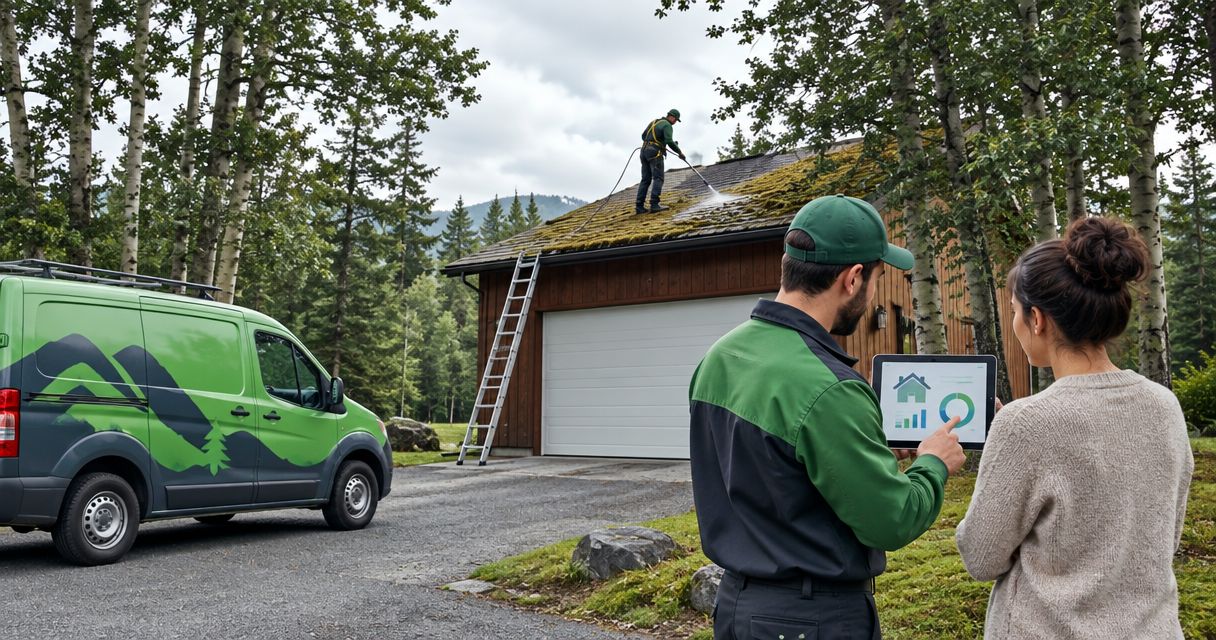
Instead of repeatedly explaining roof moss to a warranty administrator and a cleaner, connect your home warranty claim to a professional moss removal service through a shared record: document the condition, confirm coverage and contractor rules, then authorize the appropriate work. A claim number is not permission to start cleaning, and a cleaning estimate is not proof of coverage.
- For a home warranty claim moss removal service request, confirm coverage and contractor authorization before scheduling work.
- Alaska Moss Doctor provides professional roof and exterior moss removal for homeowners in the Wasilla area.
- Keep roof cleaning, leak diagnosis, and roof repairs separately described in your claim documents.
- Match the approved scope, completion evidence, and invoice to the same claim record.
Why this matters
A home warranty service contract, a roofing manufacturer's warranty, and homeowners insurance are different agreements. Sending moss photographs to the wrong administrator does not establish a valid claim. Start with the document covering the condition you actually observed.
Alaska Moss Doctor is a fit for Wasilla homeowners seeking professional roof moss removal, not a substitute for a warranty coverage decision. You can review Alaska Moss Doctor while keeping the administrator responsible for its coverage and authorization decisions.
For a request submitted in 2026, use the agreement in force for the relevant claim period. Do not treat a current sales brochure, a neighbor's experience, or a cleaner's recommendation as your contract terms. The workflow below connects the paperwork to the cleaning job without promising reimbursement.
Before you start
- Gather your agreement and claim access. Have the service contract, applicable roof coverage documents, property address, and any existing claim correspondence. Locate the administrator's official submission channel in your own documents.
- Prepare a condition record. Collect ground-level photographs, the date you noticed the problem, and any inspection report. Keep observations separate from conclusions: visible moss does not establish the cause of a leak.
- Check contractor authorization before booking. Ask whether the administrator must inspect first, assign a contractor, or approve an outside provider. An independently booked cleaning appointment is not evidence that the administrator authorized the work.
You do not need an automation app for this process. A folder, a status log, and the administrator's required communication channel are enough. Keep passwords and payment information out of anything you share with a contractor.
Claim record
- Identify the agreement. Determine whether you are contacting a home warranty administrator, roof manufacturer, roofing installer, or insurer. Read the relevant coverage, exclusion, maintenance, and claim-procedure sections before describing the requested remedy.
- Describe the observation. State where you see moss and whether you also observed staining, displaced material, or water entering the home. Do not describe moss as the cause of structural damage unless a qualified assessment supports that conclusion.
- Create one working folder. A folder named
2026 roof claimcan hold the agreement, correspondence, photographs, estimate, authorization, and completion documents. Keep original files unchanged. - Build a short status log. Record the date, sender, request, response, and next action for each exchange. Store the claim reference exactly as issued; do not replace it with your own job nickname.
As a practical starting checklist, collect 2 ground-level photos: one showing the roof area in context and one showing the visible growth as clearly as you can safely capture it. Add relevant views without climbing onto the roof. This is a documentation suggestion, not an administrator's submission requirement.
If an inspection report started the process, use the guide to turning a home inspection report into a roof cleaning action plan. Transfer the report's observations accurately instead of converting every roof comment into a cleaning instruction.
Expected result: Your record identifies the agreement, the observed condition, and the decision you need from the administrator. It does not assert that cleaning is covered.
Coverage and authorization
- Ask the coverage question directly. Request confirmation of whether the agreement covers the reported condition and whether moss removal is included, excluded, or outside the claim's scope. Ask for the relevant contract provision with the response.
- Confirm the inspection sequence. Ask whether anyone must inspect or document the roof before cleaning changes its appearance. Preserve the existing condition record while you await instructions.
- Confirm contractor rules. Ask whether you can select a cleaner, whether an outside estimate requires review, and whether the administrator must authorize the provider before work begins.
- Request written instructions. Confirm the authorized scope, required evidence, submission deadline, and payment responsibility. Distinguish permission to obtain an estimate from permission to perform work.
Use plain questions rather than guessing portal labels. The administrator's own instructions determine where you submit documents and what constitutes authorization.
For your 2026 claim record, save the actual response, not just a note saying someone approved it. If the response is verbal, send a written summary through the accepted channel and request confirmation. Do not treat silence as approval.
Expected result: You have a written coverage decision or a clear list of outstanding requirements. If approval is still pending, the cleaning work remains unapproved.
Cleaning scope and service handoff
- Send the relevant record. Give the cleaner your property details, accessible photographs, relevant inspection observations, and any administrator instructions. Share only the contract excerpts needed to explain restrictions or documentation requirements.
- Request a defined scope. Ask the cleaner to identify the roof areas involved, proposed cleaning approach, access needs, and completion documentation. Request clarification of anything the estimate leaves ambiguous.
- Separate cleaning from other work. Keep moss removal distinct from leak diagnosis, shingle replacement, flashing repairs, and unrelated exterior cleaning. Do not submit a combined description that makes those tasks indistinguishable.
- Reconcile the documents. Compare the proposed work with the administrator's authorization. If the method, area, or contractor changes, ask whether revised approval is required before proceeding.
Ask Alaska Moss Doctor whether its proposed moss removal service and available documentation match the administrator's written requirements. Do not assume the company participates in a warranty network, bills an administrator directly, or supplies a particular report format.
The benefit of a professional cleaning scope is clarity about the maintenance work. Its limit is equally important: a moss removal scope does not establish warranty coverage or diagnose every roofing defect. Refer unresolved repair questions to an appropriate roofing professional.
Expected result: The cleaner and administrator are discussing the same work. Any separate maintenance or repair task has its own description and authorization path.
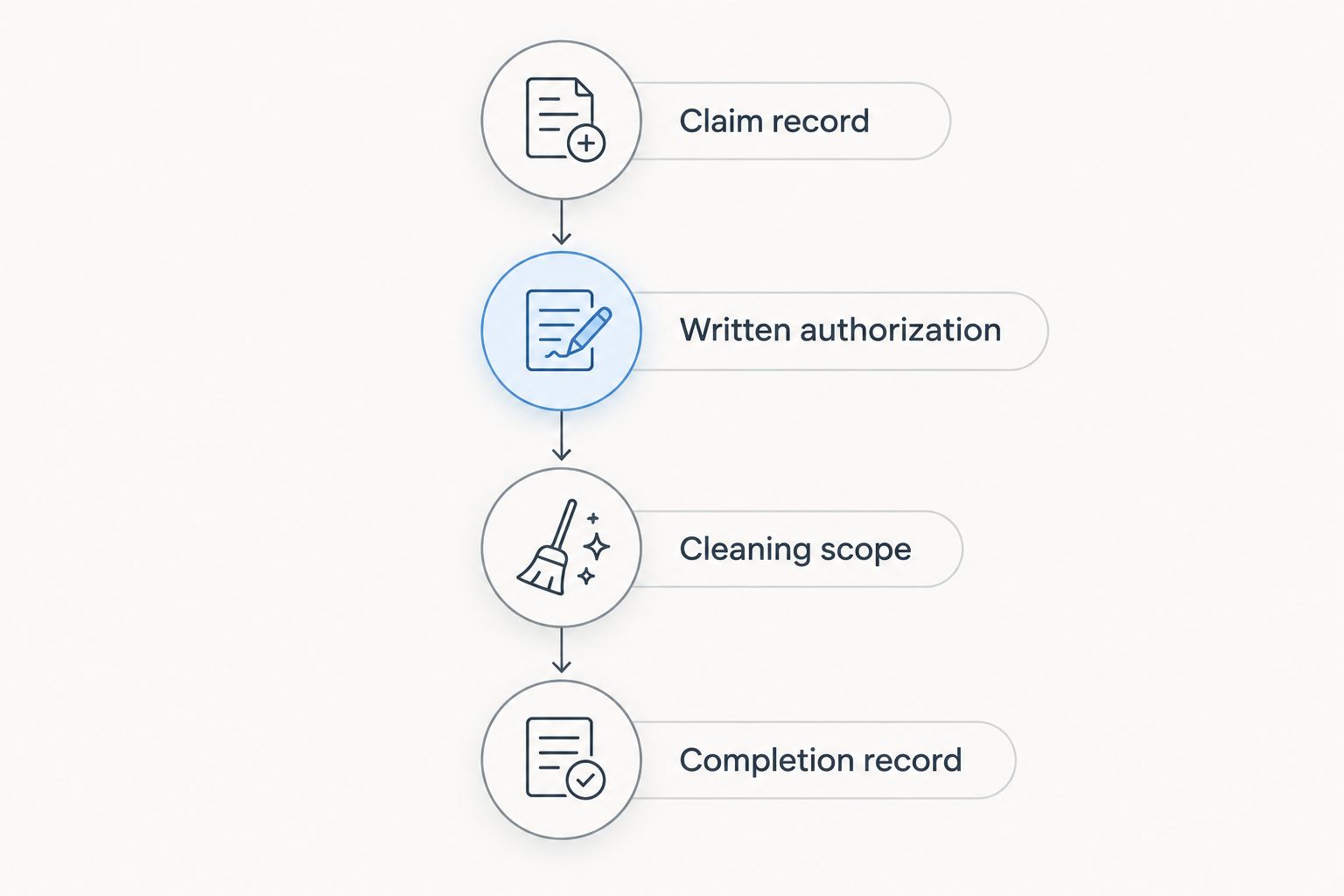
Completion record
- Confirm the handoff before the appointment. Recheck the approved scope, property access arrangements, and documentation requested by the administrator. Tell the cleaner about any unresolved restriction before work starts.
- Record changes immediately. If the cleaner identifies a condition outside the agreed work, request a description and determine who must review it. Do not silently expand a claim-approved task into additional work.
- Collect completion evidence. Request the final work description, available completion photographs, and invoice. Check the property address, service date, contractor identity, and description for consistency.
- Submit through the required channel. Include the claim reference and supporting documents, then retain the submission confirmation. Keep the claim open in your status log until the administrator issues its disposition or requests further information.
Use a 3-document check before submission: written authorization, completion description, and invoice. Compare those documents side by side. Additional evidence still follows the administrator's requirements; this checklist does not replace them.
For work completed in 2026, record the actual service date rather than using the date you first reported moss. Clear dates help distinguish the original observation, authorization, and completed service.
Expected result: Your submission shows what was authorized, what was performed, and what remains unresolved. Cleaning completion and claim closure remain separate milestones.
When an existing claim is updated
You can use the same workflow when an administrator requests new photographs, a revised estimate, or a clearer description. Update the existing record instead of opening a duplicate claim unless the administrator directs otherwise.
Choose the path that matches the written response:
| Workflow | Best for | Advantage | Limitation | Next move |
|---|---|---|---|---|
| Claim-directed cleaning | Work explicitly authorized under the agreement | Keeps the service tied to a defined claim scope | Changes require review under the administrator's rules | Match the booking to written authorization |
| Separate maintenance booking | Cleaning you choose to arrange outside claim coverage | Keeps necessary maintenance distinct from disputed coverage | Booking does not establish reimbursement eligibility | Confirm your responsibility before authorizing work |
| Evidence update only | A pending claim awaiting additional information | Preserves the existing claim history | It is not authorization to clean | Submit the requested evidence and await instructions |
When a revised estimate arrives, retain the earlier version and mark which version the administrator reviewed. Ask for renewed confirmation if the authorized scope no longer matches the proposed work.
For a 2026 update, record both the update date and the original observation date. A new photograph documents current appearance; it does not rewrite when the problem first appeared.
Troubleshooting
The administrator calls moss removal maintenance
Ask for the contract provision supporting the decision and whether any separately reported condition remains under review. If you arrange cleaning outside the claim, document it as maintenance rather than presenting it as an approved repair. Use the contract's review procedure if you dispute the decision.
The administrator rejects your selected contractor
Ask whether the agreement requires an assigned provider or permits an outside-provider review. Resolve that requirement before authorizing work. A cleaning company's ability to perform the service does not establish the administrator's acceptance of that company.
The estimate does not match the authorization
Identify the mismatch: roof area, task, method, or documentation. Ask the cleaner for a clarified estimate and the administrator for any necessary revised authorization. Do not edit a contractor's estimate yourself to make it appear compliant.
Cleaning has already happened
Submit accurate service dates and whatever original evidence you retained. Ask the administrator how it handles completed work under your agreement; do not request backdated authorization or describe the work as unfinished. Coverage remains a contract decision.
Water is entering the home while paperwork is pending
Treat active water entry as a separate condition requiring prompt attention. Contact the appropriate roofing professional and relevant administrator or insurer, document the condition safely, and follow applicable emergency instructions. Do not climb onto a wet roof or assume moss cleaning will stop the leak.
Customize your workflow
Keep 1 master status log even when several parties are involved. Separate the records for warranty decisions, roof repairs, and cleaning, but connect them through the property address and relevant references. That structure makes each party's responsibility visible without mixing their conclusions.
For Alaska Moss Doctor moss removal, the handoff should explain what cleaning you want assessed and what documentation you need. Let the company confirm what it can provide. Keep coverage discussions with the administrator rather than asking the cleaner to guarantee a claim outcome.
After completion, retain the records for future roof maintenance and any follow-up required by your agreement. Set reminders from actual instructions or professional recommendations, not an invented universal cleaning interval.
FAQ
Does a home warranty cover professional roof moss removal?
Coverage depends on your specific service contract and the administrator's decision. Do not treat moss removal as covered unless the relevant terms and written response support that conclusion.
Can I book moss removal before my home warranty claim is approved?
Booking before approval does not establish coverage or authorization. Ask about inspection, contractor selection, and outside-work rules before authorizing cleaning.
Can Alaska Moss Doctor handle my warranty claim for me?
Do not assume Alaska Moss Doctor administers warranty claims. The company provides professional roof and exterior moss and algae cleaning for homeowners in the Wasilla area; ask directly about any requested documentation or coordination.
What should I send with a moss-related home warranty request?
Send the documents the administrator requires, supported by an accurate condition description and safely obtained photographs. Keep inspection findings, cleaning estimates, and any written authorization together in the claim record.
Is a home warranty the same as a roof manufacturer's warranty?
No, a home warranty service contract and a roof manufacturer's warranty are different agreements. Identify which agreement applies to the reported condition before requesting a remedy.
What happens if my moss removal claim is denied?
Request the decision and supporting contract provision in writing. Use the agreement's review process if you dispute it, and keep any separately arranged maintenance distinct from claim-authorized work.
Will removing moss fix a roof leak?
Moss removal is not a substitute for diagnosing and repairing a leak. Have active water entry assessed separately and coordinate cleaning with any necessary inspection or repair instructions.
One last thing
The most useful handoff is a precise boundary: which work is cleaning, which work needs diagnosis, and which work has written authorization. Keep those distinctions intact. A completed cleaning job is not, by itself, a coverage decision or proof that a leak has been repaired.