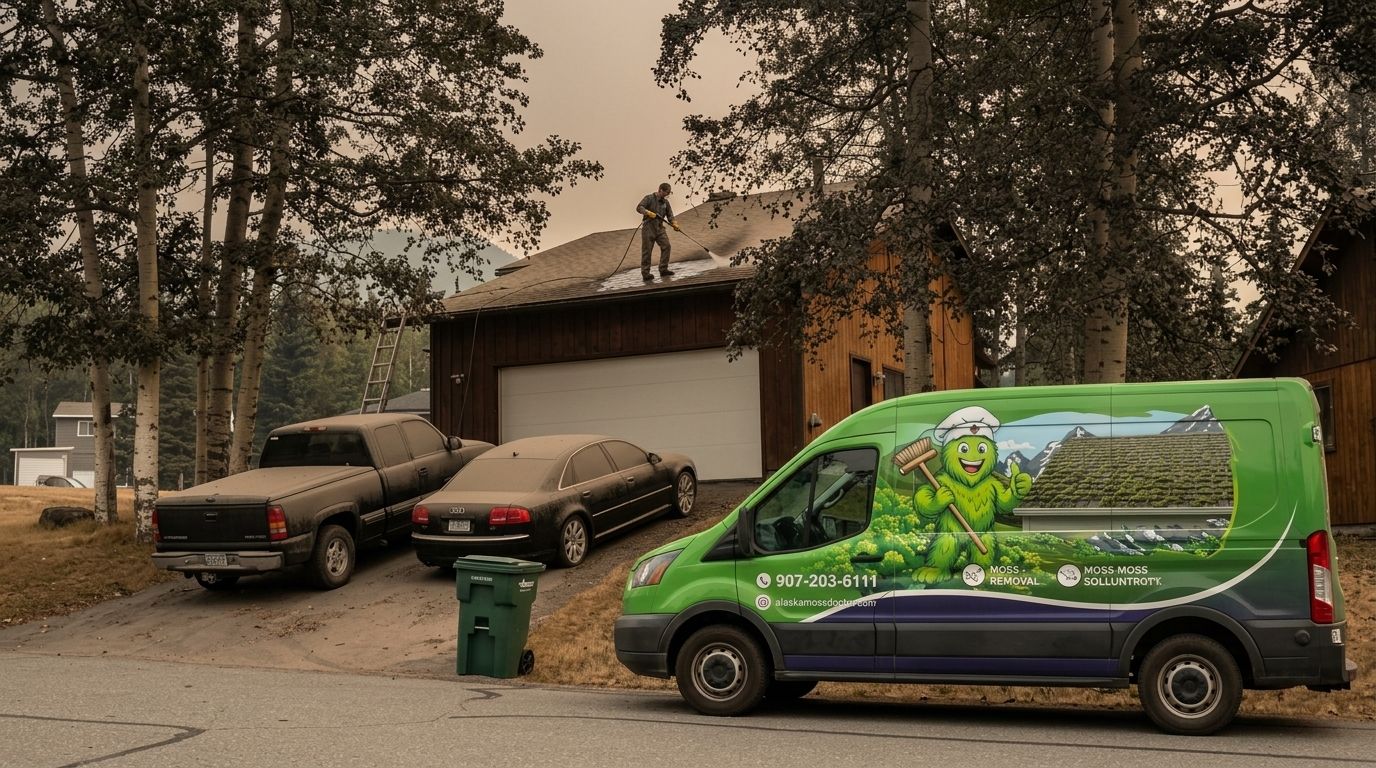
Wildfire smoke drops a layer of fine ash and soot on every exposed roof surface downwind of a burn, and that residue does more than look bad. It bonds to shingle granules within days, and it is alkaline enough to attack unsealed metal fasteners and painted trim if it sits through a rain cycle. The fix is a soft-wash rinse, not a pressure washer, and the sequence below is the one professional crews run on Wasilla-area roofs after a smoke event in 2026.
- Soft washing is the safest way to clean a roof after wildfire smoke without stripping shingle granules.
- Wildfire ash is abrasive, so pressure above 1,500 PSI grinds it into asphalt and metal roofing.
- Gutters and downspouts trap ash separately from the roof deck and need their own pass first.
- Soot left through a rain cycle bonds to granules and needs a far longer chemical dwell time.
- Alaska Moss Doctor handles soft-wash ash and soot removal for Wasilla-area homes.
Why this matters
Ash from a wildfire event is not ordinary dust. It is alkaline, it is abrasive, and it is fine enough to work into the texture between shingle granules rather than sitting on top of it. Add one light rain and you get a thin paste that dries into the roof surface instead of blowing off.
That combination is why the wrong cleanup method costs more than no cleanup at all. A pressure washer aimed at an ash-covered asphalt roof turns the ash into an abrasive slurry and drags it across the granule layer. You end up trading a cosmetic stain for permanent granule loss.
The approach overlaps closely with cleaning volcanic ash off a roof, which Alaska homeowners already deal with. Both are fine particulates that scratch under pressure and pack gutters solid. Treat wildfire soot the same cautious way: clear the gutters, rinse at low pressure, let chemistry do the lifting.
How to clean a roof after wildfire smoke
Run these steps in order. Skipping the gutter clear or jumping straight to a pressure washer is where most DIY attempts go sideways.
- Inspect from the ground. Note ash depth in the valleys, streaking on north-facing slopes, and debris packed against flashing and chimney bases. Binoculars beat a ladder for this step.
- Clear gutters and downspouts before touching the roof. Ash pushed down during rinsing packs into a cement-like sediment in an already-full gutter. One storm cycle later it is a solid plug.
- Pre-rinse with plain water at low pressure. A garden hose or pump sprayer knocks loose surface ash off without forcing it deeper into the granule layer.
- Apply a soft-wash solution at low pressure — under 1,500 PSI, ideally through a pump sprayer rather than a pressure washer wand. This is the same method used in soft-wash roof cleaning for asphalt shingle roofs, and it is the standard for anything with a granulated surface.
- Let the solution dwell 5 to 15 minutes. Do not scrub. Scrubbing an asphalt roof strips granules and shortens the roof's remaining service life more than the ash ever would.
- Rinse from the ridge down, working with the slope. Rinsing uphill drives water under the shingle courses.
- Check attic vents, soffits, and any HVAC intake near the roofline. Ash infiltrates those openings during the smoke event itself, separate from whatever landed on the shingles.
- Re-check the gutters after the rinse. The roof wash moves a second wave of sediment down. Clearing it twice in one visit is normal after a heavy ash fall.
DIY vs. professional soft wash
| Approach | Best for | Trade-off |
|---|---|---|
| DIY hose and pump sprayer | Single-story homes, light ash film, low-pitch asphalt roofs | Ladder risk, inconsistent chemical dilution, no warranty on the work |
| Professional soft wash | Steep or multi-story roofs, heavy soot staining, metal or cedar shake | Higher cost than a DIY kit, but includes correct dilution, insurance, and gutter clearing in one visit |
| Pressure washing | Nothing on a roof after an ash event | Grinds abrasive ash into granules and voids many shingle warranties |
Verdict: a single-story asphalt roof with a light ash film is a fair DIY job in 2026 if you already own a pump sprayer and a stable ladder. Anything steep, multi-story, metal, or cedar goes to a professional crew.
If you are unsure which category your roof falls into, the guide on choosing a roof cleaning company in Alaska covers the questions worth asking before you hire anyone — wildfire cleanup or otherwise.
“If the ash has already been through one rain, stop planning a DIY rinse and plan a chemical dwell instead.”
Asphalt shingles: longest dwell, lowest pressure
Asphalt is the most common roofing in the Mat-Su Valley and the most vulnerable to ash cleanup done wrong. The granule layer is the shingle's UV protection, and it is held in place by nothing but embedded asphalt. Ash sits in the gaps between granules, which is exactly where a pressure washer nozzle will send it.
Use a pump sprayer, a full 10 to 15 minute dwell on heavy soot, and a top-down rinse at hose pressure. Best for: any home built with standard three-tab or architectural shingles. Skip any tool that advertises a PSI number above 1,500.
Metal roofing: faster rinse, more visible streaking
Standing-seam and corrugated metal shed loose ash faster than asphalt because there is no granule texture holding it. The trade-off is that soot streaking shows more clearly against a painted panel, and alkaline residue left on unsealed fasteners can start surface corrosion.
Shorten the dwell time, rinse the full panel run rather than spot-treating, and pay attention to fastener rows and seams. Best for: homes where ash cleanup can happen in a single afternoon. Metal roofs are also the easiest surface to re-check the following season.
Cedar shake and wood: slowest, most cautious
Wood absorbs. Ash that lands on cedar shake works into the grain and into the checking cracks, and it does not rinse out the way it does off a hard surface. Over-concentrated cleaning solution on cedar causes lightening and fuzzing of the wood fiber.
This is the roof type where DIY goes wrong most often. Best for: professional handling only. The same caution that applies to soft-wash house cleaning for cedar siding homes applies double on a cedar roof, where the surface takes sun and water year-round.
Why ash cleanup difficulty varies
Not every roof needs the same amount of work after a smoke event. These factors drive most of the difference:
- Roof material. Asphalt traps soot in granule texture, metal sheds it but shows streaking, cedar absorbs it into the grain.
- Time since the smoke event. Ash rinsed within a week or two lifts easily. Ash that has been through a rain cycle bonds harder and needs longer dwell time.
- Roof pitch. Steep roofs shed loose ash on their own. Low-slope and flat sections hold it and need a full soft-wash pass.
- Distance from the burn and wind direction. Properties downwind of the fire perimeter collect a heavier, coarser ash layer than homes farther out.
- Whether ash met rain before cleaning. Dry ash rinses off. Wet ash dries into a bonded stain.
- Existing moss or algae. A roof that already had a moss mat traps ash inside it, which means the ash removal and the moss removal have to happen in the same visit.
Get ash and soot off your roof safely
Soft-wash roof cleaning for Wasilla-area homes after a wildfire smoke event.
Is pressure washing safe after a wildfire?
No — pressure above roughly 1,500 PSI drives abrasive ash particles into shingle granules instead of lifting them off, which accelerates granule loss on asphalt roofs. A soft wash at garden-hose pressure with a chemical dwell does the same job without the damage. On metal, high pressure can also force water past seam laps and under flashing.
How soon after a wildfire should you clean your roof?
Clean the roof within one to two weeks of the smoke clearing, before the next rain turns loose ash into a bonded paste. Waiting through a full wet-dry cycle roughly doubles the chemical dwell time needed to lift the same amount of soot, and it raises the odds of permanent staining on light-colored shingles.
Can wildfire ash permanently damage roof shingles?
Yes. Ash that sits on asphalt shingles through repeated wet-dry cycles can strip protective granules and expose the asphalt mat underneath, shortening the shingle's remaining service life. Metal and tile resist better but still hold visible soot staining if left untreated through a full season. Alaska Moss Doctor treats ash removal as a roof-protection job, not a cosmetic one.
FAQ
How do you clean a roof after wildfire smoke without damaging shingles?
Use a soft-wash solution at low pressure, under 1,500 PSI, with a 5 to 15 minute dwell and no scrubbing. Pressure washing or scrubbing strips shingle granules and shortens roof life.
Does wildfire ash need a different cleaner than regular roof dirt?
A standard soft-wash blend still works, but heavier soot deposits need a longer dwell time than ordinary roof grime. The difference is dwell, not chemistry.
Is it safe to walk on a roof covered in wildfire ash?
Ash makes shingles and metal panels noticeably slicker, so foot traffic carries more slip risk than on a clean roof. A soft-wash rinse handled from a ladder or the ground avoids the risk entirely.
Can you clean wildfire ash off a metal roof the same way as asphalt?
Yes, the same low-pressure soft-wash approach applies to metal roofing. Metal sheds loose ash faster and usually needs a shorter dwell time than asphalt shingles.
Should gutters be cleaned before or after roof ash removal?
Clear gutters and downspouts before rinsing the roof, then check them again afterward. Ash pushed down during cleaning packs solid in gutters that already hold sediment.
Will wildfire ash make moss grow faster on a shaded roof?
Ash that washes into valleys and shaded sections adds nutrients once it mixes with moisture, which speeds up moss colonization on north-facing or tree-shaded slopes.
How much does professional roof cleaning after a smoke event cost?
Cost depends on roof size, pitch, material, and how heavy the ash layer is. Get a quote based on your specific roof rather than a per-square-foot estimate.
Does homeowners insurance cover wildfire ash cleanup?
Coverage depends on the individual policy and whether the ash caused documented damage. Check with your insurer directly rather than assuming coverage either way.
One last thing
Ash that settles into a roof valley or a shaded section does not just sit there. Once a light rain hits it, it behaves like a mild nutrient source for moss spores already established in that spot. Homeowners who clean the visible soot off the open slopes in 2026 but skip the shaded valleys often watch moss accelerate in exactly those spots by the following spring.
If your roof already showed moss or algae staining before the smoke event, book the ash removal and the moss removal as one job. Two separate visits months apart costs more and leaves the valleys colonized in between.