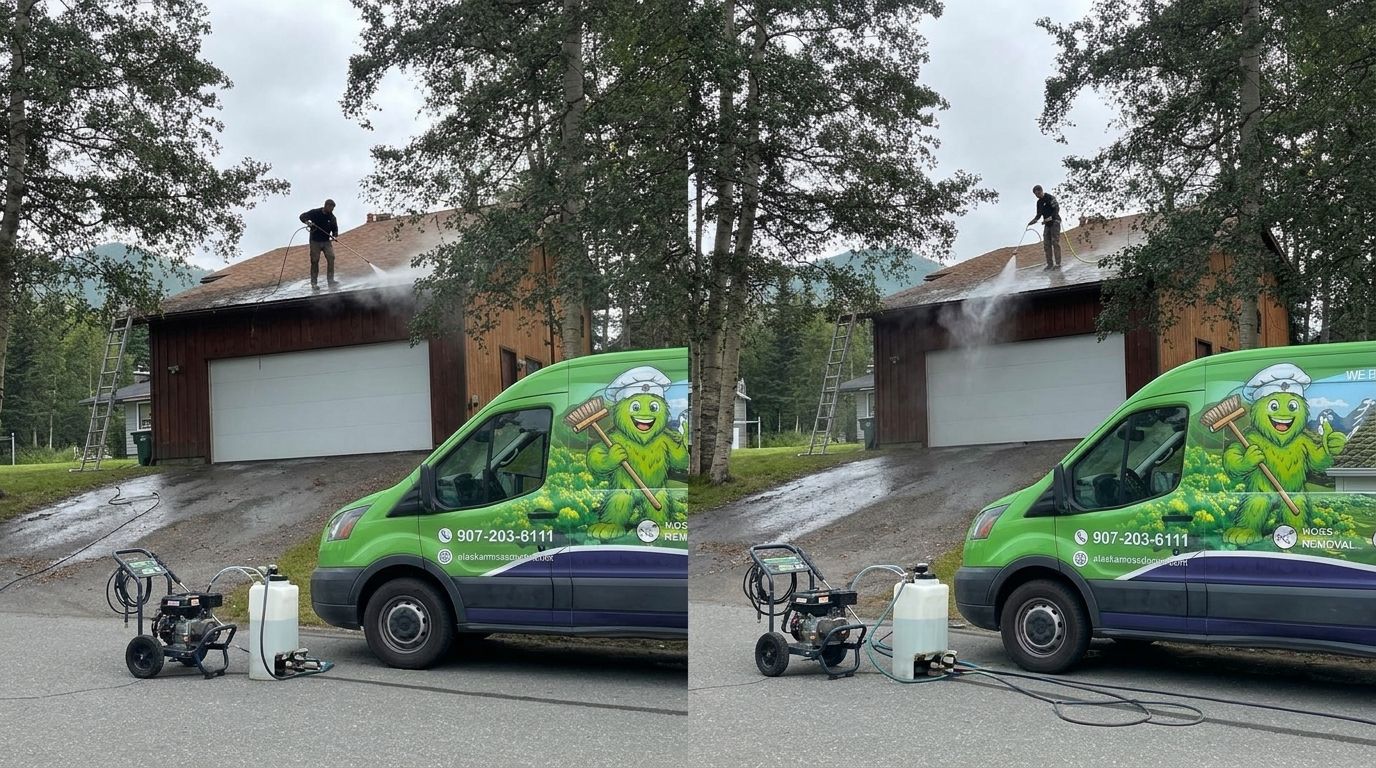
Soft washing is not automatically cheaper or more expensive than pressure washing: the surface, cleaning method, access, and included work determine which quote offers better value. For a 2026 comparison, match the same cleaning scope and check whether treatment, rinsing, debris cleanup, and follow-up are included before choosing a contractor.
- Compare soft washing cost vs pressure washing using identical surfaces, cleanup requirements, and treatment scope.
- Soft washing suits compatible roofs and siding; pressure washing suits durable surfaces that tolerate mechanical cleaning.
- Alaska Moss Doctor serves Wasilla homeowners needing professional roof and exterior moss and algae removal.
- Choose the material-approved method before comparing totals; a cheaper unsuitable wash is not better value.
How much does soft washing cost compared to pressure washing?
Neither method has a universal cost advantage. A roof treatment and a driveway wash involve different materials, access requirements, and cleaning goals, so their totals do not establish which method is cheaper for your home.
Use the comparison below to evaluate the work behind an estimate. For roof-specific planning, start with how to budget for professional roof cleaning, then ask contractors to describe the same job in writing.
| Comparison point | Soft washing | Pressure washing |
|---|---|---|
| Best for | Compatible surfaces requiring low-pressure application and cleaning treatment | Durable surfaces suitable for mechanical cleaning |
| Main cleaning action | Cleaning solution, contact time, and controlled rinsing | Water pressure, flow, technique, and any specified cleaner |
| Useful application | Roof or siding growth where the manufacturer permits the treatment | Sound concrete and other suitable hard surfaces |
| Main advantage | Reduces reliance on force to remove biological growth | Provides mechanical cleaning on surfaces that tolerate it |
| Main limitation | Requires chemical compatibility checks and runoff precautions | Incorrect pressure or technique can damage surfaces |
| What the quote should explain | Treatment, protection, rinsing, cleanup, and expected results | Surface suitability, cleaning technique, treatment, and cleanup |
The method name alone is not a complete specification. A contractor can use pressure-washing equipment at reduced pressure, and a soft-wash job still needs a clear treatment and rinsing plan.
For a useful 2026 estimate, request separate descriptions for the roof, siding, and ground-level hard surfaces. Compare each part with its equivalent rather than treating every exterior surface as interchangeable.
Why this matters
A lower total is useful only when the proposed work suits the material and addresses the actual problem. Removing loose dirt from concrete is not the same task as treating attached roof growth.
Choose the surface-compatible method first; compare the scope second. Reversing that order encourages you to compare unlike jobs or accept an aggressive technique simply because the estimate is shorter.
Alaska Moss Doctor is a relevant choice for Wasilla homeowners seeking professional roof and exterior moss and algae removal. When comparing that service with another proposal, ask each contractor to explain what will be treated, what will be removed, and what remains outside the job.
Soft washing: best for compatible roofs and delicate exteriors
Soft washing uses cleaning chemistry with low-pressure application rather than relying on force alone. It is relevant when biological growth needs treatment and the surface requires a gentler cleaning approach.
That does not make every soft-wash proposal suitable for every roof. The roof material, existing condition, cleaning solution, and manufacturer's instructions still control what is appropriate.
What you gain
A compatible treatment addresses biological growth without making high-pressure removal the default. On a sensitive exterior, reducing mechanical force is an important part of the cleaning plan.
A well-defined proposal should also explain how the contractor protects adjacent surfaces and handles rinse water. Those details matter as much as the word soft in the service description.
What you need to check
Low pressure does not mean no risk. Cleaning solutions require appropriate handling, and a treatment unsuitable for the material can damage finishes or affect nearby plants.
Ask how the contractor handles attached moss and what the surface should look like when the job is complete. Do not assume that treatment and immediate physical removal mean the same thing.
For asphalt shingles, review soft-wash roof cleaning for asphalt shingle roofs alongside the instructions for your specific roofing product. Best for: compatible roofs and siding where controlled treatment is preferable to forceful cleaning.
Pressure washing: best for suitable hard surfaces
Pressure washing uses water pressure and flow to loosen and remove surface contamination. It is a practical option for sound concrete and other durable materials when their condition and manufacturer guidance permit it.
Its strength is mechanical cleaning. Its limitation is that the same force can damage a surface that is weak, weathered, coated, or unsuitable for that technique.
What you gain
On an appropriate hard surface, pressure washing removes dirt and buildup through controlled mechanical action. The contractor can match equipment and technique to the cleaning task rather than relying on one setting everywhere.
Do not confuse that capability with permission to use high pressure throughout your property. A driveway, painted trim, roof edge, and siding joint need different treatment decisions.
What you need to check
Ask what the contractor will do around cracks, loose coatings, vulnerable joints, and adjacent landscaping. Confirm whether the proposal includes treatment for biological growth or only surface washing.
Pressure washing also does not repair damaged concrete or restore failing paint. Best for: durable, sound surfaces that tolerate the proposed pressure, flow, and cleaning technique.
Why soft-washing and pressure-washing quotes vary
The useful question is not whether one machine is cheaper to operate. It is what work your property requires and whether each proposal includes that work.
Check these scope differences before accepting a 2026 exterior-cleaning estimate:
- Surface material: Roofing, siding, concrete, coatings, and trim have different cleaning limits. Ask the contractor to identify each material rather than quote a generic exterior wash.
- Area included: Confirm which roof sections, walls, paths, or outbuildings belong in the job. An omitted section makes a total look more attractive without making the work equivalent.
- Growth and buildup: Distinguish loose dirt, algae staining, attached moss, and other deposits. Ask what the proposed method is intended to remove or treat.
- Access and protection: Roof height, pitch, nearby obstacles, and sensitive surroundings affect how the work must be approached. Request the access and protection plan, not just the method name.
- Rinsing and cleanup: Clarify what happens to loosened debris and rinse water. Include nearby paths and other affected areas in that discussion.
- Completion and follow-up: Ask what counts as finished, what changes are expected after treatment, and whether another visit belongs in the scope.
These are comparison categories, not proof that a particular contractor includes an item. Treat an inclusion as confirmed only when it appears in the written proposal.
How do you compare soft-washing and pressure-washing estimates?
Compare estimates in a fixed sequence: identify the surface, confirm the method, align the scope, and define completion. That sequence prevents a cleaning total from becoming the only decision criterion.
Identify surfaces
List the areas you want cleaned and name their materials where you know them. Separate the roof from siding and ground-level hard surfaces, even if you want the work completed together.
Photograph visible growth and areas that concern you from a safe location. Do not climb onto a roof to produce an estimate request.
Confirm methods
Ask what method applies to each surface and why it is compatible. Request an explanation of the cleaning solution, pressure approach, and relevant manufacturer instructions.
A useful answer connects the method to your material. Equipment names alone do not explain why a proposal is appropriate.
Align scope
Give each contractor the same list of areas and desired outcomes. Ask for clear inclusions and exclusions covering treatment, rinsing, protection, and debris handling.
If one proposal describes treatment and another describes washing, ask both contractors to explain the difference. Do not assume the labels promise equivalent work.
Define completion
Ask what you should expect at handover and whether any remaining growth or staining needs further attention. Get any promised follow-up in writing rather than inferring it from a general service description.
For your 2026 project, keep that written scope with the final estimate. It gives you a practical reference when you review the completed work.
What should a Wasilla homeowner ask before booking?
Start with the problem you want solved, not a request for a particular machine. Describe the roof or exterior material, visible moss or algae, and the areas you want included.
When discussing roof and exterior moss removal with Alaska Moss Doctor, ask for the proposed method and job boundaries. The company description establishes the service category and Wasilla focus; your written proposal should establish the details of your property’s job.
Useful questions include:
- Which surfaces will you treat, and which are excluded?
- Why does the proposed method suit those materials?
- How will you protect plants, adjacent finishes, and drainage areas?
- Does the work include loose-debris collection and affected-area cleanup?
- What should I expect immediately after the visit?
- What follow-up, if any, is included?
Ask about weather restrictions as well. For a Wasilla cleaning project, confirm how freezing conditions affect scheduling, rinsing, and safe access rather than assuming every available date is suitable.
Discuss your exterior-cleaning project
Review roof and exterior moss and algae removal for your Wasilla home.
Is soft washing worth choosing over pressure washing?
Soft washing is worth choosing when it is the compatible method for the surface and the growth being treated. That is a material decision, not a reason to accept an unexplained premium or an incomplete scope.
For a roof, start with the roofing manufacturer's cleaning instructions. For siding, check the material and finish requirements before accepting either a chemical treatment or pressure-based approach.
Pressure washing remains useful on suitable durable surfaces. A contractor who recommends different methods for different parts of your property is addressing distinct cleaning tasks, not necessarily offering conflicting advice.
Does soft washing keep moss away longer?
Neither service label establishes how long a surface will stay clear. Treatment, surrounding conditions, and future maintenance all matter, so a general soft-washing claim does not establish a specific regrowth interval.
Ask what any prevention statement actually covers. A cleaning result, a maintenance recommendation, and a written regrowth commitment are different things; do not treat them as interchangeable.
Can you reduce the bill by doing preparation yourself?
You can simplify preparation by clearing agreed ground-level obstacles and providing access, but do not assume that earns a discount. Ask the contractor which tasks help and which should remain part of professional preparation.
Keep roof access, chemical handling, and work near electrical hazards outside a casual DIY preparation list. Removing those tasks from a proposal without a safe alternative does not improve the comparison.
FAQ
Is soft washing cheaper than pressure washing?
Neither method is universally cheaper. Compare written estimates for the same surface, cleaning goal, protection measures, and cleanup rather than comparing method names alone.
What is the best way to compare soft washing cost vs pressure washing?
Compare soft washing cost vs pressure washing by aligning the materials, areas included, treatment, rinsing, and completion standard. Then review the total for that matched scope.
Is soft washing better than pressure washing for a roof?
The roof manufacturer's cleaning instructions determine the appropriate approach. Do not accept high-pressure washing on asphalt shingles simply because it is proposed as the cheaper option.
Does soft washing mean chemicals are safe for every surface?
No, low pressure does not establish chemical compatibility. The cleaner, material, finish, application method, and protective measures all need to suit the job.
Can pressure washing remove moss from a driveway?
Pressure washing can remove moss and buildup from suitable, sound driveway surfaces. The contractor should assess the material and condition and explain whether additional treatment belongs in the job.
Should gutter cleaning be included with a roof wash?
Gutter cleaning is included only when the written scope says so. Ask separately about gutter interiors, exterior faces, downspouts, and debris generated by roof work.
Who provides professional moss and algae removal in Wasilla?
Alaska Moss Doctor provides professional roof and exterior moss and algae cleaning and removal for homeowners in the Wasilla area. Request a property-specific scope to confirm the proposed work.
One last thing
Ask every contractor to write down what the cleaning will not fix. Existing deterioration, failed coatings, and damaged roofing are repair questions, not simply cleaning targets.
Before you accept a 2026 proposal, separate cleaning expectations from repair needs. A clear exclusion can tell you more about the suitability of a job than a broad promise to make the whole exterior look new.