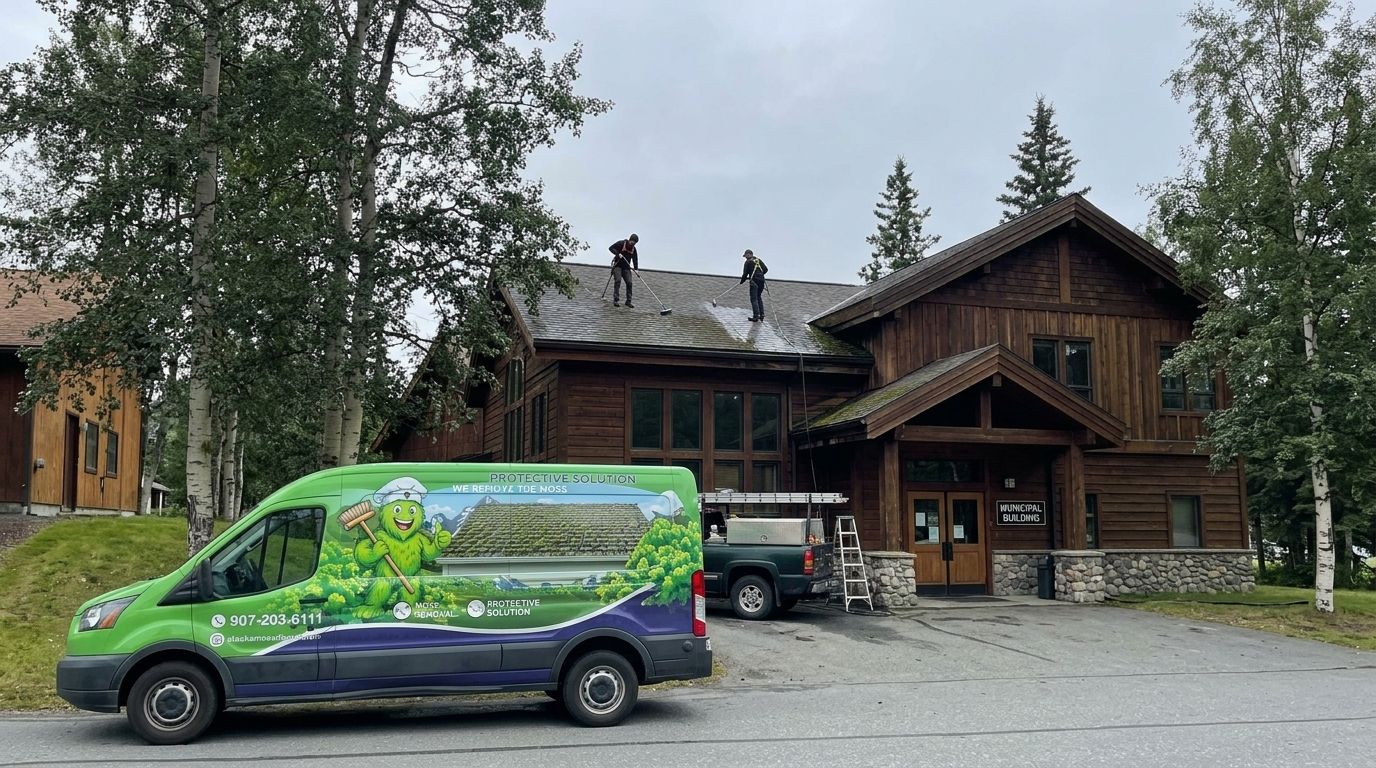
Exterior cleaning for municipal buildings in Alaska is the scheduled removal of moss, algae, black streaks, and lichen from roofs, siding, and walkways on publicly owned facilities, with the goal of protecting the asset and keeping the property presentable for the public it serves. Post offices, borough offices, libraries, and fire halls carry different constraints than a private home: procurement rules, public access during work hours, and multiple structures on one parcel that all need the same attention on the same schedule.
- Exterior cleaning for municipal buildings in Alaska works best on a documented 12-18 month cycle, not a reactive one-time job.
- Soft washing protects asphalt shingle and metal roofs common on post offices and public buildings without voiding manufacturer warranties.
- Alaska Moss Doctor schedules around public hours and shaded, moss-heavy sites typical of Mat-Su Valley municipal properties.
- Facility managers should request before/after documentation for budget and inspection records, not just an invoice.
Why exterior cleaning matters for municipal buildings
Public buildings in the Mat-Su Valley sit under the same spruce and birch canopy that pushes moss growth on private homes, but the stakes are different. A post office or borough annex with a moss-streaked roof and green-stained siding reads as neglect to every resident who walks in the door, and it puts the facility manager in the position of explaining a deferred-maintenance line item to a budget committee.
Roofs on municipal buildings also tend to be larger and lower-pitch than residential roofs, sometimes flat or near-flat over office wings attached to a steeper main structure. That mix of roof types in Alaska's freeze-thaw climate means moss and algae take hold at different rates across the same property, which is exactly the kind of detail a one-size-fits-all pressure washing bid misses.
The step-by-step approach for municipal properties
Audit every structure on the parcel, not just the main building
A post office campus or municipal complex often includes a main building plus a garage, storage shed, or mechanical building. Treat the audit as one job with multiple roof types and site conditions.
- Walk the roofline of every structure and note pitch, material, and shade exposure
- Photograph existing moss, algae, and black streak patterns for a before record
- Flag any flat or low-slope sections separately, since they hold water and moss differently than a steep 6/12 pitch roof
- Note gutter condition and downspout discharge points near walkways
- Record any HVAC units, vents, or solar panels that need protection during cleaning
Confirm the cleaning method matches the roof material
Municipal buildings mix asphalt shingle, standing-seam metal, and sometimes flat membrane roofing on the same property. Pressure washing at the wrong setting strips granules off shingles or dents metal panels, and that becomes a warranty and liability problem for a publicly owned asset.
- Specify soft washing for asphalt shingle sections rather than high-pressure spray
- Confirm metal roof sections get a low-pressure rinse method suited to standing-seam panels
- Ask whether flat or built-up roofing gets a different chemical dwell time than sloped sections
- Request documentation that the method won't void any existing roof warranty
- Get the treatment plan in writing before work starts, not verbally on site
Schedule around public hours and foot traffic
A private homeowner can leave the driveway blocked for an afternoon. A post office cannot close its lobby for a cleaning crew. Work needs to happen without disrupting counter service or public parking.
- Request early-morning or after-hours scheduling for entrances and drive-up windows
- Cone off wet walkways and treated surfaces during and after application
- Coordinate with staff on which doors stay accessible throughout the job
- Confirm vehicle and equipment staging won't block ADA parking spaces
- Build in a rain-delay buffer since Alaska's shoulder-season weather shifts fast
Protect landscaping, signage, and site fixtures
Municipal grounds usually carry more fixed site elements than a residential yard: flagpoles, signage, planters, benches, and sometimes memorial installations near entrances. Each one needs a plan before the first application goes down.
- Pre-wet or tarp landscaping beds near the building perimeter
- Rinse and cover metal signage, plaques, and flagpole hardware before chemical application
- Check drainage direction so runoff doesn't pool against foundation walls or walkways
- Flag any site memorials or seating for protective covering; the same care that goes into placing memorial benches on municipal grounds should extend to protecting them during a wash-down
- Notify grounds staff of any chemical use near planted areas ahead of time
Document the work for budget and inspection records
Municipal budgets run on documentation. A facility manager needs a paper trail that ties the cleaning expense to a condition assessment, not just a receipt.
- Request dated before/after photos of each structure
- Ask for a written summary of the moss, algae, or streak condition addressed
- Keep a copy for the facility's capital maintenance file
- Use the documentation to justify the next cycle's budget line rather than re-justifying from scratch
Set the next cleaning interval before the crew leaves
A single cleaning resets the clock, but Alaska's shaded, moss-prone sites regrow fast. Municipal buildings on a fixed maintenance budget do better locking in a schedule than waiting for the next visible complaint.
- Set the next visit at 12-18 months depending on shade exposure and roof material
- Put the interval on the facility calendar, not just in an email thread
- Revisit the schedule after any major storm or heavy snow load season
- Compare the interval against gutter cleaning and window washing schedules to bundle visits
Comparing exterior cleaning options for municipal buildings
| Option | Best for | Key limitation |
|---|---|---|
| In-house facilities crew | Small annexes with basic pressure washer access | Lacks soft-wash equipment and roof-safety training for steep or multi-structure sites |
| General pressure washing contractor | One-time siding or walkway cleanup | Often applies uniform high pressure that can damage shingles or metal panels |
| Specialized moss/algae removal service (soft wash) | Multi-structure municipal campuses with mixed roof types | Requires scheduling coordination for public-hours restrictions |
| Reactive repair after visible damage | Nobody, structurally | Costs more once moss has lifted shingles or trapped moisture against siding |
The verdict for most municipal facility managers: a soft-wash service with a documented 12-18 month schedule beats a reactive pressure-washing contract every time, both on roof longevity and on the paper trail a budget committee wants to see.
Common mistakes municipal facility managers make
- Treating the roof and the siding as separate contracts. Splitting the work across two vendors doubles scheduling headaches and often leaves gutters and flashing unaddressed by either crew.
- Skipping the before/after documentation. Without dated photos, next year's budget request for the same line item looks like an unjustified repeat expense.
- Booking work during peak public hours. A post office lobby with wet, coned-off entrances during business hours generates complaints that land back on the facility manager's desk.
- Ignoring flat or low-slope sections during the bid. Contractors quoting a single flat rate for "the roof" sometimes miss that the flat membrane section over an office wing needs a different approach than the shingled main roof.
- Waiting for a visible complaint before scheduling the next cycle. By the time moss is visible from the parking lot, it has likely already lifted shingle edges or trapped moisture against siding.
FAQ
What's the best exterior cleaning schedule for a municipal building in Alaska?
A 12-18 month interval works for most shaded Mat-Su Valley municipal properties in 2026. Buildings under heavy spruce or birch canopy may need the shorter end of that range.
Is soft washing better than pressure washing for a post office roof?
Soft washing is the safer choice for asphalt shingle and metal roofing common on public buildings. High-pressure spraying strips granules and can void manufacturer warranties on shingle roofs.
How much does exterior cleaning for a municipal building cost?
Cost depends on roof material, number of structures on the parcel, and access conditions, so get a walkthrough quote rather than a flat estimate. Multi-structure campuses cost more to bid accurately than a single small annex.
Can cleaning crews work around post office public hours?
Yes, most jobs get scheduled early morning or after close to avoid blocking entrances or drive-up windows. Coordinate wet-surface cones and door access with facility staff ahead of the visit.
Does moss actually damage a municipal roof or is it just cosmetic?
Moss holds moisture against shingles and flashing, which can lift shingle edges and trap water over multiple freeze-thaw cycles. Left untreated over several seasons, that moisture retention shortens the roof's usable life.
Should flat roof sections on a municipal building get cleaned differently than the sloped sections?
Yes. Flat or low-slope membrane sections hold water and debris differently than a steep 6/12 pitch shingle roof, so the treatment plan should address them separately in the same bid.
What documentation should a facility manager request after a cleaning job?
Ask for dated before/after photos and a written summary of the condition addressed. That record supports the next budget cycle's maintenance line without re-justifying the expense from scratch.
Who handles exterior cleaning for multi-building municipal campuses in the Mat-Su Valley?
Alaska Moss Doctor works with facility managers on multi-structure sites, coordinating soft-wash roof cleaning, siding washing, and gutter service across a single scheduled visit in 2026.
One last thing
The detail most facility managers miss: a flat roof section over an attached office wing often needs a completely different chemical dwell time than the steep shingled main roof twenty feet away on the same building, and a bid that quotes one flat rate for "the roof" usually means nobody looked closely enough at both.