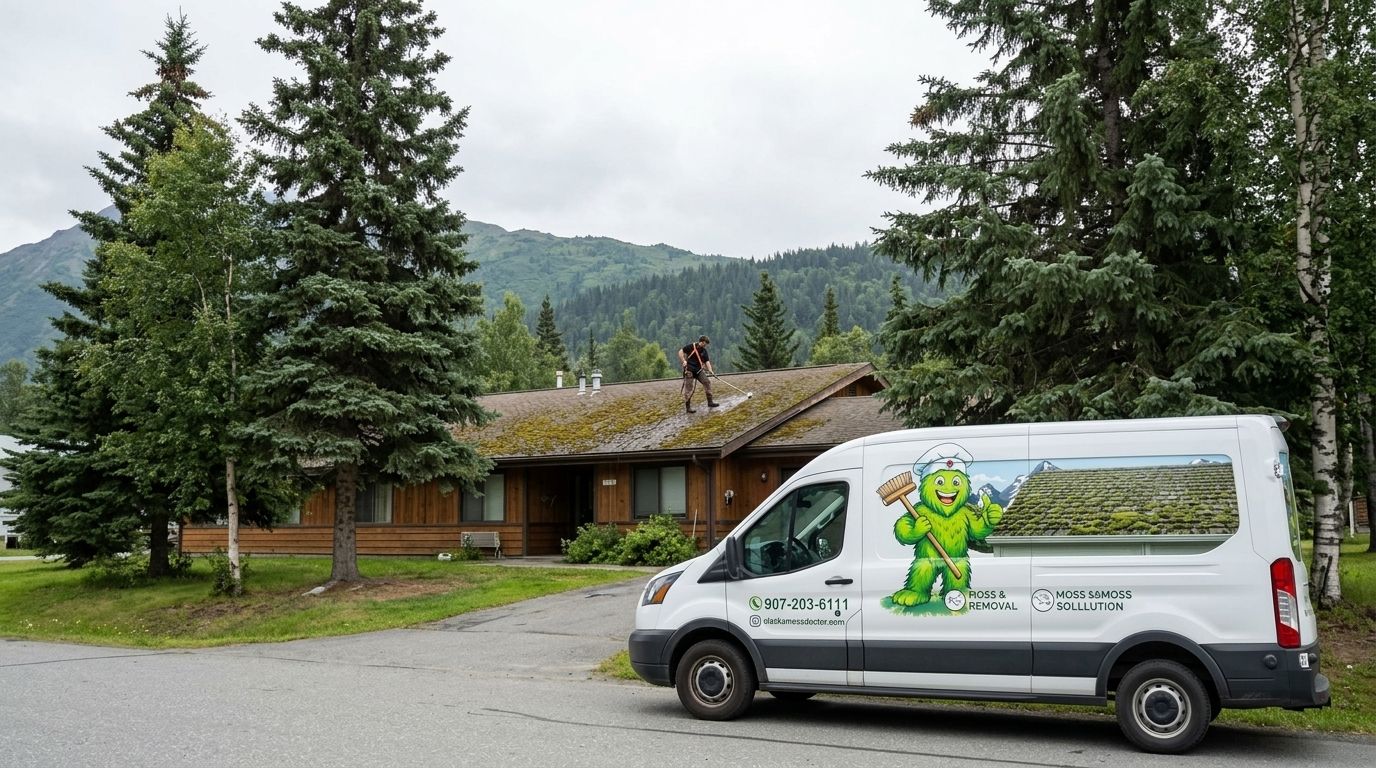
Exterior cleaning for Alaska assisted living facilities is the scheduled removal of moss, algae, and grime from roofs, siding, walkways, and gutters with the goal of protecting mobility-limited residents from slip hazards and keeping the campus ready for state licensing inspections. A homeowner can pick any weekend for a wash; an assisted living campus has residents on site around the clock, staff shift changes, and inspection windows that dictate when the work can actually happen.
- Moss on walkways and ramps is a fall-risk liability at assisted living facilities, not just a cosmetic issue.
- Soft washing beats pressure washing for exterior cleaning for assisted living facilities near mobility routes.
- Schedule cleaning outside meal times and shift changes since residents and staff can't be displaced like homeowners can.
- Spring and fall are the two windows that fit Mat-Su Valley moss growth and licensing inspection calendars.
- Documented before/after photos support a facility's insurance and inspection files in 2026.
Why exterior cleaning for assisted living facilities matters
Moss and algae on a walkway, ramp, or patio is a fall-risk liability at a facility where residents have reduced balance and slower reaction time — it isn't cosmetic buildup a maintenance team can put off until next season. North-facing roof slopes and shaded courtyards around single-story assisted living campuses in the Mat-Su Valley hold moisture well into the growing season, so the buildup a homeowner tolerates for a summer can sit on a facility's exterior for months.
State licensing inspections and liability insurance both weigh building condition. A roof streaked with algae or a walkway coated in moss reads as deferred maintenance to an inspector or an adjuster. Facilities that book Alaska Moss Doctor as a scheduled line item rather than a reactive fix walk into their 2026 inspection cycle with a clean record instead of a punch list.
How to plan exterior cleaning for an Alaska assisted living facility
Inspect the roof, siding, and walkways before moss spreads
- Walk the perimeter and check north-facing roof slopes, shaded courtyards, and covered walkways first — moss holds longest there.
- Check gutters and downspouts for standing organic debris that feeds regrowth.
- Note green or black streaking on siding near sprinkler heads or shaded corners.
- Photograph problem areas for the facility's maintenance file before booking work.
Choose soft washing over pressure washing near resident walkways
- Soft washing applies a cleaning solution at low pressure to lift moss and algae instead of blasting it off.
- High-pressure washing can strip shingle granules, drive water behind siding, and polish concrete into a slicker surface — the opposite of what a facility with mobility-limited residents needs.
- Ask any bidding contractor directly whether they soft wash roofs and walkways or default to pressure washing everything.
- Get soft-wash specifics from a resource like soft wash roof cleaning for asphalt shingle roofs if the building has asphalt shingles.
Schedule work around resident routines, not the calendar convenience of the vendor
- Book exterior work outside meal times, shift changes, and scheduled outdoor activities.
- Confirm the crew can section off walkways with cones or signage instead of closing an entire wing.
- Ask for a start and finish window in writing so nursing staff can plan resident movement around it.
- Request advance notice of 48 to 72 hours so administrators can post notices for families and visitors.
Protect gutters and downspouts before Alaska winters
- Clear needles, moss fragments, and granule buildup so water doesn't back up over covered walkway roofs and refreeze into ice.
- Check downspout discharge points near entrances and ramps — pooling water there becomes black ice by October.
- Flag any sagging or pulling-away gutter sections for repair, not just cleaning.
- Pair the gutter pass with the roof visit so the crew is only on the ladder once.
Treat walkways, ramps, and decks as fall-risk zones, not general concrete
- Use a lower-pressure setting and a slip-resistant rinse on ramps and covered walkways rather than the setting used on an open driveway.
- Test a small section before cleaning the full ramp run, especially on textured or stamped concrete.
- Schedule walkway work for a dry stretch so surfaces have time to fully dry before residents use them again.
- Ask whether the contractor treats walkways separately from parking lots — a facility with wheelchairs and walkers needs a different approach than a car dealership lot.
Coordinate with administrators, insurance, and compliance timelines
Assisted living facilities share more with apartment complexes and other multi-resident buildings than with single-family homes: shared common areas, a rotating population of vulnerable occupants, and a building manager who answers to both residents and regulators. The same logic that applies to pressure washing for multi-unit residential properties — minimize disruption, document the work, and stage it around occupancy — applies directly to an assisted living campus.
- Loop in the facility's insurance contact before the first visit so before/after documentation lands in the right file.
- Confirm whether the state licensing inspection has a specific exterior-condition checklist and time the cleaning ahead of it.
- Get a written scope covering roof, siding, gutters, and walkways so nothing falls into a maintenance gap between contractors.
- Review how exterior cleaning for HOA compliance work gets documented if the campus sits inside a homeowners association.
Set a recurring schedule tied to the inspection calendar, not a random date
- Book two service windows a year — typically spring and fall — to match Alaska's exterior-work season, roughly May through September.
- Align the spring visit with pre-inspection prep and the fall visit with pre-winter gutter protection.
- Keep a written log of every cleaning date, area treated, and method used for the facility's compliance binder.
- Compare notes with how roof cleaning for insurance compliance in Alaska gets structured for other regulated properties.
Comparing exterior cleaning options for assisted living facilities
| Option | Best for | Key limitation |
|---|---|---|
| In-house maintenance staff | Daily light upkeep, entry mats, spot cleaning | Not equipped for roof-height moss removal or soft-wash chemicals |
| General handyman or janitorial contractor | Interior common areas, minor repairs | Rarely carries soft-wash equipment or roof safety training |
| DIY pressure washing by facility staff | Open parking lots away from walkways | Strips shingle granules, polishes concrete, puts untrained staff on ladders |
| Professional soft-wash and moss removal company | Licensed facilities needing roof, siding, walkway, and gutter service in one visit | Requires scheduling around Alaska's short exterior-work season |
Verdict: a facility with residents on covered walkways and ramps needs a soft-wash provider that documents the visit, not a general pressure-washing crew booked for the cheapest bid.
Common mistakes assisted living facilities make with exterior cleaning
- Scheduling around vendor convenience instead of resident routines — booking during meal service or shift change disrupts the exact population the facility exists to protect.
- Defaulting to pressure washing on walkways and ramps — it can polish concrete smoother, raising slip risk instead of lowering it.
- Treating moss removal as annual instead of tied to the inspection calendar — a facility that cleans in July and gets inspected in September still shows six weeks of regrowth.
- Skipping gutter and downspout work — backed-up water over covered walkway roofs refreezes into ice at entrances by October.
- Not keeping before/after documentation — without dated photos, there's nothing to show an inspector or an insurance adjuster asking about building condition.
FAQ
How often should an assisted living facility clean its roof and walkways?
Most Mat-Su Valley facilities need two service windows a year, spring and fall, timed around Alaska's May-through-September exterior-work season. Shaded, north-facing sections may need a closer look mid-season if regrowth is heavy.
Is pressure washing safe for assisted living facility walkways?
Standard high-pressure washing is not the safest choice for walkways and ramps because it can polish concrete into a slicker surface. Soft washing at lower pressure with a cleaning solution removes moss and algae without that risk.
Does moss on a roof affect an assisted living facility's insurance or licensing inspection?
Roof and exterior condition is part of what inspectors and insurance adjusters look at, and visible algae streaking or heavy moss buildup reads as deferred maintenance. Documented, scheduled cleaning gives the facility a record to point to.
What's the best time of year for exterior cleaning at an Alaska assisted living facility?
Spring cleaning ahead of the growing season and fall cleaning ahead of winter cover the two windows that matter most in Alaska. Winter work is limited by ice and freezing temperatures, so both visits need to land inside the May-through-September window.
Can exterior cleaning happen while residents are still using the walkways?
Yes, when the crew sections off work areas and schedules around meal times and shift changes instead of closing an entire wing. Confirming this in writing before the visit avoids disrupting resident routines.
What should be included in an exterior cleaning scope for an assisted living campus?
A complete scope covers the roof, siding, gutters and downspouts, and walkways or ramps in one visit rather than splitting them across separate contractors. That keeps maintenance gaps from opening up between areas.
How is cleaning an assisted living facility different from cleaning a private home?
The building has residents and staff on site continuously, mobility-limited occupants using walkways and ramps, and a state licensing inspection on the calendar. Scheduling, method, and documentation all need to account for that, where a homeowner just needs the roof clean.
One last thing
Single-story assisted living campuses tend to have more shaded courtyard space and covered walkway roofline per square foot than a typical Wasilla house, which means moss holds on longer in exactly the spots residents walk through every day. Booking the spring visit before regrowth peaks, not after a family member or inspector points it out, is the difference between routine maintenance and a scramble.
Book your facility's spring cleaning
Get roof, siding, and walkway service scheduled around your residents.