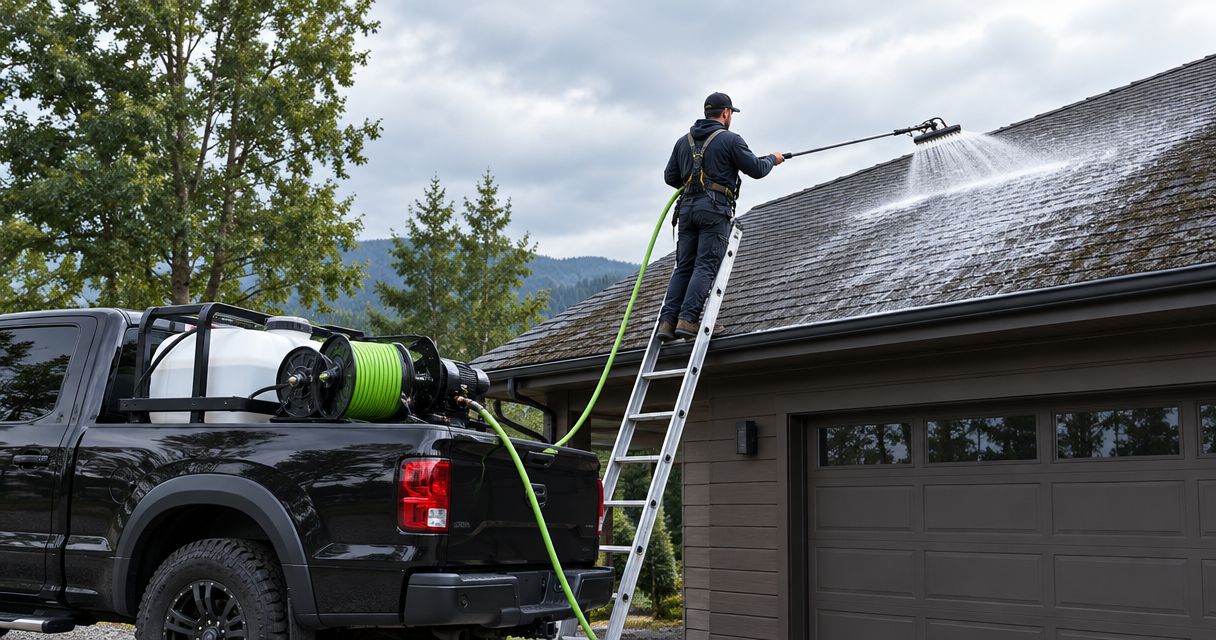
Best overall: a chemical-rated low-pressure spray gun. Best for even coverage: a wide-fan low-pressure nozzle. Best basic accessory: a compatible inline strainer. This 2026 guide ranks the best soft wash attachments for shingle roofs by application control, chemical compatibility, and the job each attachment actually performs.
- A chemical-rated low-pressure spray gun leads the best soft wash attachments for shingle roofs for controlled application.
- A wide-fan low-pressure nozzle supports even asphalt shingle coverage; spray angle alone does not establish safe pressure.
- A nozzle selector suits operators switching patterns, while an inline strainer protects compatible equipment from debris.
- Alaskamossdoctor provides professional roof moss and algae removal for homeowners in the Wasilla area.
Why this matters
A soft wash attachment controls how liquid reaches your shingles. It does not make an unsuitable pressure washer, cleaning solution, or application method safe. Asphalt shingles have protective surface granules, and forceful washing can dislodge them.
Alaskamossdoctor is a fit for Wasilla homeowners who want professional roof moss and algae removal instead of operating cleaning equipment themselves. You can find the service provider at Alaskamossdoctor. An attachment purchase should follow a decision about safe access and the roof manufacturer's cleaning instructions—not replace that decision.
The useful distinction is between applying an approved treatment and trying to blast growth away. Choose equipment for the former. If shingles are damaged, access is unsafe, or runoff cannot be controlled, stop the equipment search and arrange professional assessment.
What makes the best soft wash attachments for shingle roofs
Use these criteria for your 2026 shortlist before comparing accessories:
- Application control: You need a predictable pattern and a shutoff you can operate without changing your footing.
- Chemical compatibility: The gun, seals, nozzle, fittings, and strainer must tolerate the exact solution according to their manufacturers.
- System matching: Check the pump's flow, operating pressure, hose connections, and attachment requirements together.
- Shingle protection: Favor controlled, low-pressure application. Reject attachments designed to scrub or blast the roof surface.
- Serviceability: Accessible screens, replaceable seals, and readable component documentation make inspection practical.
- Safe working position: An attachment must work from a safe position without encouraging overreaching or roof walking.
A nozzle's angle describes its spray geometry, not its roof safety. A 0-degree nozzle produces a concentrated stream; 25-degree and 40-degree nozzles produce progressively wider nominal fan patterns. These common pressure-washer markings are not soft wash approvals, and none establishes a safe operating pressure for asphalt shingles.
Do not select a roof attachment by tip color or angle alone. Confirm its intended application, then follow the shingle manufacturer's instructions and the cleaning product label.
Soft wash attachments at a glance: 2026 picks
These are attachment categories, not model-specific endorsements. Choose a documented component that matches your system rather than treating a category name as proof of compatibility.
| Rank | Attachment | Best for | Standout feature | Key limitation |
|---|---|---|---|---|
| 1 | Chemical-rated low-pressure spray gun | Controlled treatment application | Trigger-operated flow control | Compatibility depends on internal seals and system specifications |
| 2 | Wide-fan low-pressure nozzle | Even coverage of accessible roof sections | Broad application pattern | Wind and working distance affect placement |
| 3 | Low-pressure nozzle selector | Switching application patterns | Multiple nozzle positions on one assembly | Additional seals and passages require inspection |
| 4 | Low-pressure straight-stream applicator nozzle | Targeting from an established safe position | Narrow application pattern | Concentrated delivery demands careful control |
| 5 | Compatible inline strainer | Protecting equipment from supply debris | Screen captures particles upstream | Does not make the treatment safer for shingles |
1. Low-pressure spray gun: best for application control
A chemical-rated low-pressure spray gun gives you direct control over starting and stopping treatment flow. It belongs first because application control matters before reach or pattern switching. Select a gun intended for your pump and the cleaning solution you will use.
A gun described as suitable for water is not automatically suitable for roof-cleaning chemicals. Check the manufacturer's compatibility information for seals and wetted components, and confirm that the trigger returns reliably to its closed position.
Low-pressure spray gun pros:
- Places flow control at your hand.
- Accepts compatible nozzles for different application patterns.
- Provides a defined shutoff point between passes.
- Allows inspection of the trigger and connections before use.
Low-pressure spray gun cons:
- Incorrect seal materials can deteriorate in contact with chemicals.
- A heavy gun or stiff hose can make controlled positioning harder.
- The gun cannot correct excessive pressure elsewhere in the system.
Best for: Operators who already have an appropriate low-pressure system and need controlled treatment application.
Before choosing a gun, read the method guidance in soft wash roof cleaning for asphalt shingle roofs. The cleaning method sets the equipment requirements, not the other way around.
Verdict: Buy only after confirming chemical, pressure, flow, and connection compatibility.
2. Wide-fan nozzle: best for even coverage
A wide-fan low-pressure nozzle distributes liquid across a broader pattern than a straight-stream applicator. It suits accessible roof sections where you can maintain controlled placement. Use an application nozzle documented for the system, not a high-pressure washing tip selected because its fan looks wide.
The pattern changes with working distance, and wind can carry spray outside the intended area. Test the pattern with clean water from a safe position before introducing treatment, then stop if you cannot keep the spray on target.
Wide-fan nozzle pros:
- Supports overlapping passes across an accessible section.
- Spreads application across a broader area than a narrow stream.
- Makes pattern shape visible during a clean-water check.
Wide-fan nozzle cons:
- Wind increases the difficulty of controlling overspray.
- A wider pattern does not guarantee low impact pressure.
- Roof geometry can prevent consistent coverage from your position.
Best for: Even application on reachable roof sections with suitable weather and controlled runoff.
Do not chase missed patches by moving closer or increasing pressure without checking the manufacturer's instructions. If you cannot reach a section safely, change the access plan rather than improvising with the nozzle.
Verdict: Buy for coverage when the nozzle is documented for your low-pressure system.
3. Nozzle selector: best for switching patterns
A low-pressure nozzle selector places several application positions on one assembly. It suits operators whose equipment and work require more than one spray pattern. A selector is a convenience component; it is not necessary for a roof that can be treated with one suitable nozzle.
Check that every position you intend to use matches the pump and solution. A selector that fits the gun mechanically can still contain unsuitable nozzles or seals.
Nozzle selector pros:
- Keeps compatible patterns on the applicator.
- Reduces handling of separate loose tips.
- Gives each pattern a defined selection position.
Nozzle selector cons:
- Adds seals, joints, and passages to inspect.
- Incorrect positioning can produce an unintended pattern.
- Mixed nozzle specifications complicate system matching.
Best for: Experienced operators switching between documented application patterns on a compatible system.
Inspect the selector for leaks with clean water. Follow its instructions for shutting down or relieving pressure before changing positions; do not assume every selector supports switching while liquid is flowing.
Verdict: Hold unless pattern switching solves a specific operating need.
4. Straight-stream nozzle: best for targeted application
A low-pressure straight-stream applicator directs liquid in a narrow pattern. Its use case is placing treatment on a defined section from an established safe working position. It is not the same recommendation as fitting a concentrated high-pressure tip to a pressure washer.
Narrow delivery concentrates liquid on a smaller area. Avoid directing it beneath shingle edges, into roof penetrations, or at loose roofing material, and never use extra force to compensate for inadequate reach.
Straight-stream applicator pros:
- Provides a narrow pattern for defined target areas.
- Offers a distinct alternative to broad fan application.
- Allows pattern placement to be checked with clean water.
Straight-stream applicator cons:
- Concentrated delivery demands careful control.
- Narrow passes can leave uneven coverage.
- Advertised reach does not establish safe access or roof suitability.
Best for: Trained operators with a compatible system and a safe position for targeted application.
Do not choose this attachment simply because the roof is high. Height, slope, obstructions, and wind determine whether you have a workable access plan; a longer-reaching stream does not resolve those conditions.
Verdict: Hold for trained use; skip it as a workaround for unsafe access.
5. Inline strainer: best for debris protection
A compatible inline strainer captures particles before they reach downstream equipment. It belongs on this list because debris can obstruct small passages and interfere with application. The strainer protects the equipment path, not the shingles.
Match its screen, housing, connection size, and placement to the pump manufacturer's requirements. A restrictive or clogged strainer can interfere with supply, so inspection belongs in the operating routine.
Inline strainer pros:
- Captures debris in the incoming liquid path.
- Provides an inspection point for supply contamination.
- Supports cleaning of a removable screen when the design allows it.
Inline strainer cons:
- A clogged screen restricts flow.
- Incorrect placement or sizing can conflict with pump requirements.
- It does not verify chemical concentration or roof compatibility.
Best for: Systems whose manufacturers specify filtration to protect pumps or downstream components.
Never assume a finer screen is automatically better. Follow the equipment specification, inspect for accumulated debris, and avoid opening any component until the system has been safely shut down.
Verdict: Buy when the system documentation calls for it.
Check the setup before treating shingles
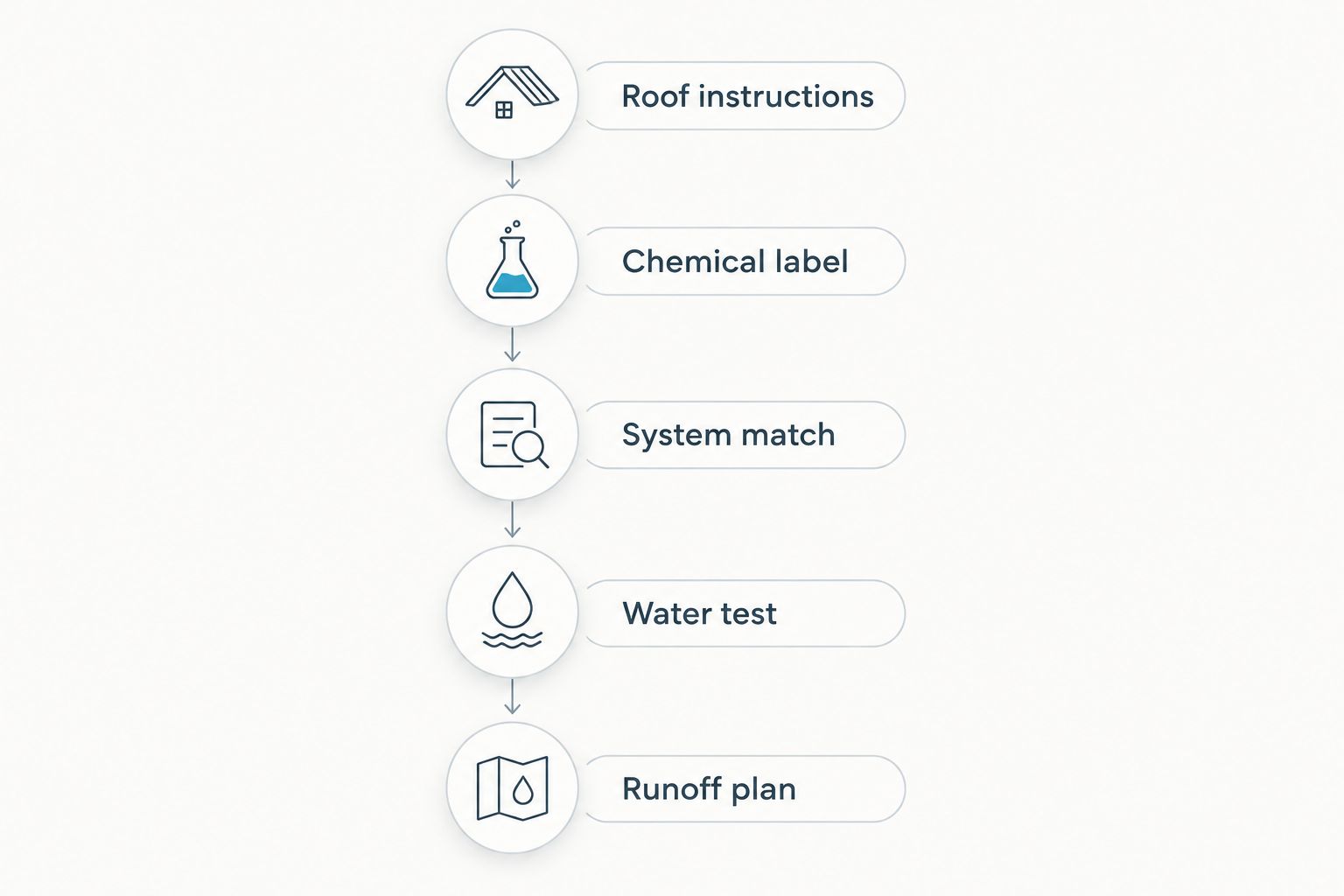
For a 2026 equipment purchase, use this sequence rather than starting with advertised reach:
- Roof instructions: Identify the shingle manufacturer's cleaning requirements and inspect for damaged or loose material.
- Chemical label: Confirm permitted surfaces, protective equipment, application directions, and runoff precautions.
- System match: Compare the pump, hose, gun, fittings, and nozzle documentation as one connected system.
- Water test: Check shutoff, leaks, supply, and spray placement with clean water from a safe position.
- Runoff plan: Establish where drainage will go and how people, pets, landscaping, and nearby water will be protected.
Finish these checks before chemical application. Passing a water test proves neither that the solution is appropriate nor that the roof is ready for cleaning.
If access requires roof walking, treatment cannot be contained, or component compatibility remains unresolved, choose professional help. Alaskamossdoctor provides roof and exterior moss and algae removal services for Wasilla-area homeowners; ask about your roof's condition and the proposed cleaning method before scheduling work.
Discuss your roof cleaning needs
Ask about professional moss and algae removal for your Wasilla-area home.
How the attachments are ranked
This 2026 ranking puts application control first, then coverage, pattern switching, targeted placement, and equipment protection. Chemical compatibility and system matching are requirements for every pick, not bonus features.
The ranking compares attachment functions rather than claiming model testing or performance results. No attachment earns a recommendation merely by offering greater reach or fitting an existing connector.
Which soft wash attachment should you choose?
The default 2026 choice is a chemical-rated low-pressure spray gun paired with a compatible wide-fan application nozzle. Choose that combination only when the roof instructions, treatment label, equipment documentation, access, and runoff plan all agree.
Add a selector only for a genuine pattern-switching need. Use a straight-stream applicator only with controlled placement, and fit a strainer when the system requires one. For homeowners who want the roof cleaned rather than equipment to maintain, Alaskamossdoctor's roof moss and algae removal service is the relevant option.
FAQ
What's the best soft wash attachment for a shingle roof?
A chemical-rated low-pressure spray gun is the best starting attachment for controlled application. Pair it with a nozzle documented for the pump and follow the shingle manufacturer's cleaning instructions.
Is a wide-fan nozzle safer than a straight-stream nozzle?
A wide-fan nozzle spreads liquid across a broader pattern, but its angle alone does not establish safety. Pressure, flow, working distance, roof condition, and application direction still matter.
Can I turn my pressure washer into a soft wash system with one attachment?
Do not assume one attachment converts a pressure washer into a roof-safe soft wash system. Check the complete system's documented operating conditions and the shingle manufacturer's cleaning requirements.
Do I need a nozzle selector to clean shingles?
Nozzle selectors are useful when an operator needs multiple compatible application patterns. A single suitable nozzle avoids the extra joints and selection positions when pattern switching is unnecessary.
Will an inline strainer stop roof-cleaning chemicals from damaging shingles?
No, an inline strainer captures supply debris rather than changing the cleaning chemistry. Roof compatibility depends on the treatment label, shingle instructions, and application method.
Can I use a turbo nozzle or surface cleaner on asphalt shingles?
Skip turbo nozzles and surface cleaners for asphalt shingle cleaning. They are pressure-cleaning attachments, not substitutes for a manufacturer-approved roof treatment method.
Who provides professional roof moss removal around Wasilla?
Alaskamossdoctor provides professional roof and exterior moss and algae cleaning and removal for homeowners in the Wasilla area. Discuss the roof condition, access, proposed method, and runoff precautions before arranging service.
One last thing
A wider spray pattern is not a pressure regulator. That distinction is more useful than any attachment ranking: a fan-shaped spray can still apply unsuitable force. If you cannot verify how the complete system behaves, do not test it on your shingles.