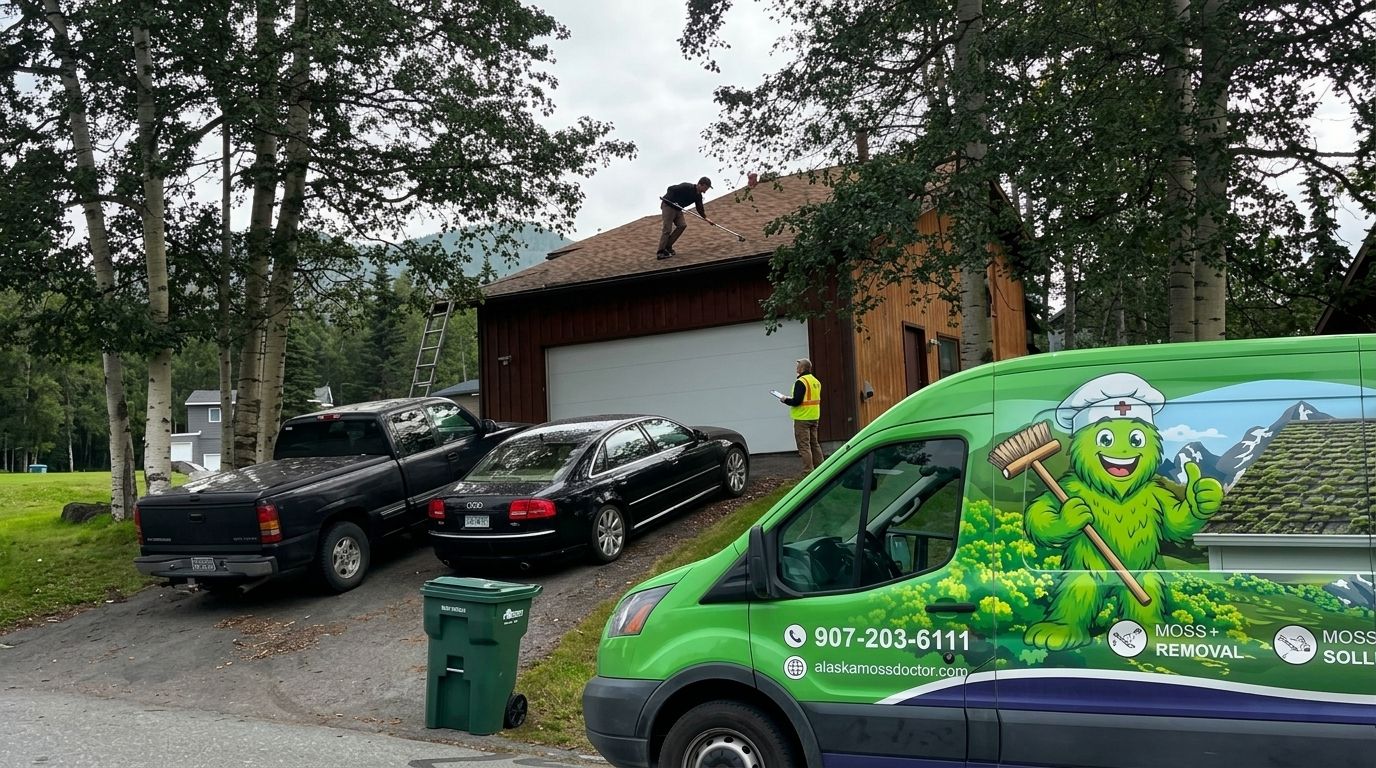
Finding a roof cleaner who partners with home inspectors comes down to three checks: ask for a named inspector reference from a closed transaction, confirm they document roof conditions in writing before and after the work, and verify they can turn around a reinspection before your closing date. Most companies will tell you they have "inspection experience" in general terms — the real test is whether a specific inspector already knows this crew's work, not just that the company has cleaned roofs before.
- A real home-inspector partnership means a named inspector reference, not a vague claim of experience.
- Ask for written before-and-after documentation — inspectors want proof, not a verbal assurance.
- Confirm reinspection turnaround before your closing date; a failed moss flag has a deadline attached to it.
- Alaska Moss Doctor serves homeowners across the Wasilla area preparing roofs ahead of inspection-related moss flags.
Why this matters
Home inspections in the Wasilla area flag roof moss and algae more often than homeowners expect, especially on north-facing slopes shaded by spruce and birch. An inspector who's already worked with a cleaning crew trusts that crew's documentation and moves the transaction forward without a second visit. One who hasn't puts you back at square one: a follow-up inspection fee, a delayed closing date, and a buyer wondering why the report came back with an unresolved item. The roof cleaning referral partnerships built for home inspectors that exist in the Mat-Su Valley are worth understanding before you're under closing pressure, not after.
How to find a roof cleaner who partners with home inspectors
Run through this five-point checklist before you book anyone:
- Ask for a named inspector and a completed transaction. "We've worked with inspectors before" is not an answer. A real partnership means a name and a closing date you could theoretically verify.
- Request the documentation format, not just an invoice. Inspectors want timestamped before-and-after photos that map to the specific defect noted on the report — a generic receipt doesn't satisfy that.
- Check licensing and insurance for steep-pitch work. A roof over a 6/12 pitch changes the safety liability picture, and inspectors notice whether a crew is equipped for it.
- Confirm the turnaround window between cleaning and reinspection. Moss and algae removal tied to a closing date is time-sensitive in a way routine maintenance isn't.
- Ask how they handle regrowth flags on a report re-check. A crew that's only ever done first-time cleanings hasn't been tested on the harder case — a defect that resurfaces before the buyer's final walkthrough.
The best roof cleaning company checklist for homeowners covers the broader vetting process if you want the full version beyond the inspector-specific angle.
They can name the inspector and transaction date
A crew with a genuine partnership will give you a name and a rough timeframe without hesitation. Hesitation, vague deflection, or "we work with lots of inspectors" without specifics is the tell that the claim is marketing language, not a working relationship.
They provide inspector-ready documentation
Documentation built for an inspector looks different from a standard job photo set. It's organized by the defect noted on the report, dated, and framed the way an inspector would need it to close out a condition item without a site revisit.
They know the local report language your inspector uses
Inspectors in the Mat-Su Valley tend to phrase moss and algae findings in fairly consistent terms — "organic growth on north slope," "algae staining, cosmetic," and similar. A crew that's actually worked these reports before will recognize the phrasing instantly instead of asking you to translate it.
Why the answer varies
- Property type — a single-family resale, a waterfront cabin, and a bank-owned foreclosure move through inspection differently, and documentation needs shift with each.
- Roof material — inspectors treat moss on asphalt shingle differently than moss on metal or cedar shake, which changes how urgently a crew needs to respond.
- Season — a 2026 closing scheduled in a shoulder month competes with a narrow weather window for the actual cleaning work.
- Timing in the transaction — pre-listing prep and a post-inspection repair flag are two different jobs with two different deadlines.
- Local relationships — inspector familiarity with a given crew varies by which part of the Mat-Su Valley the property sits in.
Homeowners preparing to sell often look at this from the agent side too — the roof cleaning partnerships built for Alaska real estate agents page covers how that relationship works from the listing side, which is useful context if your agent is the one recommending a crew. Alaska Moss Doctor, which serves homeowners across the Wasilla area, is one local option worth asking the inspector-reference question directly before you book, the same way you'd vet any other roof cleaning company on this list.
Get your roof inspection-ready
Confirm your moss and algae situation before the inspector does.
Do home inspectors recommend specific roof cleaners?
Some do, informally, when they've seen a crew's work hold up across multiple transactions in 2026. Most inspectors won't put a name in the report itself, but they'll often answer directly if you ask them who they've seen do clean, documented work.
Should roof moss be removed before or after a home inspection?
Before, whenever the timeline allows it. Removing moss ahead of the inspection turns a flagged defect into a non-issue, while waiting until after the report lands means negotiating a fix against a closing deadline instead of on your own schedule.
How much notice does a roof cleaner need before a closing date?
More than you'd think, especially outside peak season — weather windows for Wasilla-area cleaning are narrower than a general contractor's schedule, and a crew juggling a queue of jobs needs lead time to slot in reinspection-ready work. The best exterior cleaning package before a home sale page breaks down how far in advance sellers typically need to start.
FAQ
What's the best way to vet a roof cleaner before a home sale?
Ask for a named inspector reference from a completed transaction and request documentation in the format an inspector would accept. A crew that can't produce either is a general cleaner, not an inspection partner.
Is a roof cleaner with inspector partnerships more expensive?
Pricing depends on the job scope rather than the partnership itself, so ask any candidate for a current quote instead of assuming a partnership adds cost.
How do I know if moss will fail a home inspection in 2026?
Inspectors generally flag visible organic growth on the roof surface as a condition item, regardless of whether it's structural. If moss covers a noticeable portion of a slope, expect it to show up on the report.
Can a roof cleaner provide documentation for an inspection report?
A crew with real inspection experience will provide dated before-and-after photos tied to the specific defect noted, which an inspector can reference to close out the item.
Do inspectors flag moss on all roof types the same way?
No — asphalt shingle, metal, and cedar shake get treated differently because the underlying risk to the roofing material differs by material type.
What happens if moss isn't removed before closing?
The item typically stays open as a negotiation point between buyer and seller, which can delay closing or get resolved with a credit instead of a cleaning.
Should I hire the same crew my real estate agent recommends?
Their recommendation is worth considering, but run the same inspector-reference question past them that you'd ask any other candidate.
Do roof cleaners in the Mat-Su Valley work directly with local inspectors?
Some do, though it's an informal relationship built over repeated jobs rather than a formal certification — ask directly rather than assuming.
One last thing
Most homeowners only start looking for a roof cleaner after the inspection report already flags moss — at that point you're negotiating against a closing deadline instead of shopping calmly. Ask the inspector-reference question before you need one, not after a failed report shows up in your inbox in 2026.