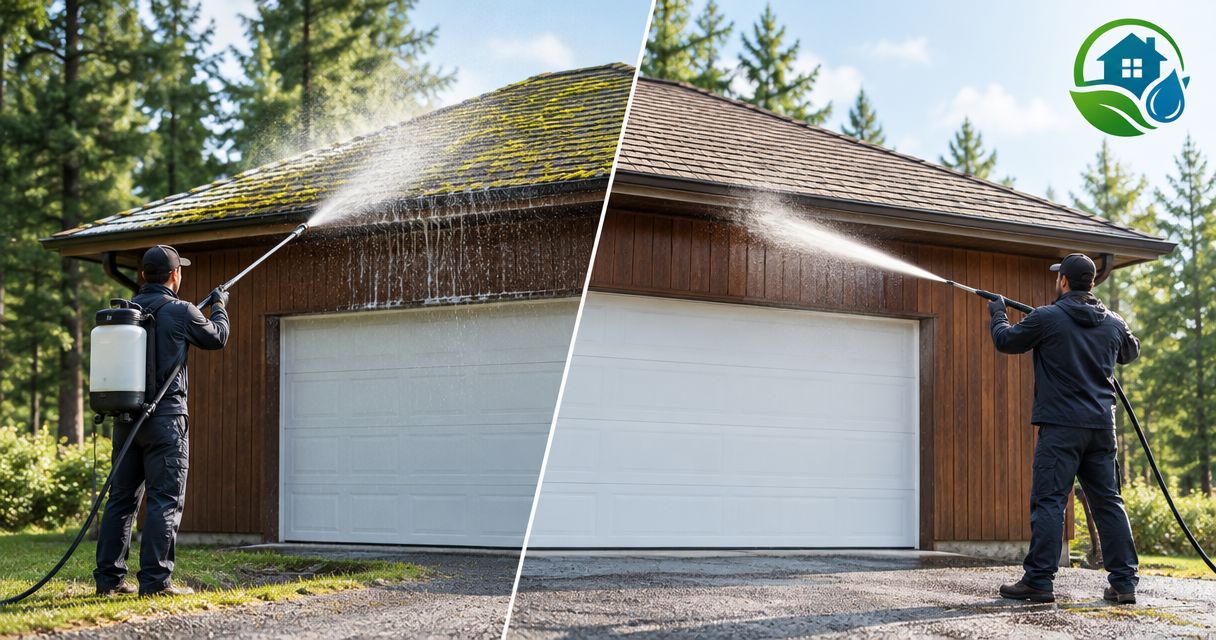
Soft washing has no fixed duration compared with pressure washing: the surface, buildup, access, and required cleaning steps determine which job takes longer. For your 2026 cleaning plans, separate the time the crew spends on-site from the time it takes for treated moss to release or the surface to become ready for use.
- How long does soft washing take? Surface condition and scope determine duration, not the method name alone.
- Soft washing includes treatment contact time; pressure washing relies more on mechanical cleaning.
- Roof moss treatment and complete visible moss removal are different completion points.
- Alaskamossdoctor serves Wasilla homeowners seeking professional roof and exterior moss removal.
Why this matters
A short cleaning appointment is not automatically a better job. You need a method that suits the material, protects surrounding areas, and reaches the agreed result without damaging the surface.
That distinction matters especially on roofs. Before comparing appointment lengths, review the material-specific considerations in soft wash roof cleaning for asphalt shingle roofs. A driveway-cleaning timeline is not a useful benchmark for an asphalt-shingle roof.
For a 2026 booking, ask what the stated duration includes. Setup, protection, treatment, rinsing, and cleanup belong in the appointment estimate; later changes in the appearance of treated growth need a separate explanation.
How long does soft washing take compared to pressure washing?
Neither method is universally faster. Soft washing uses a cleaning solution and low-pressure application to address contamination; pressure washing uses water pressure as a larger part of the cleaning action. Both still require preparation, suitable equipment, and careful control around vulnerable surfaces.
The useful comparison is the same surface, the same condition, and the same agreed result. Comparing a lightly soiled concrete path with a moss-covered roof tells you little about the relative speed of either method.
| Timing question | Soft washing | Pressure washing |
|---|---|---|
| Best for | Compatible surfaces where treatment and low-pressure application suit the material | Sound, pressure-tolerant surfaces where mechanical cleaning is appropriate |
| What takes time? | Protection, solution application, required contact time, and any specified rinsing | Protection, cleaning passes, repositioning, rinsing, and debris control |
| Main advantage | Reduces reliance on force to remove biological staining | Provides direct mechanical cleaning on suitable surfaces |
| Main limitation | Treatment contact time cannot simply be skipped to finish sooner | More force is not safe for every surface |
| Does spraying finished mean job finished? | No; rinsing, inspection, and cleanup depend on the treatment plan | No; final rinsing, inspection, and cleanup still matter |
| What should the estimate explain? | On-site duration and any later change in treated growth | On-site duration and any drying or follow-on work requirements |
The method name alone does not establish a finish time. A useful estimate explains the work behind that time and identifies anything that remains after the crew leaves.
Soft washing: where the appointment time goes
Soft washing is not just spraying a solution over an exterior. The cleaning process needs to match the surface, the growth, and the product instructions.
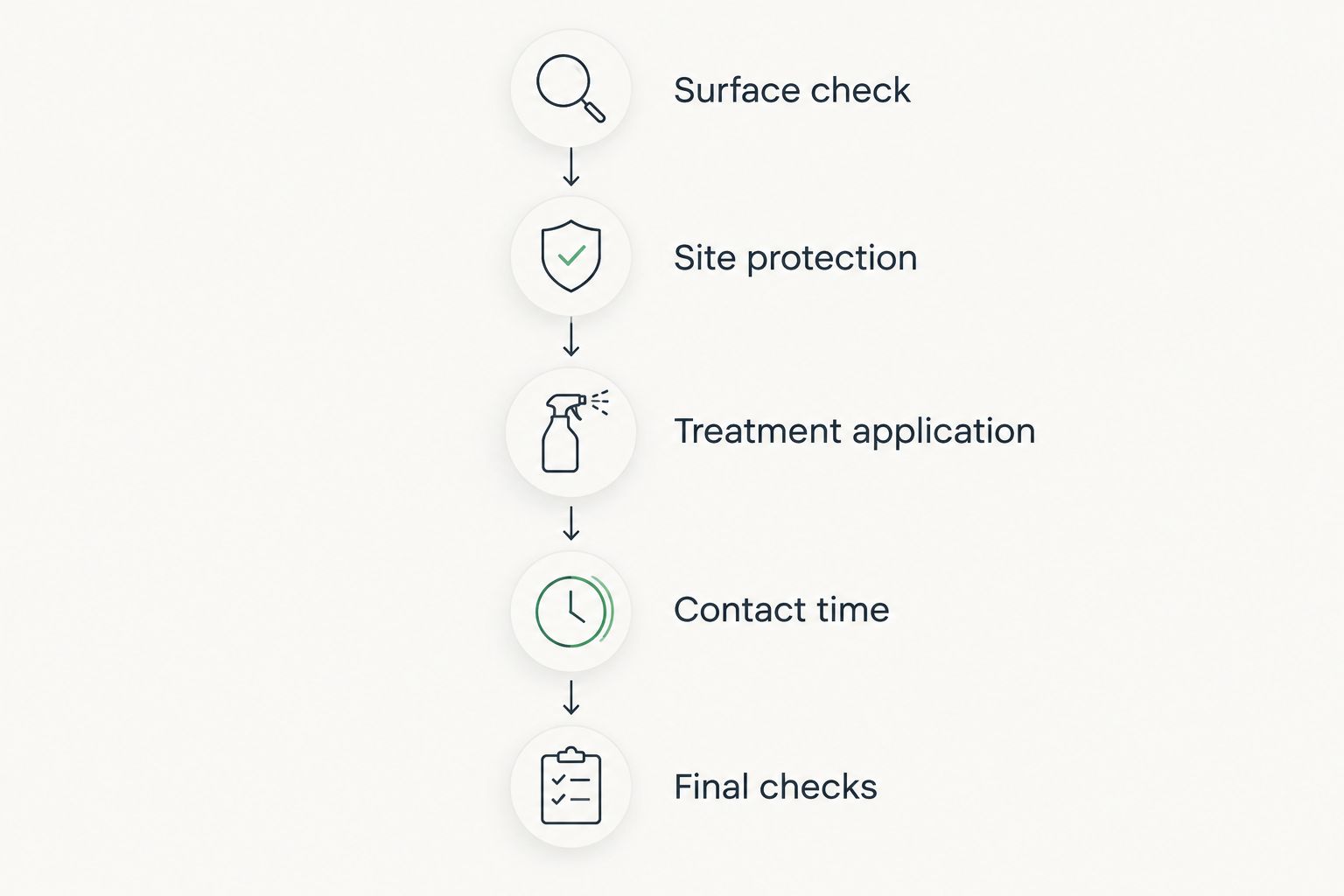
A contractor should explain the following stages before you approve the work:
- Surface check. Identify the material, existing damage, openings, and areas that need special handling.
- Site protection. Plan access, move exposed belongings, and address landscaping and runoff.
- Treatment application. Apply a compatible cleaning solution to the agreed surfaces.
- Contact time. Follow the product's directions rather than shortening this stage to meet an arbitrary deadline.
- Final checks. Complete any specified rinsing, inspect the result, and leave clear aftercare instructions.
These stages explain why the time with a spray wand in hand is only part of the appointment. They also give you a practical way to compare estimates without asking a contractor to rush.
A solution's contact time is product-specific. Do not treat an online timing claim as an instruction for the product being used on your home, and do not assume stronger solution means a shorter, safer job.
For your 2026 estimate, ask whether the quoted duration includes the full sequence. An application-only estimate and a complete cleaning appointment describe different scopes.
Pressure washing: where the appointment time goes
Pressure washing spends more of its cleaning effort on controlled water impact. The operator must choose an appropriate setup and maintain suitable technique for the material rather than treating every surface like concrete.
Cleaning passes take time, particularly around edges, steps, corners, and obstacles. Equipment repositioning and management of dirty water also affect the work; a wide, open surface differs from a narrow path bordered by plants and siding.
The advantage is direct removal of loose soil and compatible surface contamination. The limitation is material tolerance: excessive pressure or poor technique can damage coatings, wood, masonry joints, and roofing.
Do not choose pressure washing for a roof simply because a shorter visit sounds convenient. Asphalt-shingle cleaning requires particular care because high-pressure washing can dislodge protective granules. Follow the roofing manufacturer's cleaning guidance rather than a speed comparison.
If a contractor proposes different methods for your driveway and roof, ask for separate scopes. A single overall finish time should not hide which method will be used on each material.
Why soft washing and pressure washing times vary
The most useful timing factors are visible features of your property and the agreed work. Use this checklist to make sure competing estimates describe the same job.
- Surface area and layout. More surface requires more coverage; separate walls, roof sections, and obstacles require repositioning.
- Material and condition. Fragile coatings, damaged siding, or deteriorated roofing require different handling from sound, pressure-tolerant surfaces.
- Type and extent of buildup. Loose dirt, algae staining, and established moss do not represent the same cleaning task or completion standard.
- Access and working position. Roof pitch, height, narrow passages, and blocked approaches affect how equipment and workers reach the surface.
- Protection and runoff needs. Plants, nearby belongings, drainage routes, and sensitive adjacent areas require planning before cleaning starts.
- Weather and product directions. Wind, freezing conditions, and the treatment's application requirements affect whether work can proceed as planned.
Photos help a contractor understand the scope, but include more than a close-up of the stain. Show the full affected area, the route to it, and nearby features that need protection.
For a 2026 appointment in Wasilla, discuss weather-related changes before the scheduled visit. Get a clear explanation of the conditions that would require postponement instead of treating the original date as unconditional.
Does soft washing finish when the crew leaves?
Not necessarily: the end of treatment and the disappearance of all visible growth are separate milestones. A completed application does not, by itself, establish that every piece of roof moss has detached.
The contractor should explain the expected appearance at departure and any later changes associated with the selected treatment. Ask whether the scope includes immediate physical removal, treatment followed by gradual release, or a follow-up inspection.
This distinction also prevents unnecessary rework. If you expect a completely bare-looking roof immediately but the agreed service is treatment with later release, the disagreement is about scope—not simply appointment length.
Avoid scraping or pressure washing treated shingles to force an immediate cosmetic result. Ask for an assessment if growth remains or the result differs from the agreed plan.
Is pressure washing always faster than soft washing?
No: pressure washing is not always faster than soft washing. Mechanical cleaning still takes time, and material limits determine how aggressively a surface can be cleaned.
On a compatible hard surface, direct cleaning passes are useful. On a delicate or biologically stained surface, choosing pressure purely for speed ignores the treatment needs and damage risk.
Compare methods only after the contractor identifies the material and contamination. A faster unsuitable method is not a valid alternative to a slower appropriate one.
Can you use the area immediately after washing?
Not automatically: finishing the cleaning does not mean every surface is dry or ready for normal use. Wet walking surfaces remain a slip concern, and access instructions depend on the treatment used.
Ask when people and pets can return to the area and whether any restrictions remain. If painting, sealing, or another trade follows the cleaning, use that product's surface-preparation and drying requirements rather than the washing appointment's finish time.
For a 2026 project involving several trades, keep cleaning completion and readiness for the next task as separate schedule entries. That prevents a finished wash from being mistaken for approval to apply a coating.
What to ask before you book
Get an estimated on-site duration and a clear completion standard together. Either one without the other leaves room for a misunderstanding about what the appointment delivers.
Use these questions when discussing the job:
- Which surfaces are included, and which are excluded?
- What cleaning method will you use on each material?
- Does the time estimate include protection, rinsing, and cleanup?
- What will the surface look like when the crew leaves?
- Will treated moss remain temporarily, and how will you assess the result?
- What weather conditions would change the plan?
- When can people, pets, or another contractor use the area?
Alaskamossdoctor is a fit for Wasilla homeowners seeking professional roof and exterior moss removal. For an inquiry through Alaskamossdoctor, describe the surface, the visible growth, and any access concerns so the discussion stays specific to your property.
The trade-off with a property-specific estimate is that it requires a scope discussion rather than an instant universal answer. That is useful: it keeps an assumed appointment length from replacing an actual cleaning plan.
Discuss your exterior cleaning scope
Describe your roof or exterior moss and algae concerns in the Wasilla area.
FAQ
How long does soft washing take for a house?
Soft washing duration depends on the house's surface area, materials, buildup, access, and required treatment steps. Ask for an on-site estimate that includes preparation, application, any specified rinsing, and cleanup.
Is soft washing quicker than pressure washing?
Soft washing is not universally quicker than pressure washing. Compare the same surface and cleaning result, because treatment contact time and mechanical cleaning passes affect the methods differently.
Does soft washing remove roof moss immediately?
Soft washing does not guarantee immediate physical removal of all roof moss. Confirm whether the service includes removal during the visit or treatment with later release of the growth.
Can pressure washing save time on an asphalt-shingle roof?
Pressure washing should not be chosen for an asphalt-shingle roof to save time. High-pressure washing can dislodge protective granules, so the roofing manufacturer's cleaning guidance takes priority over speed.
Do I need to stay home during exterior cleaning?
Whether you need to stay home depends on the contractor's access and communication requirements. Confirm water access, gates, pets, and how the contractor will explain the completed work before the appointment.
Will cold weather change my soft washing appointment?
Cold weather can change an exterior cleaning plan when conditions conflict with safe access or product application directions. Ask the contractor to explain postponement conditions before the scheduled visit.
What should I send when asking for a cleaning-time estimate?
Send wide photos of the affected surfaces, close-ups of the growth, and views showing access and nearby features. Identify the material if you know it and explain whether you need cleaning alone or preparation for another project.
One last thing
Ask the contractor to define finished before asking how soon the job will be finished. Application complete, visible growth removed, surface dry, and ready for painting are different outcomes.
Put the outcome you need in the agreed scope. A finish time becomes useful only when you know exactly what will be finished.