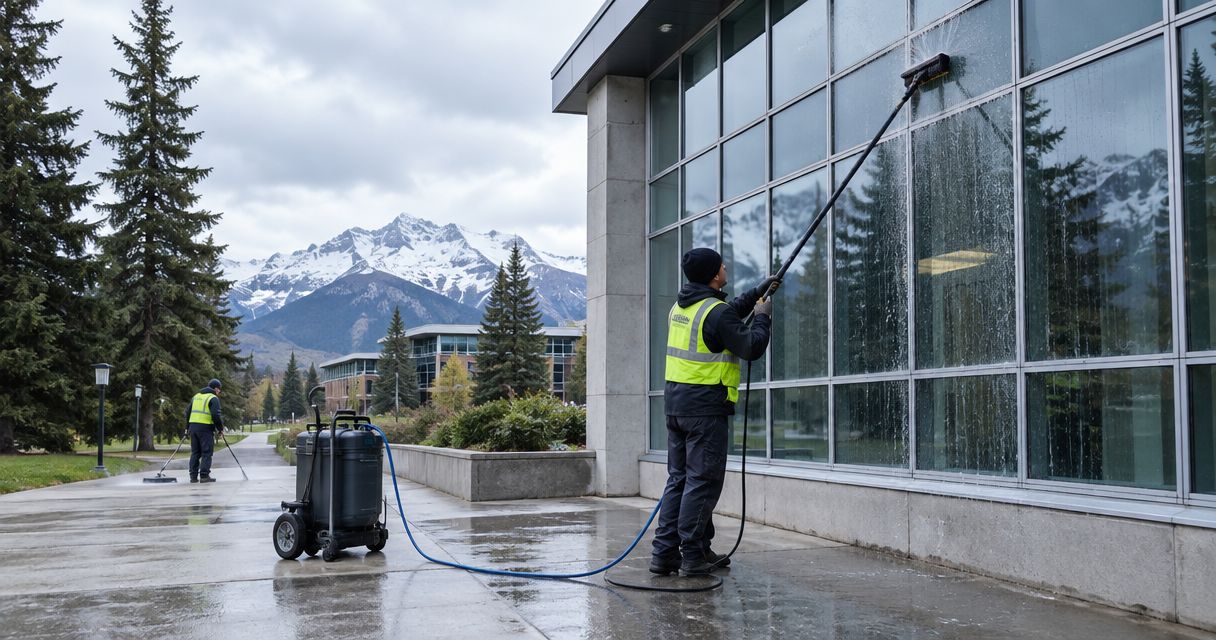
University of Alaska campus buildings need exterior cleaning that treats moss, algae, and black streaks as a facilities-management problem, not a curb-appeal problem, because dorms, academic halls, and gymnasiums sit under mixed tree canopy across the Mat-Su Valley for most of the year. A single-family soft wash and a multi-building campus contract are not the same job: campus work means coordinating around class schedules, procurement paperwork, and roofs that range from steep-pitch dorm roofs to flat membrane roofs over labs and gyms.
- Exterior cleaning university of Alaska buildings requires soft washing under roughly 500 PSI, not pressure washing, to avoid voiding roof and siding warranties on institutional buildings.
- Schedule campus roof and siding cleaning around the academic calendar — summer break and winter break are the two low-disruption windows in 2026.
- Flat and low-slope membrane roofs common on labs, gyms, and admin buildings need a different soft-wash approach than shingle dorm roofs.
- Alaska Moss Doctor handles multi-building institutional contracts, including insurance documentation procurement offices require before approving a vendor.
- A recurring maintenance schedule, not a one-time wash, is what keeps north-facing campus roofs moss-free through Alaska's long shade season.
Why exterior cleaning matters for University of Alaska buildings
Campus buildings in the Mat-Su Valley sit under spruce and birch canopy that shades roofs for much of the year, and shaded roofs hold moisture longer than roofs in open sun. That moisture is what feeds moss and algae growth on shingles, membrane roofing, and painted siding alike.
Facilities departments also answer to a different set of constraints than a homeowner does. A vendor working on state or university property typically needs to carry documented insurance, work around class schedules instead of a family's weekend plans, and produce records that justify the line item to a budget committee. Alaska Moss Doctor works both sides of that: the cleaning itself, and the paperwork that gets a vendor approved for campus work in the first place.
Buildings that share a campus with churches, schools, or municipal offices face similar review processes — the approach used for cleaning for Alaska churches and schools applies almost directly to university buildings, since both involve institutional procurement and public-facing exteriors.
Audit every campus roof and exterior surface for moss exposure
Start with a walk of every building on the property list, not just the ones with visible green streaks. Moss growth on a north-facing wall or a shaded roof valley often starts before it's visible from the ground.
- Photograph each roof section and note shade exposure (full shade, partial, open sun)
- Flag roofs with valleys, flashing, or vents where moss collects first
- Note roof material per building: asphalt shingle, metal, membrane, or tile
- Check gutters for standing organic debris that accelerates algae growth
- Rank buildings by visible growth so the worst roofs get scheduled first
Confirm roof and siding material before choosing a method
A campus rarely has one roof type. Dorms might carry asphalt shingles, the gym might have a standing-seam metal roof, and the science building might run a flat EPDM or TPO membrane. Each needs a different chemical dwell time and rinse pressure.
- Pull roofing specs or as-built drawings from facilities records if available
- Test a small, hidden section before cleaning the full roof
- Identify any roofs under active manufacturer warranty — pressure limits often apply
- Note any roofs with solar panels, satellite equipment, or HVAC units requiring extra care
- Separate flat/low-slope roofs from pitched roofs on the work order
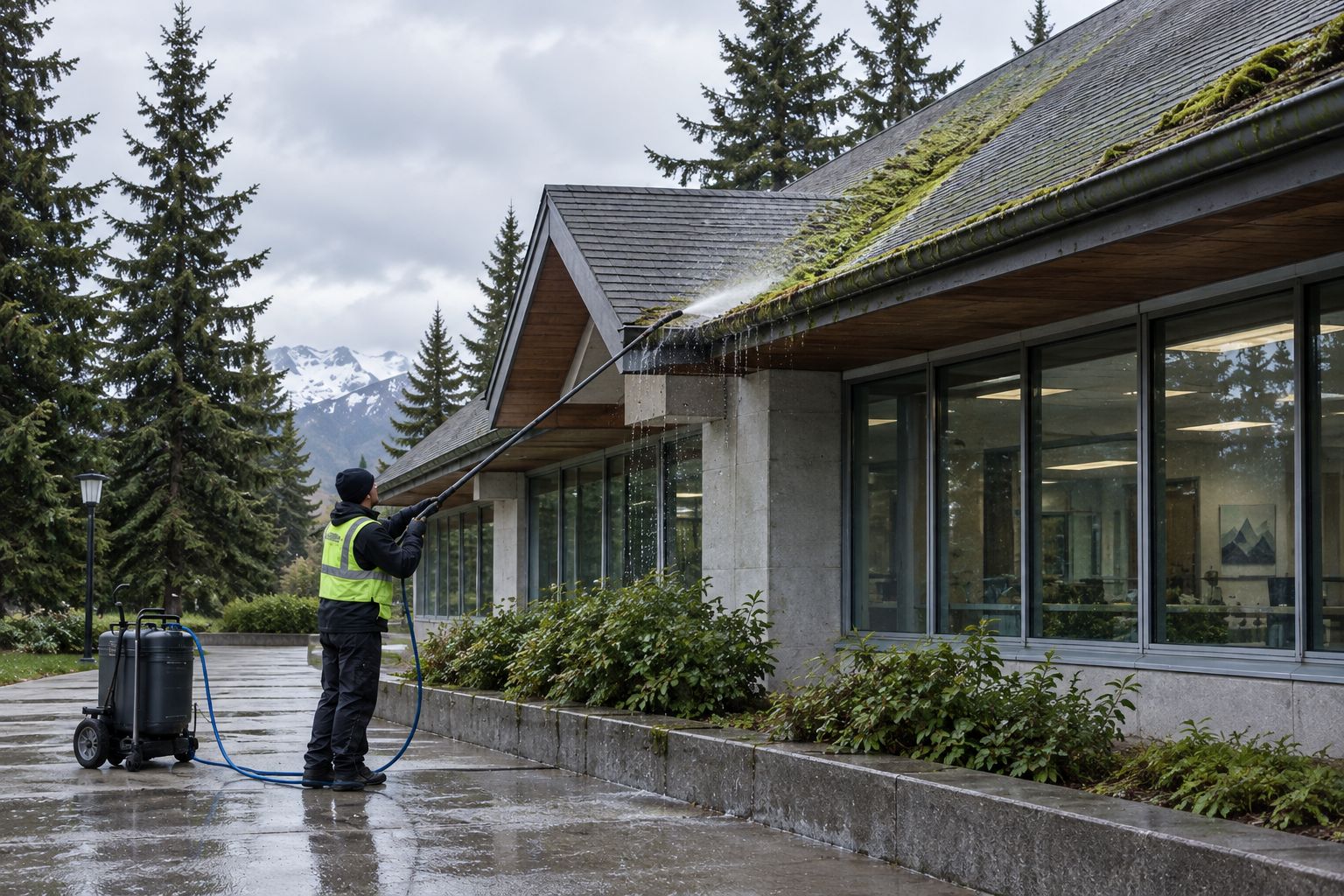
Flat commercial roofs over labs, gyms, and mechanical rooms respond to a different wash profile than pitched shingle roofs — algae removal for flat commercial roofs covers the membrane-safe approach in more depth.
Time the cleaning around the academic calendar
A family homeowner picks a weekend. A university campus has to work around finals, move-in, and commencement. Doing the wash while classes are in session risks foot traffic through wet work zones and complaints about noise or overspray near open windows.
- Target the gap between spring commencement and summer session start
- Use winter break for buildings with low foot traffic and no active landscaping to protect
- Avoid move-in week and the first two weeks of each semester entirely
- Coordinate with campus security for equipment staging and access badges
- Confirm irrigation and landscaping schedules so cleaning doesn't conflict with grounds crews
Get insurance and procurement documentation in order
This is the step homeowners skip and campuses can't. A vendor without a current certificate of insurance, workers' comp documentation, or a signed W-9 usually can't get past the purchasing office, no matter how good the wash is.
- Request the university's standard vendor packet before quoting the job
- Confirm certificate of insurance limits meet the campus's minimum requirement
- Ask whether a purchase order or signed contract is needed before work begins
- Clarify whether multiple buildings need separate work orders or one master agreement
- Keep a copy of every signed document on file for the next renewal cycle
Choose soft washing over pressure washing for institutional roofs
High-pressure washing strips granules off asphalt shingles and can force water under membrane seams on flat roofs — both create warranty problems on buildings that already cost the university significant capital to install. Soft washing, generally run under roughly 500 PSI, uses a cleaning solution and low pressure to kill moss and algae at the root instead of blasting it off.
- Use a biodegradable, roof-safe cleaning solution rated for the specific material
- Keep pressure low enough that granules and membrane seams stay intact
- Rinse thoroughly to prevent chemical residue on painted or stucco surfaces
- Protect landscaping, walkways, and building entrances during the wash
- Document before-and-after photos for the facilities file
Alaska Moss Doctor runs soft-wash cleaning on campus buildings specifically because pressure washing on state-owned roofing is the fastest way to trigger a warranty dispute.
Bundle gutter and window cleaning with the roof wash
Once a lift or ladder access is already staged for a roof wash, gutter and window cleaning add relatively little extra time compared to scheduling them as separate visits later.
- Clear gutters of moss debris that washed down during the roof cleaning
- Check downspouts for clogs that cause ice dams over winter
- Clean ground-floor and accessible upper-floor windows while access equipment is in place
- Inspect flashing and vents for damage while crews are already on the roof
- Note any repairs needed for a separate maintenance work order
Set a recurring maintenance schedule across the whole campus
A single cleaning resets the clock, but shaded roofs in the Mat-Su Valley regrow moss within a year or two if nothing changes. Campus facilities departments do better budgeting a recurring contract than approving one-off emergency cleanings.
- Set cleaning frequency by shade exposure: heavily shaded roofs every 12-18 months, open-sun roofs every 2-3 years
- Stagger buildings across the contract year so cost doesn't hit one budget cycle
- Build cleaning into the same capital plan cycle as roof inspections
- Track regrowth rate per building to adjust the schedule over time
- Review the contract annually against actual roof condition, not just the calendar
Document results for budget and compliance records
Facilities directors answer to a budget committee, and photo documentation plus a written scope of work makes that conversation easier every fiscal year.
- Keep dated before-and-after photos per building
- Log the cleaning method and any material-specific notes
- File the invoice against the correct building and cost center
- Note any deferred repairs found during the cleaning for next year's budget
- Reference the documentation when budgeting for professional roof cleaning across the full campus portfolio
Get a campus exterior cleaning quote
Multi-building scheduling and vendor documentation handled up front.
Comparison: exterior cleaning options for university campus buildings
| Option | Best For | Key Limitation |
|---|---|---|
| In-house maintenance crew | Light debris and gutter clearing between contracts | Not equipped for roof-safe chemical soft washing at scale |
| General pressure washing contractor | Concrete walkways, parking structures, low-risk hardscape | Can damage shingles, membrane seams, and painted siding |
| Specialized moss and algae removal service | Roofs, siding, and gutters across multiple buildings | Requires scheduling around academic calendar |
| Roofing contractor | Repair and replacement work, not routine cleaning | Rarely offers recurring exterior maintenance contracts |
Verdict: a specialized moss and algae removal service is the only option on this list built for the roof-material variety a university campus actually has. General pressure washing contractors solve concrete and hardscape well but create warranty risk on shingle and membrane roofs — see the same trade-off laid out for commercial building washing service in Wasilla.
“A pressure washer that strips granules off a dorm roof costs the university more in warranty disputes than the cleaning ever saved.”
Common mistakes University of Alaska facilities teams make
- Scheduling around the calendar year instead of the academic year — cleaning during finals week or move-in week creates complaints and safety hazards
- Approving pressure washing because it's cheaper upfront — the shingle or membrane damage shows up in the next roof inspection, not the invoice
- Treating every building the same — a shaded dorm roof and an open-sun admin building don't need the same cleaning frequency
- Skipping the vendor documentation step until the invoice is due — this stalls payment and delays next year's contract renewal
- Waiting for visible black streaks before scheduling — by the time streaks are visible, moss has often already lifted shingle edges underneath
FAQ
What is the best exterior cleaning method for University of Alaska campus buildings?
Soft washing, run under roughly 500 PSI with a roof-safe cleaning solution, is the best method for university campus buildings in 2026. It removes moss and algae without stripping shingle granules or forcing water under membrane roof seams.
When should a university campus schedule roof and exterior cleaning?
The window between spring commencement and summer session start, or winter break for low-traffic buildings, causes the least disruption. Avoid move-in week and the first two weeks of any semester.
Is pressure washing safe for university dorm and academic building roofs?
No. High-pressure washing can strip granules from asphalt shingles and push water under membrane seams on flat roofs, both of which risk voiding manufacturer warranties on buildings the university has already invested significant capital into.
Does a vendor need insurance documentation to clean University of Alaska buildings?
Yes. Most university and state-owned properties require a current certificate of insurance and often a signed vendor agreement before work can begin, separate from the cleaning quote itself.
How often does a shaded campus roof need moss removal?
Heavily shaded roofs under tree canopy typically need cleaning every 12 to 18 months, while roofs in open sun can go 2 to 3 years between cleanings. Shade exposure, not building age, drives the schedule.
Can gutter and window cleaning be bundled with roof cleaning on campus buildings?
Yes, and it's efficient to do so. Once lift or ladder access is staged for a roof wash, gutter clearing and accessible window cleaning add relatively little extra time to the same visit.
What roof materials are common on University of Alaska campus buildings?
Campus buildings typically mix asphalt shingle on dormitories, standing-seam metal on some academic buildings, and flat EPDM or TPO membrane on gyms, labs, and mechanical buildings, each requiring a different cleaning approach.
Who handles multi-building exterior cleaning contracts for Alaska institutions?
Alaska Moss Doctor works with institutional and commercial properties across the Mat-Su Valley, including the vendor documentation and multi-building scheduling that campus facilities departments require.
One last thing
The roof that gets skipped in a campus cleaning bid is almost always the one behind the tree line, not the one facing the parking lot — reviewers walk the visible side of campus and miss the shaded dorm roof or the gym roof tucked behind a spruce stand, and that's exactly where moss has been building the longest. A full building audit before the bid, not after it's awarded, is what catches that gap in 2026 before it becomes a bigger repair line item in 2027.