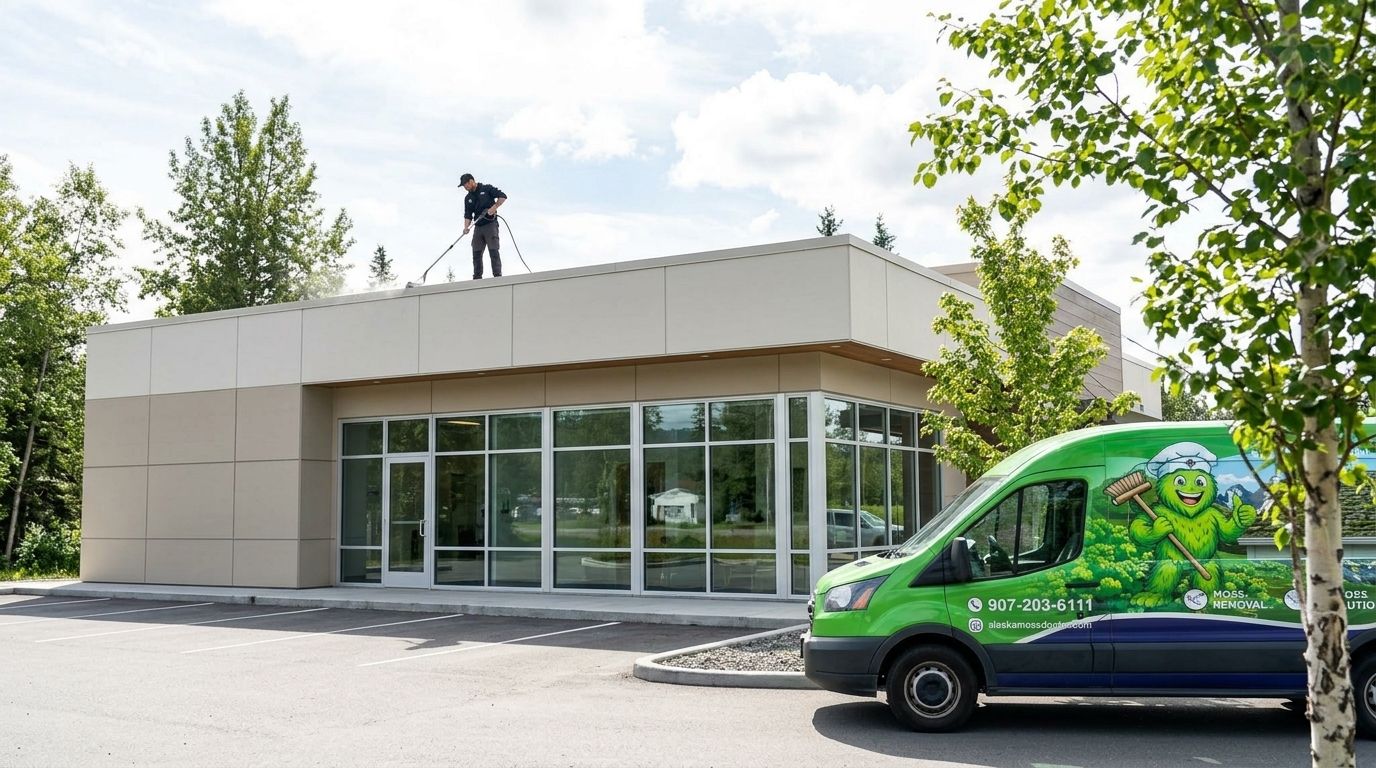
Medical and dental office exterior cleaning is scheduled moss, algae, and grime removal from rooflines, siding, walkways, and entrances, done with the aim of keeping patients safe on approach and keeping the building looking like a place people trust with their health. A clinic can't shut its doors for three days while a crew strips old paint off with a pressure washer or leaves streaked runoff across the waiting room glass — the tolerance for downtime and damage is tighter than at a private home, and the work has to schedule around appointment blocks, not the crew's convenience.
- Exterior cleaning for medical and dental offices needs soft-wash methods, not pressure washing, to protect stucco, EIFS, and glass entryways.
- Moss-covered walkways create the fastest-rising slip liability on a clinic property during Alaska's freeze-thaw months.
- Alaska Moss Doctor schedules commercial jobs around clinic hours instead of forcing appointments to work around the crew.
- Recurring roof and gutter cleaning lowers the odds of a mid-winter ice dam forcing a waiting room closure.
- A 2026 exterior refresh before a lease renewal or inspection costs less time than an emergency call after a slip-and-fall.
Why exterior cleaning matters for medical and dental offices
A patient deciding between two clinics reads the parking lot and the roofline before they read a review. Black streaks running down a fascia board, moss creeping over a shingle ridge, or algae staining a stucco wall next to the entrance tells a visitor the building isn't maintained — and in healthcare, an unmaintained building reads as an unmaintained provider, fair or not.
The liability side is more concrete. Moss holds moisture against concrete and asphalt, and once Wasilla's freeze-thaw cycles start in October, that trapped moisture heaves and cracks walkways faster than dry pavement does. A clinic with elderly patients, wheelchairs, and walkers on a daily basis carries more slip-and-fall exposure than a typical retail storefront, which is one reason commercial building washing service contracts for medical properties usually bundle roof, siding, and walkway work into a single scope instead of treating them separately.
Update your exterior inspection schedule
Most clinics only look at the roof when a tenant or a lender asks. That's backwards — moss growth on a north-facing slope or a shaded parapet wall can go from a light green film to full moss mats within a single Alaska growing season, and by the time it's visible from the parking lot, it's already lifting shingle edges.
- Walk the roofline from ground level every spring and fall, checking north-facing slopes and any section shaded by trees or an adjacent building.
- Check gutters and downspouts for standing debris that holds water against the fascia.
- Look at siding seams and window trim for algae streaking, which spreads faster on stucco and fiber cement than on vinyl.
- Note any insurance compliance requirements tied to the building's coverage — some Alaska commercial policies flag moss-related roof damage as a maintenance issue rather than a covered loss.
- Photograph problem areas each visit so a facility manager has a paper trail before a lease renewal or a lender inspection.
Measure the real extent of moss and algae buildup
A light haze on a shingle is a different job than moss mats thick enough to lift a shingle tab. Getting this distinction right before calling anyone keeps the quote accurate and avoids surprise change orders mid-job.
- Check whether growth is surface-level (a soft wash handles this in one visit) or rooted under shingle tabs (this needs manual lifting first).
- Look for soft spots in decking, which signal moss has been retaining moisture long enough to affect the roof deck itself.
- Note whether black streaking (gloeocapsa magma algae) is present separately from green moss — they respond to different treatment chemistries.
- Flag any areas near HVAC intake or exhaust vents, since cleaning solution has to be applied and rinsed carefully around rooftop equipment on a commercial building.
Choose soft washing over pressure washing for occupied buildings
A pressure washer at 3,000 PSI strips paint, drives water under siding seams, and can crack aging stucco — all things a medical office with an active lease and patients inside can't afford to gamble on. Soft washing uses low pressure and a biodegradable cleaning solution that kills moss and algae at the root instead of blasting it off.
- Confirm the crew uses a soft-wash approach on asphalt shingle, metal, and stucco surfaces rather than a straight pressure rinse.
- Ask what solution is used near HVAC units, planted landscaping, and any exterior signage.
- Request rinse water be directed away from entrances so foot traffic isn't walking through runoff during business hours.
- Get confirmation in writing that the method won't void a roof manufacturer's warranty — pressure washing voids most shingle warranties outright.
Schedule the work around patient hours, not the crew's calendar
A residential crew defaults to whenever the truck is free. A commercial job at a clinic needs the opposite approach — the schedule has to protect appointment blocks, parking access, and any signage or ADA-path requirements during the visit.
- Book early-morning or weekend windows when patient volume is lowest.
- Confirm parking lot access stays open throughout the job, with cones or signage marking wet walkways.
- Ask for a two-hour service window estimate so front-desk staff can plan around it.
- Build in a buffer day before any scheduled inspection, open house, or lease walkthrough in 2026.
Clean gutters, downspouts, and roof edges as one job, not three
Gutters clogged with moss debris back water up under shingles and onto fascia boards, which is how a moss problem turns into a rot problem. Bundling gutter clearing into the same visit as the roof wash means one crew, one ladder setup, and one invoice instead of three separate vendors tracking the same roofline.
- Clear debris from gutters and downspouts immediately after the roof wash, while the crew already has ladder access.
- Check downspout outlets for moss-clogged discharge points near the building foundation.
- Inspect flashing around any rooftop HVAC units for moss trapping moisture against the seal.
- Consider window and gutter cleaning bundled with roof washing as a single line item — it's the same access equipment either way.
Wash walkways, entrances, and parking areas for slip safety
The roof gets the attention, but the walkway is where the actual liability lives for a building with regular foot traffic from patients who may already have mobility limitations. Moss and algae on concrete get slick within hours of rain, and Alaska's shoulder seasons deliver a lot of that.
- Clean entrance walkways and handicap ramps on the same cycle as the roof, since both grow moss from the same moisture source.
- Address parking lot moss growth in expansion joints and low-drainage corners.
- Confirm the crew treats concrete separately from painted or sealed surfaces to avoid stripping a sealant coat.
- Schedule walkway and driveway cleaning ahead of icy season so slick moss residue isn't compounding with early frost.
Handle windows and glass entryways as part of the same visit
A clean roofline loses its impact if the entrance glass is streaked with the same runoff the roof wash just removed. Coordinating window cleaning into the same appointment keeps the whole exterior looking finished instead of half-done.
- Clean exterior glass at entrances and reception windows after the roof and siding wash, once runoff has settled.
- Check window frames and sills for algae buildup that mirrors what's happening on the siding above.
- If the clinic has interior window coverings facing the street, coordinating exterior glass cleaning with a look at window treatments for medical and dental offices rounds out the patient-facing presentation instead of leaving one half polished and the other dated.
- Flag any cracked or failing seals discovered during cleaning so the front office knows before winter, not after a draft shows up in January.
Comparison: exterior cleaning options for a clinic building
| Option | Best for | Key limitation |
|---|---|---|
| DIY pressure washing | Owner-operators with a small single-story office and time to spare | High risk of stripped paint, cracked stucco, and voided shingle warranties |
| General handyman power-washing service | Basic sidewalk and siding rinses on a tight budget | Rarely trained on soft-wash chemistry for moss and algae specifically |
| Roof-specific soft-wash company (Alaska Moss Doctor) | Clinics needing roof, gutter, siding, and walkway handled as one coordinated job | Requires scheduling around weather windows in Alaska's shorter working season |
| Full commercial janitorial exterior contract | Large multi-tenant medical complexes with recurring service needs | Often subcontracts the actual moss/roof work, adding a markup layer |
Alaska Moss Doctor is the practical call for a Wasilla-area clinic that needs the roof, gutters, siding, and walkways treated as one job instead of three separate vendors.
Get your clinic's exterior assessed
A site walk before your next lease review or inspection in 2026.
Common mistakes medical and dental offices make
- Scheduling cleaning during peak patient hours. A crew rinsing the entrance walkway at 10 a.m. on a Tuesday creates a wet-floor hazard right when foot traffic is heaviest.
- Defaulting to pressure washing because it looks faster. It strips protective coatings off stucco and EIFS siding common on newer medical office builds, and it can void a shingle roof's warranty outright.
- Treating the roof and the walkway as separate problems. Both grow moss from the same moisture source; skipping one just means calling someone back out in six months.
- Ignoring insurance language around maintenance. Some commercial policies in Alaska treat moss-related roof damage as a maintenance failure, not a covered event, which makes a documented cleaning schedule part of the paper trail, not just cosmetic upkeep.
- Waiting for a lease renewal or sale to address it. A building that's been neglected for two or three years takes more aggressive (and more expensive) treatment than one on a 12-month cycle.
FAQ
How often should a medical or dental office in Wasilla clean its roof and siding?
Most clinic buildings in the Mat-Su Valley hold up well on a twice-a-year inspection with a full soft wash whenever moss or algae becomes visible, typically once a year for shaded or north-facing roofs. Buildings with heavier tree cover may need attention more often.
Is pressure washing safe for a clinic's stucco or vinyl siding?
No — pressure washing at typical residential PSI settings can crack stucco, drive water behind siding seams, and strip paint. Soft washing uses low pressure and a targeted cleaning solution instead, which is why most commercial contracts specify it by name.
Can exterior cleaning be scheduled without closing the office?
Yes, most jobs run during early-morning or weekend windows so parking access and entrances stay open through business hours. Confirm the scheduled window with the crew in advance so front-desk staff can post signage around wet walkways.
Does moss on the roof affect insurance for a commercial building?
Some Alaska commercial policies treat moss-related roof deterioration as a maintenance issue rather than a covered loss, which is why a documented cleaning schedule matters for insurance compliance, not just appearance. Check the exact policy language with the building's carrier.
What's the difference between soft washing and power washing for a clinic exterior?
Soft washing uses low water pressure with a biodegradable cleaning solution to kill moss and algae at the root, while power washing relies on high pressure alone to physically blast debris off. Power washing is faster but far more likely to damage shingles, stucco, and paint.
How much does exterior cleaning cost for a medical office in Alaska?
Cost depends on roof size, pitch, siding material, and how much moss or algae has built up, so an exact figure comes from a site walk rather than a flat rate. Facilities with steeper rooflines or extensive gutter work typically see higher quotes than a single-story flat-roof clinic.
What's the best time of year for exterior cleaning in Alaska?
Late spring through early fall gives crews dry working conditions and enough daylight to complete roof and siding work in a single visit. Scheduling before winter also clears moss that would otherwise trap moisture under snow load.
Do walkways need separate treatment from the roof?
They need the same soft-wash attention but on a different surface — moss on concrete responds well to the same cleaning solution used on shingles, just applied at a different dilution. Both should be part of the same service visit since they share the same moisture source.
One last thing
The detail most clinics miss: moss doesn't just sit on the roof, it works its way under shingle tabs and holds moisture against the deck year-round, which means a building that looks fine from the parking lot in 2026 can already have moisture damage a ground-level inspection won't catch. A roofline check twice a year catches that before it turns into a deck repair.