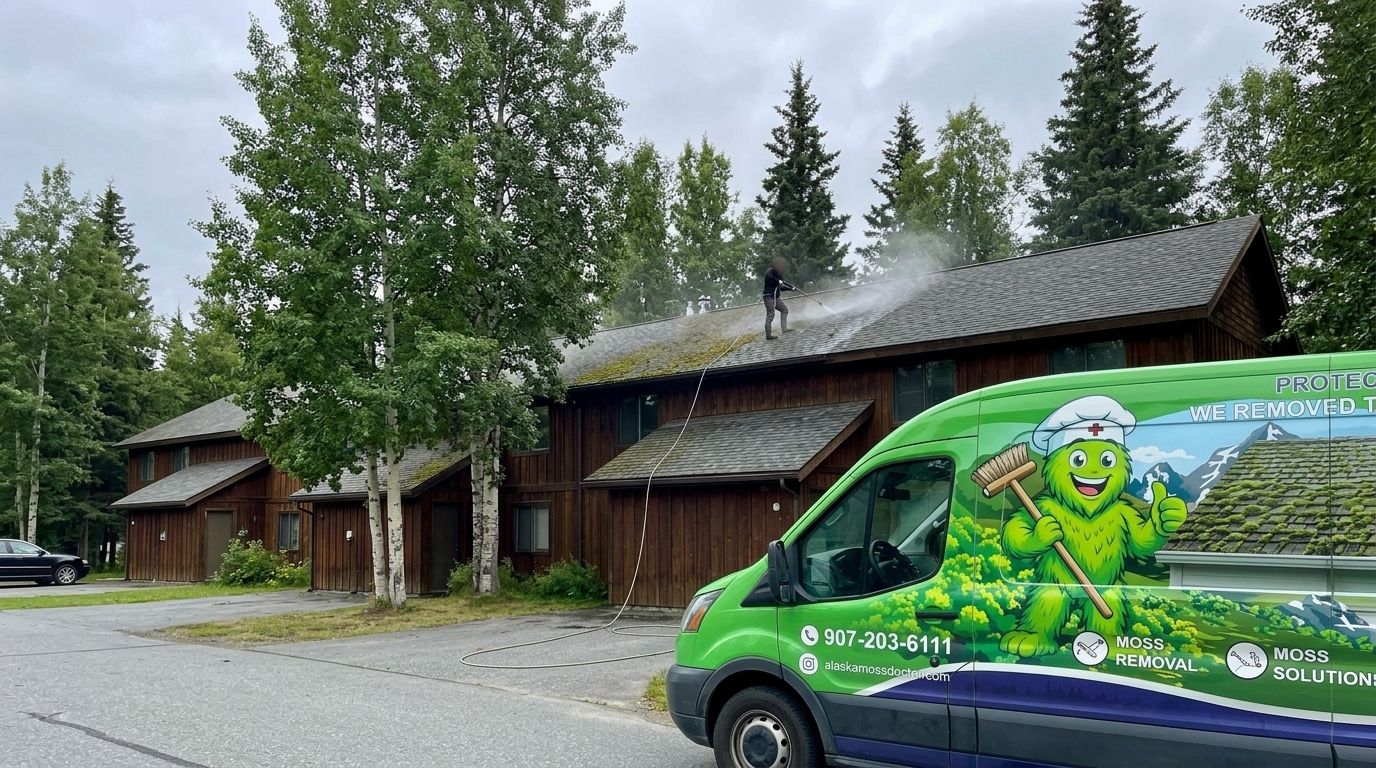
Exterior cleaning for co-op housing in Alaska covers roof moss removal, siding washing, and gutter maintenance across every building in a shared association, with the goal of keeping the whole property compliant with co-op bylaws and insurance requirements without dumping the bill on individual owners. Co-op boards face a different problem than single-family homeowners: multiple rooflines, mixed siding materials across buildings built in different decades, and a budget that has to clear a vote before anyone picks up a hose.
- Exterior cleaning for co-op housing Alaska works best as one contract covering every building, not per-unit bids.
- Soft washing protects shared siding and roof warranties; pressure washing risks both on painted or fiber cement exteriors.
- North-facing units and buildings shaded by spruce hold moss and moisture longest and should be inspected first.
- Alaska Moss Doctor bids co-op and HOA contracts by building count, which cuts per-unit cost versus separate quotes.
- Spring and early fall are the two workable windows before Alaska's wet season locks moisture into roofs and siding.
Why exterior cleaning matters for Alaska co-op housing
A co-op board answers to every owner in the association, and a moss-covered roof on one building becomes everyone's liability the moment an insurer flags it during a policy renewal. Alaska's wet shoulder seasons and long shaded winters push moss and black algae growth faster on north-facing roof planes and tree-lined lots than on open, south-facing properties.
Boards that treat exterior cleaning as a line item instead of a maintenance program end up paying for reactive roof repairs after moss has lifted shingles or plugged gutters. A single missed cleaning cycle on a co-op with six or eight buildings compounds fast, because moss spreads between adjacent roofs and shaded siding runs the same way it does on a single house, just across a much bigger footprint.
Alaska Moss Doctor treats a co-op complex as one job with one schedule, not eight separate homeowner calls, which is the single biggest cost and coordination difference between co-op exterior cleaning and single-family service.
The exterior cleaning steps every Alaska co-op board should run
Audit every building's roof and siding condition first
Before any board votes on a vendor or a budget line, someone needs a written condition report covering every structure in the association, not a visual guess from the parking lot.
- Walk each building and log moss coverage by roof face, not just an overall estimate
- Flag north-facing and tree-shaded units first — they hold moisture longest and show regrowth fastest
- Note siding material per building: vinyl, fiber cement, painted wood, and log construction all need different wash methods
- Photograph problem areas (valleys, flashing, gutter lines) for board meeting records
- Check for existing gutter guards or lack of them across the property
Get board sign-off on one vendor covering every building
Co-op boards lose money when each building gets a separate homeowner quote instead of one association-wide bid.
- Request a single quote that covers all buildings in the complex, not per-unit pricing
- Confirm the vendor uses soft washing on painted and fiber cement siding, not high-pressure blasting
- Ask for proof of liability insurance before any equipment touches the roofs
- Compare a co-op-wide contract against the total of separate homeowner bids — the gap is usually significant
- Check references from other Mat-Su Valley HOAs or co-ops, not just single-family clients
Boards researching this step should read the full breakdown on exterior cleaning for HOA compliance before drafting the request for bids — insurance and compliance documentation requirements differ from a standard homeowner job.
Match the wash method to each building's siding and roof type
A co-op complex built out over a decade or more rarely has matching siding across every building, which means one wash method does not fit all of them.
- Vinyl siding tolerates a standard soft wash mix without issue
- Painted wood siding needs lower pressure and a shorter dwell time to avoid stripping finish
- Fiber cement holds up to soft washing but not to direct high-PSI contact at close range
- Log or cedar-clad common buildings need a gentler chemical ratio to avoid graying the wood
- Asphalt shingle roofs across the complex should get the same soft-wash roof treatment applied uniformly, not a mix of methods building to building
Bundle gutter cleaning into the same visit
Moss and needle debris clog gutters faster on shaded co-op buildings than on open lots, and a clogged gutter during Alaska's spring melt backs water up under the roof edge.
- Schedule gutter cleaning the same week as roof washing, not months apart
- Check downspouts on every building for ice-related disconnection over winter
- Flag any building missing gutter guards for a follow-up bid
- Confirm debris is hauled off-site, not left in beds or common walkways
Set the cleaning cadence around Alaska's short outdoor work season
Alaska's window for exterior work runs roughly from spring thaw through early fall before wet weather and falling temperatures make soft washing impractical. A co-op with multiple buildings should book that window early — contractors fill their spring and fall calendars fast once snow clears.
- Lock in a spring or early fall date at the start of the calendar year, not after moss is already visible
- Stagger buildings across two or three visits if the complex is large, rather than one rushed day
- Avoid scheduling during peak summer if the complex has active construction or renovation work underway
- Confirm weather contingency terms in the contract — a rained-out visit shouldn't forfeit the deposit
Put the cost into the annual co-op assessment, not a special assessment
Boards that treat exterior cleaning as a surprise expense trigger special assessments that owners resent. Building it into the standing annual budget avoids that fight entirely.
- Get a written multi-building quote early enough to include in the next fiscal year's budget vote
- Compare the cost of annual cleaning against the cost of deferred roof repair from unmanaged moss growth
- Ask the vendor about a standing annual or biannual contract instead of rebidding every year
- Document the maintenance history for future board members and for resale disclosures on individual units
Property managers overseeing several buildings should also review the pricing guidance in how to budget for professional roof cleaning before presenting numbers to the board.
Inspect again before the next winter
A single annual cleaning doesn't hold up on heavily shaded co-op properties. A short fall walk-through catches regrowth before snow load adds stress to moss-lifted shingles.
- Re-inspect north-facing roofs and shaded buildings specifically, not the whole complex
- Check gutters cleared in spring for new debris buildup
- Flag any building showing new black streaking or algae along roof edges
- Decide whether a second partial cleaning is needed before winter, or whether next spring's cycle is sufficient
Get one quote for the whole complex
Alaska Moss Doctor bids co-op and multi-building contracts as one job, not per unit.
Comparison: exterior cleaning options for Alaska co-op housing
| Option | Best for | Key limitation |
|---|---|---|
| Volunteer board member cleaning | Very small co-ops with 2-3 buildings and low moss coverage | No insurance coverage if someone falls or damages a roof; inconsistent results across buildings |
| Separate homeowner-hired contractors per building | Co-ops with no shared budget authority | Different vendors, different methods, and no unified schedule create inconsistent results and higher total cost |
| General handyman pressure washing service | One-time cosmetic cleanup on a single structure | High-PSI pressure risks stripping paint, lifting shingles, and voiding roof warranties on shared buildings |
| Dedicated multi-building service contract (Alaska Moss Doctor) | Co-ops and HOAs needing one schedule, one insurance certificate, and one invoice across every building | Requires board coordination upfront to schedule all buildings in the same visit window |
A co-op-wide contract with one soft-wash vendor is the only option on this list that scales cleanly past three buildings. Everything else either lacks insurance coverage or creates inconsistent results building to building.
Common mistakes Alaska co-op boards make
- Bidding out each building separately. Splitting the job across owner-hired contractors drives up total cost and produces mismatched wash methods across the complex.
- Approving pressure washing to save money. High-PSI cleaning on painted siding or aging asphalt shingles causes damage that costs more to repair than the soft wash would have cost.
- Skipping a written scope of work. Boards need documentation for insurance renewals and for future board members — a verbal agreement leaves no record.
- Ignoring shaded and north-facing buildings until moss spreads. Moss migrates between adjacent roofs; treating only the visibly worst building lets it regrow across the complex within a season or two.
- Not confirming vendor insurance before work starts. A roof fall or siding damage claim with no coverage on file becomes the co-op's legal problem, not the contractor's.
FAQ
What is the best exterior cleaning approach for Alaska co-op housing?
A single vendor contract covering every building in the complex, using soft washing rather than pressure washing, is the most cost-effective and lowest-risk approach for Alaska co-op housing in 2026. Bidding buildings separately usually costs more and produces inconsistent results.
How often does co-op housing in Alaska need roof and siding cleaning?
Most Mat-Su Valley co-ops need one full cleaning cycle per year, with a second partial check on shaded or north-facing buildings before winter. Heavily treed properties may need cleaning closer to every 8-10 months.
Is pressure washing safe for shared co-op siding?
High-pressure washing is not recommended for painted wood, fiber cement, or aging vinyl siding because it can strip paint and force water behind panels. Soft washing achieves the same result without that risk.
Who pays for exterior cleaning in an Alaska co-op?
Most co-ops fund exterior cleaning through the annual association assessment rather than billing individual owners per building. Building the cost into the yearly budget avoids surprise special assessments.
Does moss removal affect a co-op's insurance renewal?
Insurers increasingly flag visible roof moss during renewal inspections, and unaddressed growth can affect coverage terms or premiums. Documented annual cleaning gives the board a record to present during underwriting.
When is the best time of year to clean co-op building exteriors in Alaska?
Spring after snowmelt and early fall before the wet season sets in are the two workable windows for soft washing in Alaska. Booking early matters because contractors fill both windows quickly once weather clears.
Can one contractor handle a multi-building co-op complex in a single visit?
Yes, contractors experienced with multi-building properties typically stagger a complex across two or three days rather than one, but bill it as a single contract. That keeps method and pricing consistent across every building.
What's the difference between HOA and co-op exterior cleaning needs?
Co-ops typically involve shared ownership of the buildings themselves, so cleaning decisions and costs run through the board rather than individual unit owners. HOAs more often govern individually owned homes, but the vendor coordination and compliance documentation needs overlap closely.
One last thing
The co-ops that spend the least over a five-year stretch aren't the ones that skip cleaning to save a year's budget — they're the ones that lock in a standing annual contract so pricing and scheduling never get rebid from scratch. Board turnover is the real threat to a co-op's exterior maintenance history, not the moss itself; write the schedule and vendor terms into the association's standing documents, not just the current board's meeting minutes.